In Spain, three women were killed by their partners or former partners over the past week. In addition, another case occurred in Bilbao yesterday, Thursday. This brings the number of women killed by gender-based violence in 2026 to 50 – the highest figure since 2023.
Spain Expat Press Editorial Team
by Marlon Gallego Bosbach
The most recent cases occurred right around November 25 – the International Day for the Elimination of Violence against Women. The victims were from Villarrobledo (in the province of Albacete), Bullas (in Murcia), and Bilbao. Furthermore, a homicide that took place back in October in Chiclana de la Frontera (Cádiz) has now been officially classified as gender-based violence.
Victims were between 32 and 44 years old
In the most recent cases, the age of the victims is particularly striking. Three of the women were only in their early to mid-thirties. Furthermore, two of the women had ended their relationships with the alleged perpetrators only shortly before – a phase that, according to experts, can be associated with an increased level of risk.
On November 19, a 37-year-old woman named Elena was found dead in Villarrobledo under circumstances that initially suggested a natural death. However, an autopsy raised doubts, leading the Guardia Civil to arrest her 47-year-old partner. According to the investigation so far, he is believed to have suffocated her. There were no prior reports of domestic violence against the woman.
On November 25 – a date known as “25-N” – a 32-year-old woman named Verónica was killed in Bullas, in the Region of Murcia. She lived with her two daughters, aged ten and 15. Her 37-year-old former partner allegedly killed her by stabbing her multiple times. According to people close to her, she had ended the relationship only a short time earlier and had reportedly been threatened by her ex-partner.
The suspected perpetrator subsequently fled by train from Murcia to Cantabria. There, he turned himself in to the police and confessed to the crime. According to the authorities, there had been no prior reports of gender-based violence against him. However, Verónica was registered in the Spanish monitoring system, VioGén, in connection with a different man.
Woman in Bilbao killed despite existing protection order
The case in Bilbao is particularly shocking. On Thursday evening, a 34-year-old woman was attacked with a knife in her home by her 47-year-old ex-partner. Her two children, aged four and six, were in the apartment at the time of the attack.
A woman from the victim’s circle alerted the police. Responding officers found the woman severely injured with stab wounds to her chest and arrested the suspected perpetrator at the scene. The 34-year-old was taken to the Hospital de Cruces but succumbed to her injuries during the night into Friday.
According to investigators, the man was already subject to a court-ordered restraining or no-contact order regarding the woman. Furthermore, both individuals had prior records involving incidents of violence. According to the Basque police, the woman had most recently been classified as being at a “basic” level of risk – the lowest of four risk categories.
The case in Bilbao is the first murder of a woman in the Basque Country in 2026 to be classified as gender-based violence. The suspected perpetrator has since been placed in pre-trial detention.
A case from Cádiz was also subsequently confirmed
In addition to the three recent incidents, the Spanish Ministry of Equality confirmed this week that another case, in Chiclana de la Frontera (Cádiz), was a gender-based femicide.
44-year-old Gloria had already been found dead on October 18. Her body, partially covered by sand, was discovered in a dune on the beach at Sancti Petri. Investigators concluded that she had died a violent death. On November 25, her partner was arrested by the Guardia Civil as the suspected perpetrator.
According to the ministry, there had already been prior reports of gender-based violence against the alleged perpetrator in this case. With this official confirmation, the number of such homicides in Andalusia has risen to 13 for the year 2026. This makes Andalusia currently the autonomous region with the highest number of fatal cases of gender-based violence in Spain.
50 deaths since the beginning of the year
With the inclusion of the case from Bilbao, the official statistics from the Ministry for Equality now record 50 women who have been killed by their partner or ex-partner in 2026. Since official record-keeping began in 2003, a total of 1,391 women have fallen victim to lethal gender-based violence.
As recently as yesterday, Thursday – following the confirmation of cases in Murcia and Cádiz – the ministry had reported a death toll of 49. This brought the total number of victims recorded since 2003 to 1,390. The figure of 50 already exceeds the annual total for 2025; that year, 48 women were killed by their partners or former partners. In 2024, there were 49 victims. The last time the figure was higher was in 2023, with 58 cases.
Four children lose their mother
Furthermore, the three most recent incidents in Villarrobledo, Bullas, and Bilbao have left at least four minor children with only one surviving parent. In the case in Murcia, 32-year-old Verónica leaves behind two daughters. In Bilbao, two children – aged four and six – were present during the attack on their mother.
According to official statistics, 40 minors had already been left orphaned in 2026 as a result of gender-based violence, following 49 confirmed cases. Since the collection of these statistics began in 2013, the total number of children affected has reached 550. The case in Bilbao brings the figure for 2026 up accordingly.
Many cases without a prior report
The recent acts once again raise the question of how to identify and prevent gender-based violence. In not all cases had the victims previously reported the alleged perpetrator for violence.
In the case of Murcia, according to the Ministry of Equality, there had been no prior report filed against the alleged perpetrator. In Villarrobledo, too, there were no known previous reports of domestic violence. The situation was different in Cádiz, where a report against the alleged perpetrator had already been filed.
In Bilbao, there was even a court-ordered restraining order in place. The case from Bilbao thus clearly illustrates that even existing protective measures cannot always prevent a lethal attack.
Help for those affected
The Spanish Ministry of Equality reminds those affected – as well as people in their social circle – that support is available 24 hours a day by calling 016. Counseling is also accessible to family members and anyone who witnesses or suspects an instance of violence against a woman. The service offers support in 53 languages.
In urgent, dangerous situations in Spain, you can contact 112, the police at 091, or the Guardia Civil at 062. In an emergency, you can also use the ALERTCOPS app to send a report to the police, including your location information.
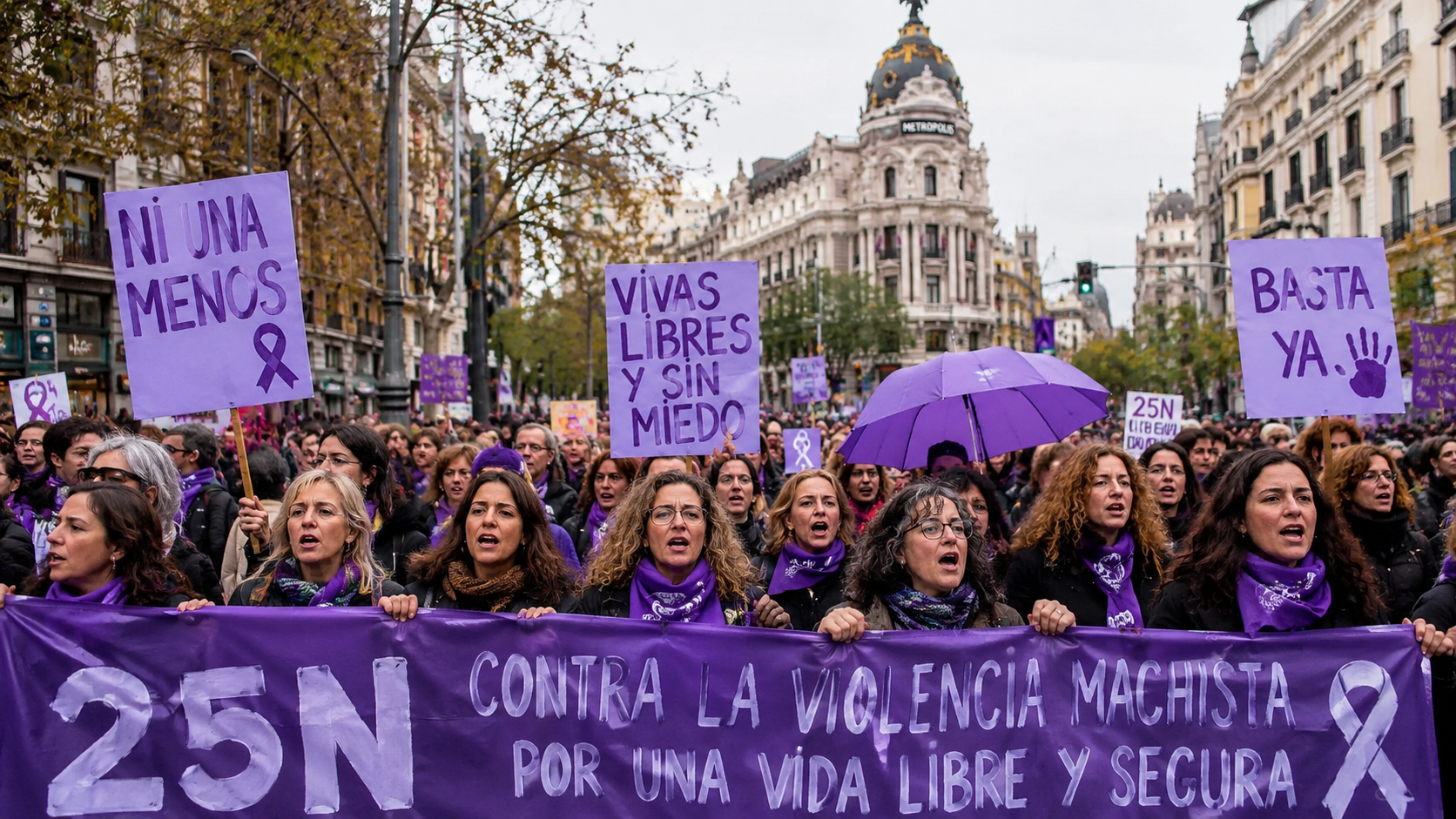
The three new deaths around November 25th lend a particularly somber significance to this year’s International Day for the Elimination of Violence against Women in Spain. Even as demonstrations against violence toward women took place across the country – with participants also honoring the victims – additional women lost their lives at the hands of their partners or former partners within the span of just a few days.