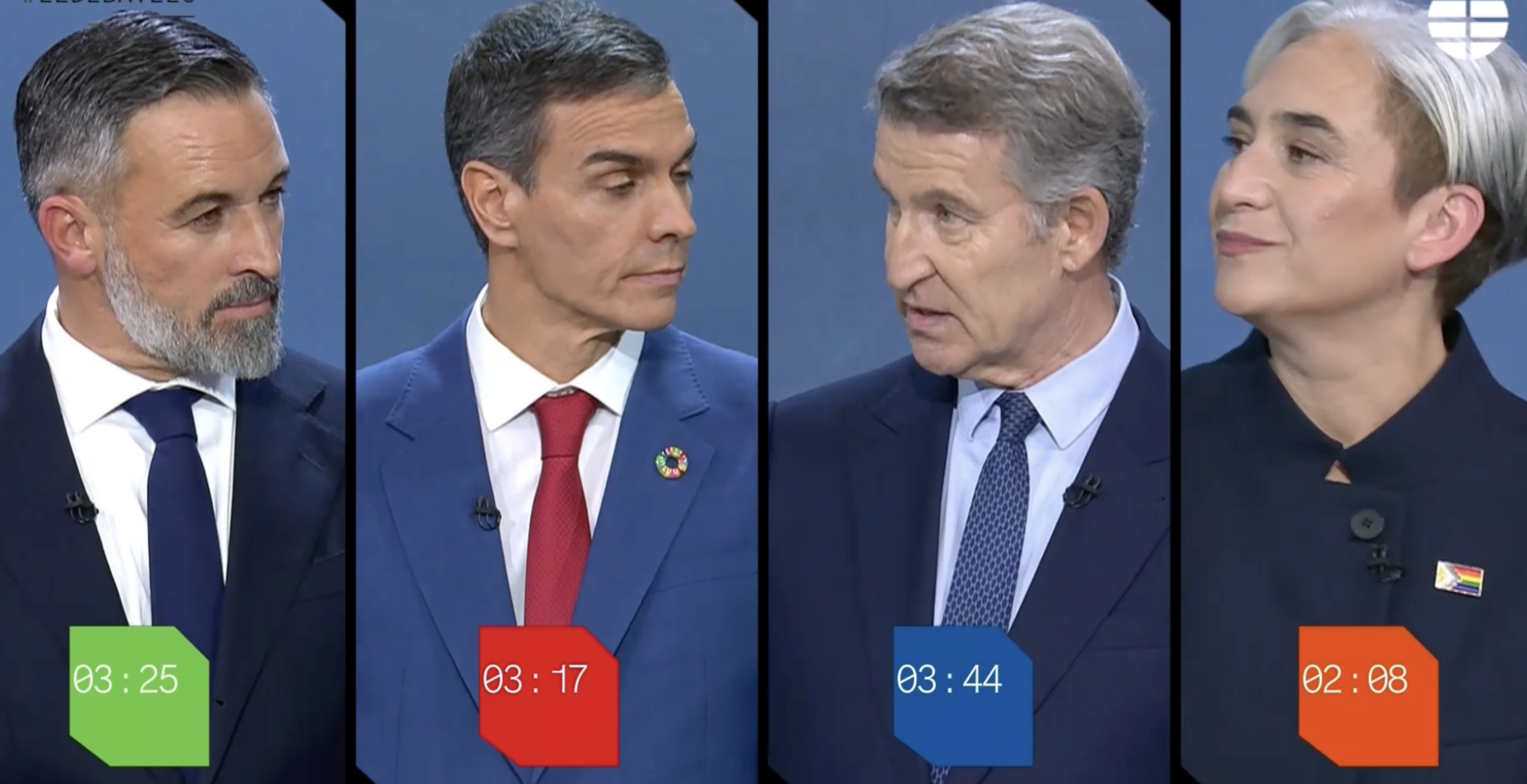
At the last major televised debate before Sunday’s general election, a four-way contest turned into a clash between two blocs. Ada Colau impressed the commentators, Pedro Sánchez was combative again, and the conservative People’s Party and the far-right Vox avoided any direct exchange.
Spain Expat Press Editorial Team
There were four lecterns in the studio, but within minutes it was obvious there were only two teams. The debate between the four main candidates, hosted by Spain’s Television Academy on Thursday night, three days before the general election on 29 November, was not a contest of four programmes. It was a duel between left and right, and each bloc played it in its own way. The evening was moderated by María Casado.
On stage were the Socialist (PSOE) prime minister, Pedro Sánchez; the opposition leader, Alberto Núñez Feijóo, of the conservative People’s Party (PP); Santiago Abascal, of the far-right Vox; and Ada Colau, the former mayor of Barcelona, standing for the left-wing alliance Frente Amplio.
The numbers back this up. The newspaper El Español counted 296 attacks, roughly one every 23 seconds. Of these, 150 went from left to right and 143 from right to left. Only three were aimed at an ally, all of them from Abascal towards the PP. Nearly three hundred blows, then, and almost none landed on a partner.
Colau, the surprise of the night
Colau had the most to lose. She had stepped in at short notice as her alliance’s candidate, and Frente Amplio is polling at little more than 6 per cent on average. Even so, she ended up as the main character of the evening. She opened by condemning violence against women and challenged Feijóo and Abascal to do the same, which set the tone for the whole debate.
The commentators made her the winner. Most of the columnists polled by El País put her ahead, concluding that she had gone from a weak starting position to setting the pace, and had countered the two right-wing parties with figures and concrete proposals. In Público‘s online vote she took 49.4 per cent, ahead of Sánchez on 39.2 per cent. Such reader polls should be treated with caution, however, because each outlet mainly reflects its own audience. In the Sociómetro, for example, Sánchez led with 49 per cent, Feijóo had 36, Abascal 11 and Colau just 4.
Nor did Colau simply play the loyal sidekick. On housing, she urged Sánchez to cut rents and expropriate homes held by investment funds if a progressive government is returned. She did not attack him, but she kept up the pressure. At around 27 and a half minutes, she also had the most speaking time of the four.
Sánchez on the attack again
A week after a head-to-head with Feijóo that left him bruised, Sánchez cut a very different figure. He opened by framing the election as a choice between two opposing models for the country and parried attacks with irony. He defended his government’s record and supplied the night’s headline: “We throw corruption out; the PP buys it.”
At party headquarters on Madrid’s Calle Ferraz, the mood was upbeat. According to the broadcaster COPE, the verdict there was “The dog is back”, a nod to “Perro Sanxe”, a nickname coined by his opponents that Sánchez has long since adopted with a wink. He was the centre of the debate in both directions: he attacked the most and was attacked the most, accounting for nearly four in ten of the night’s attacks.
The coordination between Sánchez and Colau was impossible to miss. They used the informal tú with each other, called each other “Pedro” and “Ada”, and repeatedly insisted that the PP and Vox share the same ideas. It was most striking during the exchange on the deadly floods in Valencia, known in Spain as the DANA. While Feijóo was talking about the floods and about Carlos Mazón, the regional president at the time, he turned to Colau, finger raised: “Usted calladita”, roughly “And you keep quiet.” Sánchez immediately called the remark sexist. Colau milked the moment to the end, reminding viewers in her final contributions that Feijóo “interrupts a lot and tells me to be quiet”.
Feijóo and Abascal: together, but at arm’s length
On the other side, the strategy was the opposite: do each other no harm. Feijóo did not attack Abascal once. In almost two hours the pair did not address each other directly; there was not a single “señor Feijóo” or “señor Abascal”. That was by design. Before the broadcast, there was talk that the PP intended to honour a tacit non-aggression pact with Vox and concentrate its fire on Sánchez.
The calculation is simple. Feijóo knows he will probably need Abascal to govern, so both men aimed at the same target. Abascal took on the role of attack dog and called Sánchez a “vulture”, prompting the reply: “Señor Abascal, save the insults for reality TV.” Feijóo opted instead for cross-examination. He put 17 direct questions to Sánchez, 14 of which went unanswered.
His riskiest moment was a wager. Sánchez asked whether he would accept the election result. Feijóo took up the challenge: if he loses, he said, he will stand down as PP leader and give up his seat in parliament along with his parliamentary immunity. What hurt him most, though, was “calladita”. After the debate he rowed back, saying that if he had offended anyone he withdrew the remark. He said his words had been twisted and that he had only meant to criticise Colau’s camp for failing to hold Sánchez to account after the disaster.
Not every verdict was negative for the right. Some commentators argued that Abascal deftly fended off attacks on himself and even blunted some of the joint assaults by Sánchez and Colau on Feijóo. Others summed up the PP leader’s evening more soberly: Feijóo survived.
What it means
The left put on show an alliance that the right preferred to keep out of sight. Whether that pays off at the ballot box is another matter. The polls still put the conservative bloc ahead. In the average compiled by the website Demócrata on 19 November, the PP stands at 31 per cent, the PSOE at 27.7, Vox at 19 and Frente Amplio at 6.2. Even in the reader poll most favourable to Sánchez, he and Colau together reach only 53 per cent, against 47 for Feijóo and Abascal. That gap is considerably narrower than after earlier debates.
It was a four-way debate with the logic of a run-off. On Sunday, Spain will find out whether the left managed to mobilise its voters, or whether the right’s non-aggression pact let it escape unscathed.