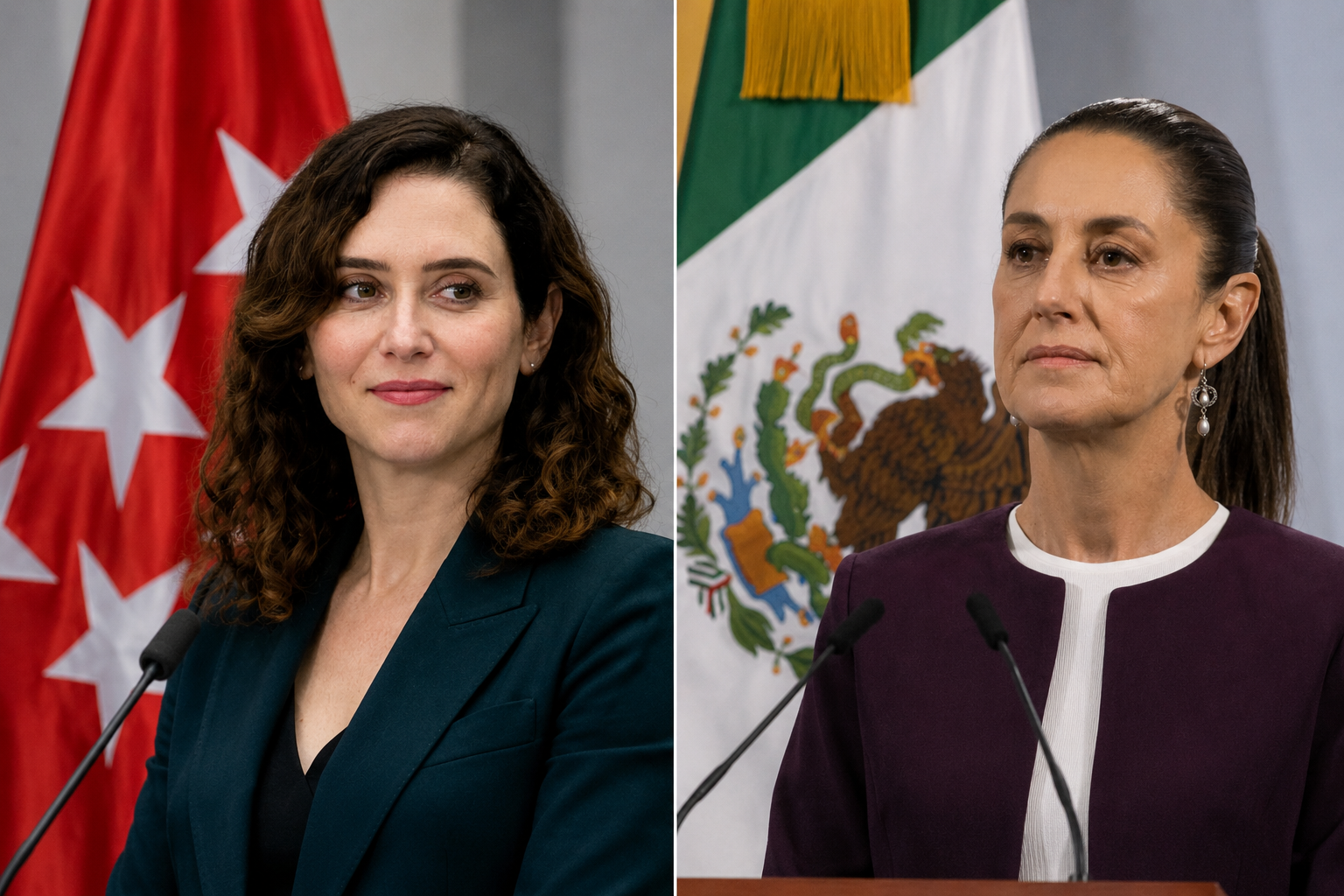
Relations between Spain and Mexico are once again experiencing a period of significant political tension following the public confrontation between Mexican President Claudia Sheinbaum and the President of the Community of Madrid Isabel Díaz Ayuso.
What initially began as an institutional visit by Ayuso to Mexico rapidly evolved into a highly emotional and ideological debate surrounding the Spanish conquest of the Americas, Spain’s role in Latin America and Mexico’s historical identity.
Spain Press Editorial Team
Ayuso cuts short her trip to Mexico
The controversy intensified further after Isabel Díaz Ayuso decided to interrupt her visit and return to Spain earlier than planned.
According to people close to Ayuso, the Madrid leader increasingly felt under political pressure during her stay in Mexico. She publicly spoke of constant attacks coming from Claudia Sheinbaum and her political environment.
There were also growing concerns regarding possible repercussions for the businesspeople and entrepreneurs accompanying Ayuso during the trip. According to Ayuso’s team, fears emerged that political or institutional pressure could be exerted against members of the delegation.
The Mexican government has denied such accusations. Nevertheless, Ayuso’s early departure has significantly increased diplomatic tensions between both sides.
Sheinbaum continues demanding apologies from Spain
The dispute comes within a wider context that has existed for years in Mexico, where certain political sectors continue demanding an official apology from Spain over the conquest of the Americas. Former President Andrés Manuel López Obrador strongly promoted this position internationally, and Claudia Sheinbaum now appears to be maintaining that political narrative.
For many critics, however, the current discourse resembles an attempt to continuously reopen historical wounds dating back more than 500 years.
Mexico itself remains deeply divided over the issue. Some sectors argue that modern Mexican identity is inseparable from Spanish influence, the Spanish language, Christianity, institutions and the process of mestizaje — the blending of Spanish and indigenous cultures. Others reject Spain’s historical legacy entirely and view the conquest solely through the lens of oppression and violence.
A far more complex history than often presented
Historians frequently point out that the real historical context is considerably more complicated than modern political narratives often suggest.
Although Hernán Cortés led the conquest of the Aztec Empire, the Spanish forces did not act alone. Thousands of indigenous groups allied themselves with Cortés, particularly peoples who were dominated by the Aztecs and exhausted by systems of tribute, warfare and human sacrifice imposed by the Mexica Empire.
Many historians believe that without these massive indigenous alliances, the conquest would have been virtually impossible for the relatively small number of Spaniards who initially arrived.
At the same time, historians also recognise that severe violence and atrocities occurred during the conquest, as happened in many imperial expansions throughout that era.
Viceroyalties rather than classic colonies
Another argument frequently raised in the debate is that the American territories under Spanish rule were not officially considered “colonies” within the legal structure of the Spanish Crown, but rather viceroyalties integrated into the Spanish Empire itself.
Historians also note that Spain developed legal frameworks relatively early that — at least formally — attempted to grant certain protections and rights to indigenous populations. The so-called Laws of the Indies and debates led by figures such as Bartolomé de las Casas remain central to this historical discussion today.
Mestizaje — and an uncomfortable reality for many
Many historians further argue that the Spanish Empire encouraged extensive mixing between Europeans and indigenous peoples from the very beginning. This process of mestizaje clearly differentiated the Spanish model from later colonial systems developed by several northern European powers.
For this reason, some observers believe it is contradictory when modern political discourse attempts to completely separate indigenous and Spanish identities, since modern Mexican identity itself emerged largely from the blending of both worlds.
Claudia Sheinbaum herself is frequently associated with a strongly indigenist political narrative. At the same time, she comes from a family of European Jewish immigrants who arrived in Mexico during the 20th century.
Critics of the apology demands also point to another uncomfortable reality: modern Mexicans descend not only from indigenous peoples, but also from the very Spaniards who emigrated to the Americas centuries ago. In other words, the ancestors of many Mexicans were not “the Spaniards who remained in Spain”, but those who travelled to the New World, settled there and formed families.
For that reason, many historians and commentators argue that presenting “Spaniards” and “Mexicans” as entirely separate historical groups ignores the deep intertwining of both identities over centuries..
Far more than a dispute between two politicians
The confrontation between Ayuso and Sheinbaum has now evolved far beyond a personal political clash.
It demonstrates how the history of the conquest continues to be used today as a powerful political tool both in Spain and Mexico, particularly at a time of growing ideological polarisation in both countries.
While Ayuso openly defends Spain’s Hispanic legacy and the concept of mestizaje, Sheinbaum focuses more heavily on historical reparation and indigenous identity politics.
More than five centuries after the arrival of the Spaniards in the Americas, the debate remains as alive as ever.