At first glance, many people do not even realise that some surnames in Spain are actually of Irish origin. Names such as O’Donnell, O’Neill, Fitzgerald, Murphy, Walsh, Kelly, Burke, Butler, McMahon, O’Brien, Doyle, Lynch, Roche, Power, Keating or Blake ( mostly their Spanish version) have been part of Spanish history for centuries. Even today, traces of this historic connection between Ireland and Spain can still be found in regions such as Andalusia, Galicia, Madrid and northern Spain.
But how did so many Irish families end up in Spain in the first place?
Spain Expat Press Editorial Team
A relationship shaped by religion, politics and war
The connection between Spain and Ireland became particularly strong between the 16th and 18th centuries. At the time, Ireland was under English rule, and many Irish Catholics viewed the Spanish Crown as a natural ally against Protestant England.
Numerous Irish noble families, soldiers and clergymen fled their homeland following military defeats and religious persecution. One of the best-known episodes was the so-called Flight of the Earls in 1607, when several leading Gaelic families left Ireland. Some eventually found refuge in Spain, where they were welcomed due to the shared Catholic tradition.
The Irish in the Spanish Tercios
One of the most fascinating chapters of this story is the participation of Irish soldiers in the famous Spanish Tercios, which for centuries were regarded as one of the most feared elite military forces in Europe.
The Tercios were elite military units of the Spanish monarchy founded during the 16th century. They combined pikemen, swordsmen and soldiers armed with arquebuses and muskets — an extremely modern form of warfare for its time. Spain dominated large parts of Europe during that era, and the Tercios became renowned for their discipline, endurance and military effectiveness, often being considered almost unbeatable.
They fought in major battles across Italy, Flanders, Germany and France, and to this day remain a symbol of Spanish military power during the Siglo de Oro, Spain’s Golden Age.
Thousands of Irish Catholics joined these elite Spanish units. Many had fled English rule and religious persecution. In Spain they found not only protection, but also military careers and opportunities for social advancement.
Spain even created Irish regiments within its army. Entire families built military careers and later received noble titles, land and influential positions within the Spanish administration.
Spain even created Irish regiments within its army. Entire families built military careers and later received noble titles, land and influential positions within the Spanish administration.
From O’Donnell to Odonel
Over time, many Irish surnames adapted to the Spanish language. Some retained their original spelling, while others were slightly modified or hispanicised.
One of the best-known examples is Leopoldo O’Donnell, a 19th-century Spanish general and politician who even became Prime Minister of Spain. Although his family had Irish roots, they had already been fully integrated into Spanish society for generations.
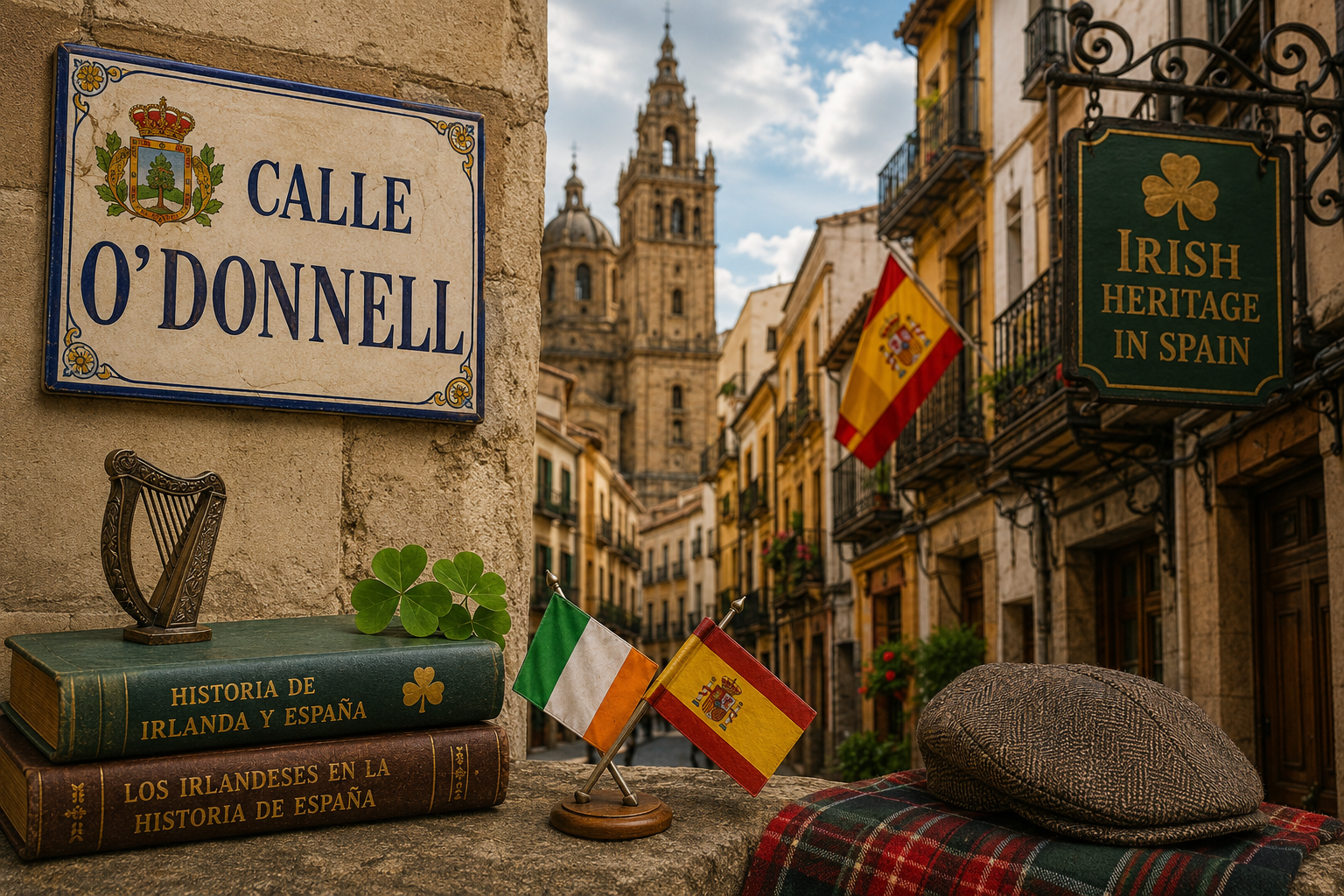
Even today, Madrid’s famous Calle O’Donnell serves as a reminder of this Irish heritage.
Merchants, wine and maritime trade
Not all Irish arrivals came as soldiers. Many settled in Spain as merchants, particularly in port cities such as Cádiz, Seville and La Coruña.
For centuries, Spain and Ireland maintained strong commercial and maritime links. Some Irish families became involved in the wine trade or traded goods arriving from the Americas and the Spanish colonies.
Especially in Andalusia, certain Irish families became highly successful economically and gradually blended into local society through marriages and business ties.
The famous “Irlandesas” schools in Spain
Ireland also left a strong mark on education in Spain. To this day, many Spaniards are familiar with the well-known “Irlandesas” schools, particularly in cities such as Seville and Madrid.
The origins of these schools are also linked to the centuries-old relationship between the two countries. Spain welcomed Irish Catholic religious orders, clergymen and exiles for generations, leading to the creation of schools and educational centres with a strong Irish influence.
The so-called “Irlandesas” schools traditionally became known for their discipline, international outlook, strong language education and Catholic values. For decades, Irish educational institutions enjoyed an excellent reputation among many Spanish families.
This too reflects how deeply rooted the historical connection between Spain and Ireland truly is — far beyond surnames alone.
Two nations that still feel close today
Beyond their shared history, Spaniards and Irish people also have many cultural similarities. Both are often regarded as open, sociable, cheerful and strongly family-oriented societies.
In both Spain and Ireland, family life, shared meals, celebrations, music and social gatherings play a central role in everyday culture. Both nations place great value on traditions, folklore, festivals and community life.
A connection to nature and outdoor living also links the two countries in different ways. While social life in Spain often revolves around plazas, terraces and street cafés, Ireland’s pub culture, live music and communal gatherings are equally central to daily life.
In addition, both countries partly share Celtic roots. Regions such as Galicia and Asturias still preserve cultural and musical traditions strongly reminiscent of the Celtic world. Many Irish visitors therefore feel surprisingly at home in northern Spain.
It is no coincidence that many Irish people have felt comfortable in Spain for centuries — and likewise that many Spanish families continue to choose Ireland as a destination for their children to study or learn English.
Today fully Spanish — yet proud of their Irish roots
Today, most of these families naturally consider themselves fully Spanish. After centuries in Spain, their identity has become entirely Spanish. Nevertheless, many still proudly preserve their Irish surnames and remain aware of their origins.
In certain social and historical circles in Spain, there continues to be considerable interest in this unique Irish-Spanish connection.
A historic relationship that still lives on today
Today, Spain and Ireland maintain close tourist, economic and human ties. Thousands of Irish citizens now live on the Costa del Sol, in Alicante or on the islands, while many Spaniards have moved to Ireland or studied there.
What many people do not realise, however, is that this connection did not begin with Erasmus programmes, low-cost airlines or modern tourism. It stretches back many centuries and is deeply rooted in the shared history of both countries.