Every spring, southern Spain experiences one of the most extraordinary cultural and religious events in Europe: the Romería del Rocío.
Perhaps over the last few days you have suddenly seen groups of people dressed in traditional Rocío clothing, travelling on horseback, singing, playing music or moving slowly along roads and through Andalusian towns with beautifully decorated wagons. In most cases, that means only one thing: they have begun “the Camino” — the traditional pilgrimage route through Andalusia towards Doñana and the famous pilgrimage of El Rocío.
For many foreigners, the first images of El Rocío can seem almost surreal: thousands of people on horseback, women wearing traditional “Batas Rocieras” walking across sandy tracks, flower-covered wagons, guitars, singing, dust, emotion, wine, faith — and a tiny white village on the edge of Doñana National Park that, for a few days, becomes the emotional heart of Andalusia.
But what exactly is El Rocío?
Spain Expat Press Editorial Team
Much more than a religious celebration
El Rocío is a massive Catholic pilgrimage held in honour of the Virgen del Rocío, affectionately known in Andalusia as “La Blanca Paloma” — The White Dove. The main celebrations take place each year during Pentecost in the tiny village of El Rocío, in the province of Huelva.
In 2026, the famous pilgrimage takes place from May 22 to May 25, although many brotherhoods begin their traditional journey several days earlier.
While the event has a deeply religious character, for many Andalusians El Rocío is also about family, tradition, friendship, music and a very particular way of life.
Some families have been taking part for generations. Others join mainly for the social and cultural experience. And increasingly, international visitors travel to Andalusia simply because they have never seen anything quite like it.
El Rocio.
Capítulo I. La Salida. #ElRocio2026 pic.twitter.com/2DAJ3rXka4
— Santiago Molina López (@fotosantimolina) May 20, 2026
El Rocio.
Capítulo II. El camino. #ElRocio2026 pic.twitter.com/IwJ47xA5AX
— Santiago Molina López (@fotosantimolina) May 21, 2026
The “Hermandades” — the heart of El Rocío
At the centre of El Rocío are the so-called “Hermandades” — religious brotherhoods from across Spain, and even from abroad, which organise the pilgrimage for their members.
Each Hermandad follows its own route over several days, crossing fields, villages, pine forests and even parts of Doñana National Park.
Among the most famous are the Hermandad de Triana, the Hermandad de la Macarena and the Hermandad Matriz de Almonte, considered the main and most historic brotherhood.
Today, there are more than 120 official Hermandades.
❤️ Las espectaculares imágenes de los peregrinos en su camino al Rocío: carreteras abarrotadas en una una de las fiestas más especiales de Sevilla
📷 Vídeos cedidos por @viaje_polonia y @danicuberosss_ pic.twitter.com/VoEeJemI4i
— EL ESPAÑOL (@elespanolcom) May 21, 2026
What does each Hermandad bring?
At the centre of every brotherhood is the “Simpecado” — a richly decorated religious banner featuring the Virgin Mary, which guides pilgrims throughout the journey.
The Simpecado usually travels on an ornate wagon decorated with silver, flowers and embroidered fabrics, often pulled by oxen or mules.
Travelling alongside it are: horses, traditional wagons, decorated tractors,mobile kitchens,entire families,choirs,guitar players and thousands of pilgrims.
Some Hermandades include several thousand participants.
The famous “Camino” — the road to El Rocío
When Spaniards say they are “doing El Rocío”, they are usually referring to “doing the Camino” — the pilgrimage journey itself.
And for many people, the Camino is the real experience.
Pilgrims sleep in temporary camps, cook outdoors, sing late into the night and travel through sandy paths, pine forests and the spectacular landscapes of Doñana.
For many, the Camino is a mixture of spiritual pilgrimage, family gathering and traditional adventure.
One of the best-known moments is the crossing of the “Vado del Quema”, a river crossing where thousands of spectators gather to watch the brotherhoods pass through.
The clothing: not flamenco, but “Bata Rociera”
Many international visitors initially assume that the women at El Rocío are wearing traditional flamenco dresses. Strictly speaking, however, that is not correct.
The Bata Rociera is lighter, less tight-fitting and designed for long days walking through sand or riding horses under the Andalusian sun. It is usually combined with flowers in the hair, large earrings, shawls and sturdy riding boots or espadrilles.
Men often wear traditional Andalusian riding clothing, including the Cordobés hat, short jackets and riding trousers
Because El Rocío is not an ordinary fair — it has its own unique culture, traditions and aesthetic.
The village of El Rocío: a place frozen in time
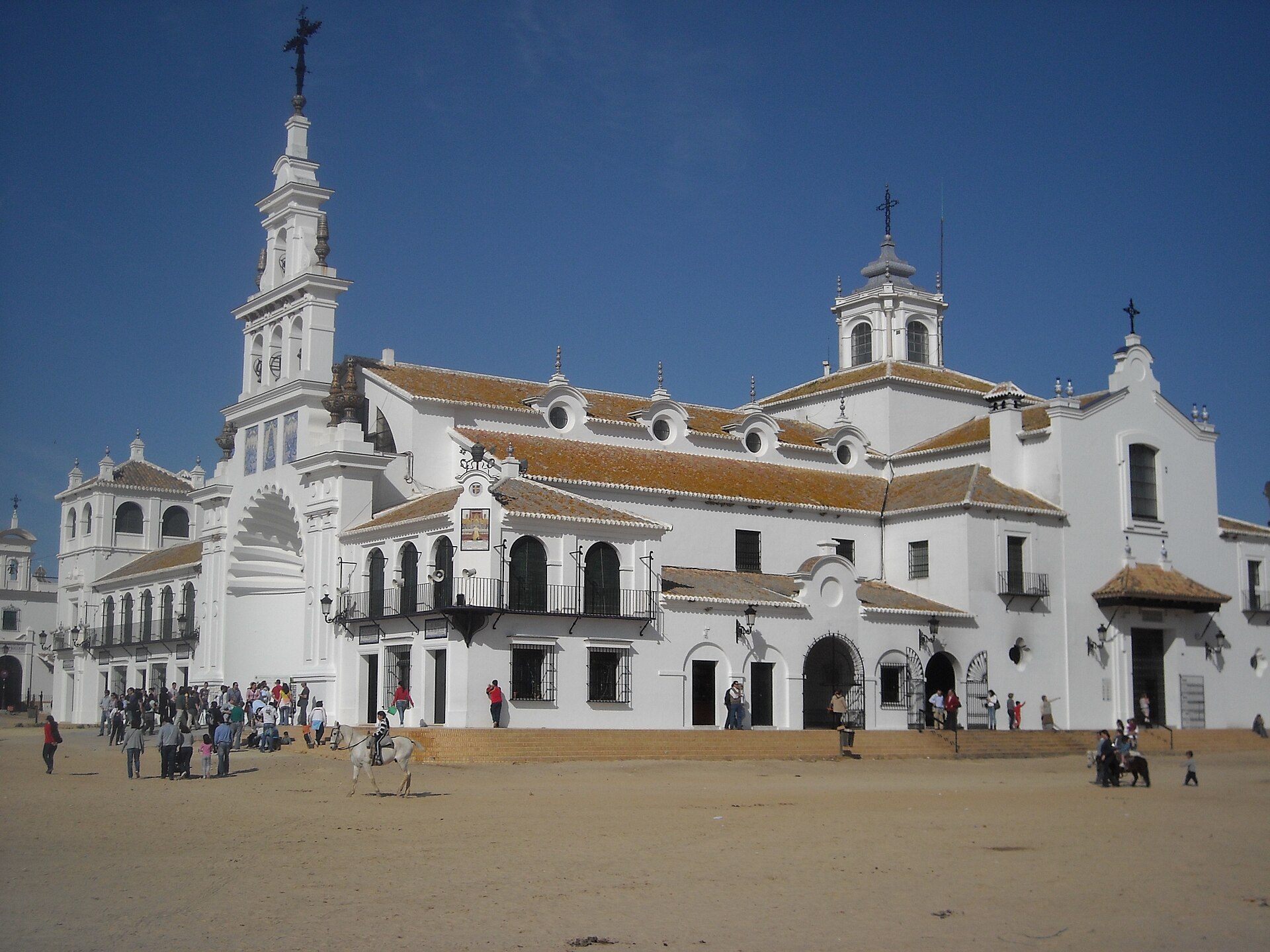
The small village of El Rocío looks almost like something from another era.
Many streets are covered entirely in sand rather than asphalt. Horses are everywhere, enormous white brotherhood houses line the streets and the atmosphere feels completely different from modern Spanish cities.
For most of the year, the village is quiet.
But during the pilgrimage, close to a million people can pass through El Rocío.
The most emotional moment: “El Salto de la Reja”
The most famous moment of El Rocío takes place during the night between Sunday and Monday.
Thousands of people wait around the church of the Virgen del Rocío in the village of El Rocío. Then, suddenly, the people of Almonte jump over the iron railings surrounding the altar — the famous “Salto de la Reja”.
The statue of the Virgin is then carried on shoulders through the entire village.
People cry, sing, pray and shout “¡Viva la Virgen del Rocío!” as the procession slowly moves through the enormous crowds.
Even many Spaniards say it is almost impossible to describe unless you experience it yourself.
A tradition that also sparks debate
For many foreign visitors, El Rocío is fascinating because it combines religion, folklore, celebration, emotion and Andalusian identity in a way that feels completely unique
At the same time, the event also attracts criticism:because of the crowds, environmental concerns, animal welfaredebates and the pressure placed on Doñana National Park.
And yet, even many critics agree on one thing: Few traditions in Europe still possess such a strong sense of collective identity and emotional power.
Because El Rocío is not something you truly understand through photographs or videos.
It is something you have to live.