Archaeologists working on Seville’s new Metro Line 3 have uncovered an extensive medieval Islamic cemetery in the Macarena district. The remains of 214 people have so far been documented – and researchers believe the burial ground may extend considerably further.
Spain Expat Press Editorial Team
Almost 1,000 years after they were buried, more than 200 inhabitants of medieval Seville have emerged from beneath the modern city.
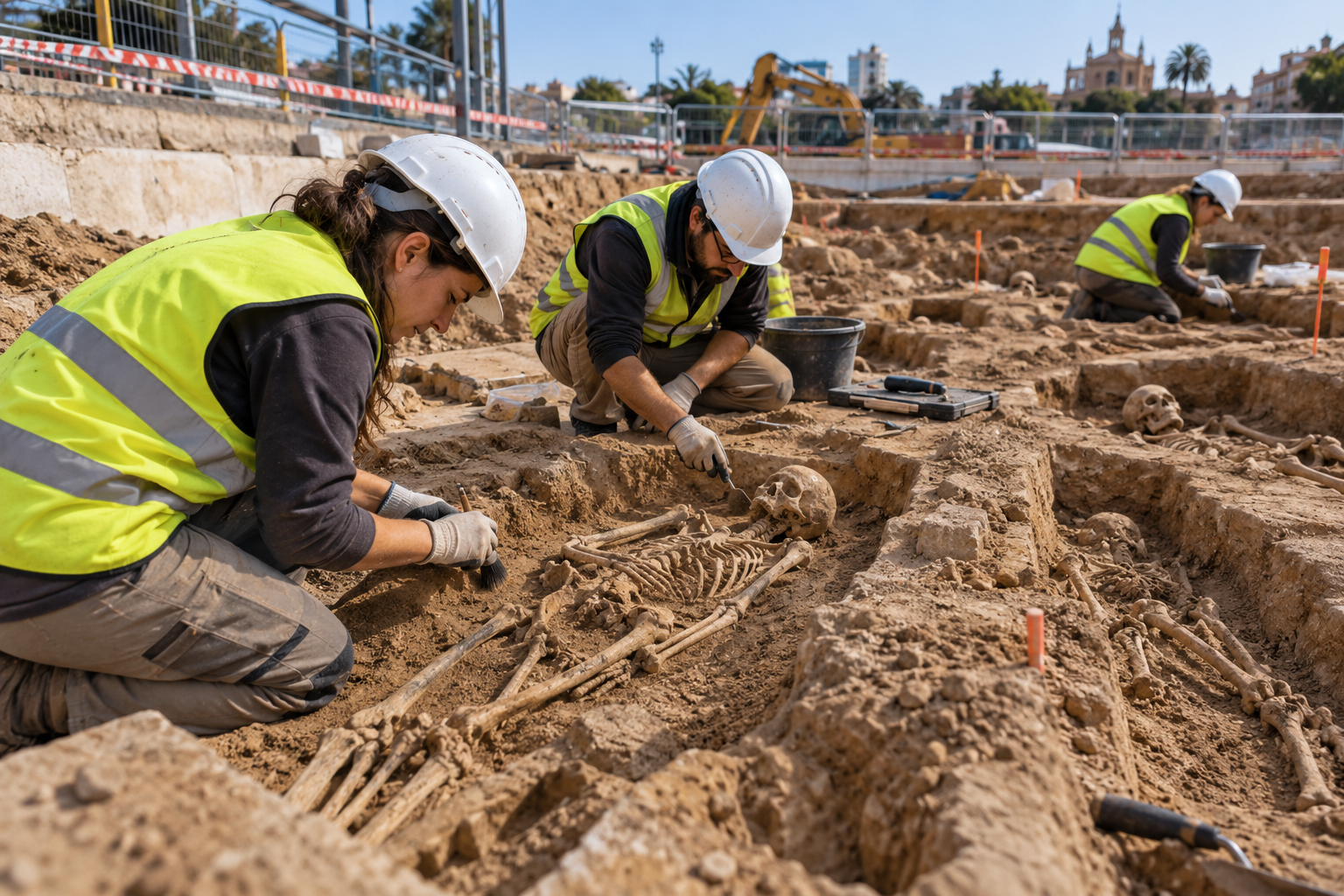
Archaeologists working alongside the construction of Metro Line 3 have uncovered a substantial Andalusi necropolis close to the Virgen Macarena University Hospital. So far, the remains of 214 individuals have been documented.
The burials have been dated to between the 11th and 13th centuries, when Seville was one of the most important cities of Al-Andalus, the Muslim-ruled territories of the Iberian Peninsula.
What began with the discovery of around 40 graves has developed into a much larger archaeological investigation.
A medieval Islamic cemetery beneath modern Seville
Experts have identified the site as a maqbara, an Islamic burial ground.
The position of the bodies provides some of the clearest evidence of the cemetery’s origins. The deceased were generally buried according to Islamic funerary customs, lying on their right side and orientated towards Mecca.
The cemetery appears to have remained in use over a considerable period, suggesting that several generations of the same community may have buried their dead here.
But one of the most intriguing questions remains unanswered: who were these people?
A community outside the city walls?
Researchers believe the cemetery may have belonged not to residents living within medieval Seville itself, but to a smaller settlement on its outskirts.
One possibility is the existence of an alquería, a rural settlement typical of Al-Andalus whose inhabitants would probably have depended largely on farming and livestock.
The settlement itself has yet to be located.
If that theory proves correct, the discovery could provide an unusually detailed picture of everyday life beyond the walls of one of medieval Spain’s great cities.
Palaces, mosques and monumental buildings tend to tell the story of rulers, wealth and political power. Cemeteries can reveal something very different: the lives of ordinary people who left few written records behind.
Analysis of the remains could eventually provide information about their age, health, diet, illnesses and physical working conditions.
In other words, these graves may tell researchers not simply how people died, but how they lived.
Metro construction meets nearly 1,000 years of history
The discovery also illustrates the particular challenge of building major infrastructure in a city with such a deep archaeological past.
After the first graves were uncovered, work had to be adapted along a section of roughly 50 metres while construction continued elsewhere.
The initial archaeological phase lasted several months.
Researchers are using far more than traditional excavation techniques. The investigation involves physical anthropologists as well as archaeologists, while technology including ground-penetrating radar, 3D laser scanning, surveying equipment and georeferencing systems is being used to record the site.
Every burial must be carefully documented before the remains can be removed and studied.
There may be many more graves
Perhaps the most remarkable aspect of the discovery is that the 214 individuals identified so far may represent only part of the cemetery.
Further archaeological work is planned, and because excavation has largely concentrated on areas directly affected by Metro construction, the true boundaries of the burial ground remain unknown.
Earlier work connected with Line 3 had already revealed dozens of Andalusi graves, reinforcing archaeologists’ expectations that substantial burial areas could survive beneath the historic approaches to the city.
That should perhaps come as little surprise.
Seville has been shaped by successive civilisations, from the Romans and Visigoths to centuries of Muslim rule and the Christian city that followed the conquest by Ferdinand III in 1248.
Modern Seville stands quite literally on top of those earlier cities.
There is also a striking irony to the latest discovery. A Metro line being built to transform the way future generations move around Seville is simultaneously revealing the people who inhabited the area almost a millennium ago.
And beneath the Macarena district, there may still be much more waiting to be found.