Spanish Interior Minister Fernando Grande-Marlaska has ordered an investigation into reports surrounding the migration crisis in Ceuta. The move was prompted by a document which, according to media reports, suggests that Moroccan security forces may have been involved in the mass arrival of migrants at the end of July. Police chief Francisco Pardo has since rejected this account.
Spain Expat Press Editorial Team
by Marlon Gallego Bosbach
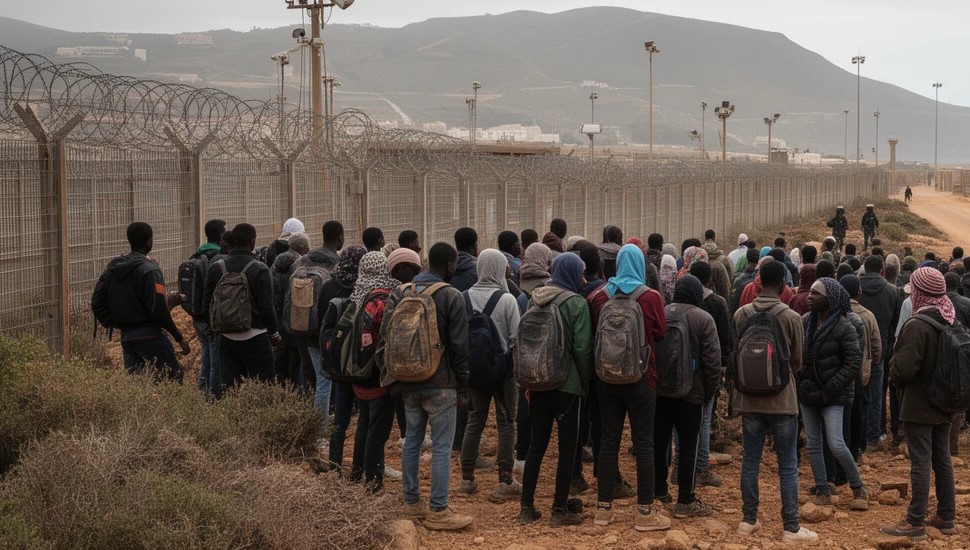
The political debate surrounding the severe migration crisis in Ceuta is intensifying. At the centre of the controversy is a police document concerning the events of 30 and 31 July, when tens of thousands of people made their way towards the Spanish enclave.
Several media outlets reported that a document from the Centro Nacional de Inmigración y Fronteras (CENIF) suggested that Moroccan security forces had directed the movement of people towards Ceuta, thereby at least facilitating the mass movement towards the border.
However, Spain’s Interior Ministry disputes this account. Following an internal review, Police Director Francisco Pardo told Interior Minister Fernando Grande-Marlaska that there was no police report attributing the planning or execution of the events to Moroccan security forces.
Marlaska demands immediate explanations
Grande-Marlaska called for urgent clarification after the reports emerged. The Interior Minister wanted to know in particular whether such a document actually exists, when the police leadership became aware of it, and why the information had not been passed on to the political leadership sooner.
The matter is particularly sensitive because the events in Ceuta are now the subject of proceedings before the Audiencia Nacional, Spain’s national criminal and administrative court.
According to the Interior Ministry, the judge in charge of the case, María Tardón, had instructed investigators not to pass information about the preparation or contents of the report to their superiors. As a result, Police Chief Pardo said he was initially unaware of the investigative documents.
Police leadership reviews the documents
After the judge granted the police leadership access to the documents, Pardo instructed the relevant police units to carry out an urgent review. According to the Interior Ministry, both the General Commissariat for Information and the General Commissariat for Immigration and Borders were involved in the review.
The findings of the review were clear: there was no official police report attributing the planning or execution of the events of 30 and 31 July to Moroccan security forces.
What happened to the 29 July warning?
A second question concerns a warning issued by the CENIF to border posts on 29 July, one day before the mass migration movement. Its significance is now also being interpreted differently.
According to the Interior Ministry, it was a routine risk warning of the kind regularly issued for the region. It did not, therefore, contain a specific warning of a mass entry into Ceuta being imminent the following day.
The ministry is therefore also rejecting the impression that the Spanish security authorities already had specific information on 29 July about the escalation that was to follow.
Media reports put forward a different account
However, the controversy is far from over. Several media outlets had previously reported, citing investigative documents, that the events in Ceuta may not have been entirely spontaneous.
According to these reports, Moroccan security forces are alleged to have directed groups of people towards the Spanish border. The reports also put forward the theory that the mass movement may have been deliberately intended to overwhelm Spanish border security forces.
However, this account contradicts the current official statements from the Interior Ministry and the police chief. The key question, therefore, is what exactly the documents held by the Audiencia Nacional contain and how investigators assess their findings.
Government urges caution
In light of the conflicting accounts, the Spanish government is seeking to temper the debate. The Interior Ministry stresses that the actual contents of the investigative documents must first be established before any definitive assessment can be made.
The government had already highlighted its cooperation with Morocco during the crisis. In an official statement issued on 30 July, the Interior Ministry explicitly emphasised the cooperation between the two countries on migration, stating that Moroccan security forces had prevented thousands of attempts at irregular migration.
Opposition steps up pressure
The issue is particularly politically sensitive for the Spanish government. The opposition is demanding clarification over whether the government had received specific warnings ahead of the mass migration movement and whether information about possible Moroccan involvement was not given sufficient consideration.
The leader of the conservative Partido Popular, Alberto Núñez Feijóo, has gone considerably further, holding Morocco responsible for the crisis. He accuses Pedro Sánchez’s government of being aware of the neighbouring country’s possible role and withholding information. The government rejects these allegations.
Audiencia Nacional investigates the events
The legal investigation is continuing independently of the political dispute. The Audiencia Nacional is examining the events surrounding the mass migration movement and any potentially criminal aspects. So far, there has been no judicial finding that Morocco organised or directed the events.
Two contrasting accounts therefore currently stand side by side: media reports that infer a possible coordinated role for Moroccan security forces from the investigative documents, and the official position of Spain’s Interior Ministry, which maintains that no police report attributes such responsibility to Morocco.
Dispute over Ceuta continues
The dispute is likely to continue to occupy Spanish politics for some time. At its core are two questions: What did the Spanish security authorities know before 30 July – and what can actually be established about Morocco’s role in the migration movement?
Until the full investigative documents have been publicly assessed, the claim that Moroccan security forces deliberately directed the movement remains a disputed investigative theory rather than an established fact.
The ongoing investigation by the Audiencia Nacional could therefore be crucial in determining which account of the Ceuta crisis ultimately stands.