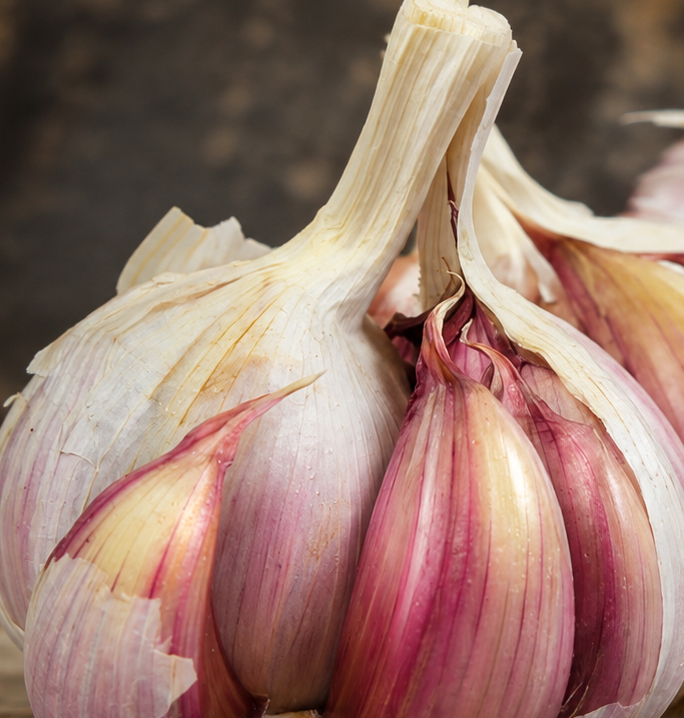
In the province of Cuenca, a distinctive purple garlic has become both a culinary treasure and a symbol of regional identity. Protected by the European Union and prized for its unusually intense flavour, Ajo Morado de Las Pedroñeras has acquired a reputation that extends far beyond Castilla-La Mancha.
Spain Expat Press Editorial Team
When people think of Spain’s great culinary products, jamón ibérico, olive oil, Manchego cheese or saffron are likely to come to mind. Garlic, by comparison, is a rather humbler ingredient. Yet few foods are quite so deeply woven into Spanish cooking.
And among Spain’s many varieties, one has acquired an almost legendary reputation: Ajo Morado de Las Pedroñeras, the purple garlic grown around the town of Las Pedroñeras in the province of Cuenca.
It is frequently described in Spain as one of the finest garlics in the world. Occasionally, enthusiasts go further and simply call it “the best garlic in the world”.
That claim requires a little perspective. There is no universally recognised international competition or institution that has officially awarded Las Pedroñeras such a title. But behind the boast lies a product with a genuinely remarkable history, distinctive characteristics and protected status.
White on the outside, purple within
At first glance, Ajo Morado may not appear dramatically different from ordinary garlic. Its outer skin is pale, almost white. Peel it back, however, and its defining feature becomes immediately apparent: cloves wrapped in skins ranging from pinkish purple to a deep violet.
The bulbs tend to be round and uniform, usually containing around eight to 10 slightly curved cloves.
But appearance is only part of the story.
What distinguishes the garlic of Las Pedroñeras is its powerful aroma, pronounced pungency and intense, lingering flavour. It is the sort of ingredient that refuses to disappear quietly into a dish.
A relatively small amount can be enough to impart a distinctly garlicky character – one of the reasons it is so highly valued by cooks.
A protected product of Castilla-La Mancha
Ajo Morado de Las Pedroñeras is not merely a clever piece of regional marketing. Its name and origin are protected under the European Union’s Protected Geographical Indication (PGI) system.
The designation links the product to a defined geographical area and establishes standards governing its production and characteristics.
Its home is Castilla-La Mancha, a vast central Spanish region of cold winters and hot, dry summers. The climate, soils and generations of agricultural knowledge have helped shape the garlic produced here.
Planting traditionally takes place during the winter, particularly in December and January, with harvesting following in June and July.
Modern agricultural machinery has inevitably transformed parts of the process, but garlic cultivation remains deeply rooted in the traditions of the area.
Las Pedroñeras, the capital of garlic
For the people of Las Pedroñeras, garlic is far more than another crop. It is part of the town’s identity – economically, culturally and even socially.
Indeed, the municipality has long promoted itself as the “Capital Mundial del Ajo” – the world capital of garlic.
Its importance is perhaps best demonstrated by the annual Feria Internacional del Ajo, or International Garlic Fair. In 2026, the event celebrated its 52nd edition, bringing together producers, traders and specialists from the sector.
Over the decades, an entire industry has developed around garlic in this part of Cuenca, combining traditional farming with modern processing, packaging and international distribution.
For a relatively modest Spanish town, garlic has quite literally put Las Pedroñeras on the map.
Why is its flavour so powerful?
Much of garlic’s unmistakable aroma and pungency comes from its sulphur-containing compounds.
One of the most interesting processes begins the moment a clove is cut, crushed or chopped. Compounds that were previously separated inside the intact clove come into contact, triggering enzymatic reactions that produce allicin.
Allicin and related compounds are largely responsible for the familiar smell, sharpness and flavour associated with freshly cut garlic.
It is precisely this intensity that has helped make Ajo Morado so prized.
The quiet foundation of Spanish cooking
Garlic rarely receives the attention afforded to expensive cuts of ham or bottles of extra virgin olive oil, yet it is difficult to imagine traditional Spanish cooking without it.
It forms the backbone of countless sofritos, sauces, marinades, stews, fish and meat dishes.
Sometimes it moves from supporting actor to star.
There are gambas al ajillo, prawns sizzling in olive oil with generous quantities of garlic; the traditional Castilian sopa de ajo, or garlic soup; and, of course, alioli, where the quality and character of the garlic can transform the result.
It appears alongside vegetables and pulses, rubbed on toasted bread, crushed into sauces or simply fried gently in good Spanish olive oil.
And this is precisely where the purple garlic of Las Pedroñeras comes into its own. It is not designed to disappear into the background.
So, is it really the best garlic in the world?
There is no objective answer.
Taste is hardly an exact science, and there is no internationally recognised title of “world’s best garlic” that would settle the argument.
The phrase is better understood as an expression of the extraordinary reputation the product has acquired rather than an official accolade.
But Las Pedroñeras has plenty to justify its confidence. Its garlic has European geographical protection, distinctive characteristics, generations of agricultural tradition and an entire local economy and culture built around it.
Perhaps, then, deciding whether it really is the best garlic on Earth rather misses the point.
Its place among Spain’s most distinctive agricultural products is considerably harder to dispute.
And the next time you find “Ajo Morado de Las Pedroñeras PGI” in a Spanish market or supermarket, it may be worth taking a closer look. Behind those small purple cloves lies a surprisingly large piece of Spanish culinary culture.