Nearly three weeks after the mass border crossing at the end of July, frustration is mounting in Ceuta. Residents complain of robberies and thefts, young women are increasingly reluctant to go out alone, parts of the coastline have become makeshift sleeping areas, health services have faced exceptional pressure and schools have been used as emergency shelters just weeks before the new academic year. Anger is increasingly being directed at the Spanish government in Madrid.
Spain Expat Press Editorial Team
Residents of Ceuta are exhausted by the situation – and increasingly angry.
Nearly three weeks after the mass border crossing at the end of July, what began as an extraordinary humanitarian and security emergency has developed into a prolonged crisis affecting everyday life across the small Spanish city.
Ceuta has a population of just over 80,000 and covers only around 19 square kilometres. Migration and the challenges associated with one of the European Union’s most sensitive external borders have long been part of life here.
The scale of the latest crisis, however, has been different.
For many residents, the debate is no longer simply about migration policy, asylum or border controls. It is about whether they feel safe in their own streets, whether they can use their usual beaches, whether local health services can cope and whether schools will be ready when children return after the summer holidays.
Robberies and thefts add to fears
Security has become one of the most sensitive issues.
There have been reports of thefts, robberies and violent incidents since the beginning of the crisis, while videos purporting to show confrontations and other incidents circulate widely on WhatsApp, TikTok and Instagram.
Not all of the footage can be independently verified. Some videos document genuine incidents, while others circulate without a clear date, location or context. Confirmed crimes therefore need to be distinguished from rumours and unverified social-media claims.
What is clear, however, is that the perception of safety among some residents has changed.
Parents say they are collecting their children more frequently in the evenings. Some teenagers are avoiding particular areas, while young women who previously thought little of walking home alone are increasingly choosing to be accompanied or picked up.
When parents begin telling their daughters not to walk home alone, the consequences of the crisis have reached well beyond the border.
Families avoid parts of the coastline
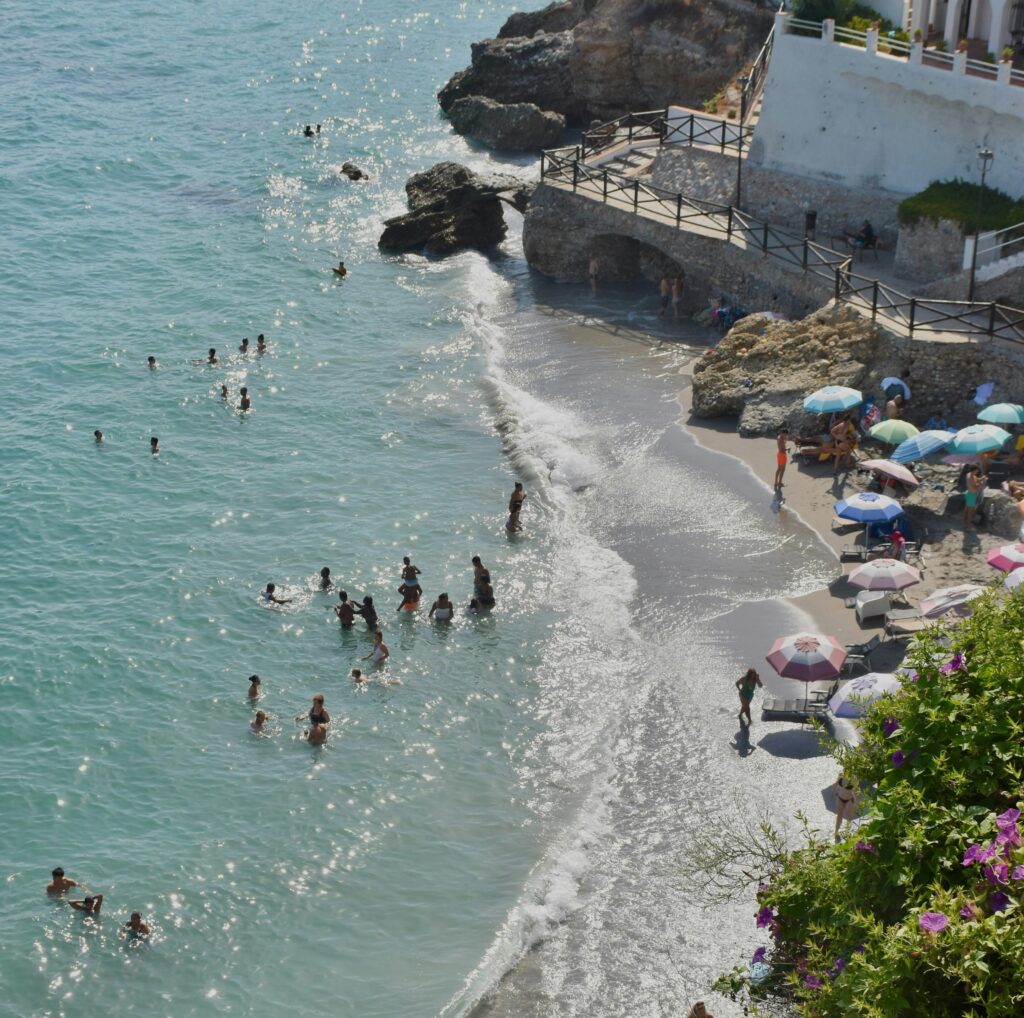
The impact is also highly visible on Ceuta’s beaches.
Playa del Trampolín has become one of the symbols of the crisis, with migrants sleeping outdoors on mattresses and blankets and keeping bags, food and personal belongings in areas normally used by swimmers and families.
Portable toilets and showers have been installed to improve sanitary conditions, while migrants themselves have also taken part in efforts to clean the area.
There is no general ban on swimming at Ceuta’s beaches. Nevertheless, some residents say they are avoiding certain stretches of coastline because of concerns over cleanliness, hygiene or simply because they no longer feel comfortable there.
In a Mediterranean city in the middle of August, that loss of normality is particularly noticeable.
The conditions are equally unacceptable for those forced to sleep there. A beach may provide emergency space for a night or two; it is not a sustainable or dignified form of accommodation.
Scabies cases heighten health concerns
Health concerns have added to the unease.
The Spanish military has confirmed 24 cases of scabies among soldiers stationed in Ceuta.
The army has explicitly said there is no evidence linking the outbreak to contact with migrants, and some cases had already been detected beforehand.
Doctors have nevertheless warned more broadly about the health risks associated with large numbers of people living for prolonged periods in overcrowded conditions with inadequate sanitation.
The issue is not where people come from, but the conditions in which they are being forced to live.
Ceuta’s health system has also faced exceptional pressure.
The city has just one public hospital. In the immediate aftermath of the border crossing, more than 1,000 medical consultations involving migrants were recorded within a single 24-hour period.
The extraordinary pressure of those first days has since eased, but medical representatives and trade unions have called for additional staff and resources.
For many residents, the episode has highlighted how quickly the infrastructure of a city of Ceuta’s size can reach its limits.
The school year is approaching
There is now another deadline looming.
The summer holidays are coming to an end.
During the emergency, the Príncipe Felipe and Reina Sofía schools were used to provide temporary accommodation for migrant minors.
Authorities are working to return the buildings fully to their normal purpose, but the approaching start of the academic year is increasing the pressure.
The schools must be cleared, cleaned, checked and prepared for pupils. At the same time, suitable alternative accommodation must be found for the minors housed there.
For many parents, the use of schools as emergency shelters has become another powerful symbol of how deeply the crisis has entered ordinary life.
What began at the border at the end of July has reached their children’s classrooms.
Schools can provide emergency shelter during an exceptional humanitarian crisis. They cannot become permanent accommodation.
Ceuta’s children have a right to return to their classrooms after the holidays. Migrant children also have a right to safe and appropriate accommodation.
The challenge for the authorities is to guarantee both.
Madrid considers moving around 500 girls to mainland Spain
At the same time, the Spanish government and the Ceuta authorities are working on plans to transfer around 500 unaccompanied migrant girls to mainland Spain.
The girls are considered particularly vulnerable and would be placed in appropriate protection facilities.
Finding places, however, has become politically contentious.
Several of Spain’s autonomous regions have expressed reservations about receiving additional migrant minors or have opposed compulsory redistribution.
It would be inaccurate to suggest that every region has refused to take them, but securing sufficient capacity remains difficult.
Madrid is therefore pursuing two tracks simultaneously: examining individual cases in which a lawful return to Morocco may be possible, while seeking immediate accommodation on the mainland to relieve the pressure on Ceuta.
For residents, however, the lengthy political and legal discussions are increasingly frustrating.
While Madrid negotiates with regional governments and the conditions for possible returns are assessed, Ceuta continues to carry the immediate burden.
Anger increasingly directed at Madrid
That frustration is becoming one of the defining features of the crisis.
The anger is not directed solely at the migrants themselves.
Many Ceutíes helped during the first days of the emergency. Volunteers, neighbourhood organisations, medical staff and charities distributed water, food and clothing and assisted people who had arrived exhausted or injured.
Nearly three weeks later, however, many residents believe an emergency response has been allowed to become a semi-permanent situation.
Ceuta’s president, Juan Jesús Vivas, has also hardened his language towards the central government.
He has called for additional National Police and Guardia Civil officers, as well as more administrative staff, interpreters and resources for the courts, health services and social care.
Madrid rejects accusations that it has abandoned Ceuta, pointing to additional security personnel, temporary accommodation and planned transfers to mainland Spain.
Yet a growing gap has emerged between the government’s account of its response and the experience described by many people on the ground.
What Madrid presents as a substantial mobilisation of resources is regarded by many Ceutíes as simply too slow.
Support for Ceuta spreads across social media
The mood in Ceuta is also beginning to attract greater attention elsewhere in Spain.
Messages of solidarity with residents are spreading on social media under slogans including “No estamos solos, yo también soy Ceuta” – “We are not alone, I too am Ceuta”.
Public figures have also begun speaking about the situation.
Comments by José Juan Romero, manager of AD Ceuta, attracted particular attention after he spoke publicly about the effect of the crisis on everyday life in the city.
The focus of the wider debate is therefore beginning to shift.
During the first days, coverage centred overwhelmingly on the humanitarian situation facing migrants and the extraordinary scenes at the border.
Nearly three weeks later, another perspective is becoming increasingly prominent: that of the people who live in Ceuta.
From solidarity to frustration
Ceuta showed considerable solidarity during the initial emergency.
That solidarity has not disappeared.
But solidarity does not mean accepting an emergency indefinitely.
It is entirely possible to demand humane treatment for people who cross a border exhausted and in need of help while also expecting local families to be able to use their beaches, young people to feel safe, hospitals to function normally and children to return to their classrooms after the summer.
Nor are beaches, makeshift camps and school buildings a dignified long-term solution for migrants themselves.
Nearly three weeks on, the most significant story emerging from Ceuta is therefore no longer simply how many migrants remain in the city.
It is the growing frustration of its residents.
They want to use their beaches normally again. They want clean public spaces. Parents want their daughters to be able to come home without fear. Patients want confidence that local health services can cope.
And, with the summer holidays drawing to a close, families want something that under normal circumstances would barely merit a second thought: for their children to return to school as usual.
While Madrid, Spain’s autonomous regions, Brussels and Morocco continue discussing transfers, returns and responsibilities, the clock in Ceuta is ticking.
Summer is coming to an end, the new school year is approaching – and many Ceutíes now expect one thing above all from the Spanish government: a swift and concrete solution.