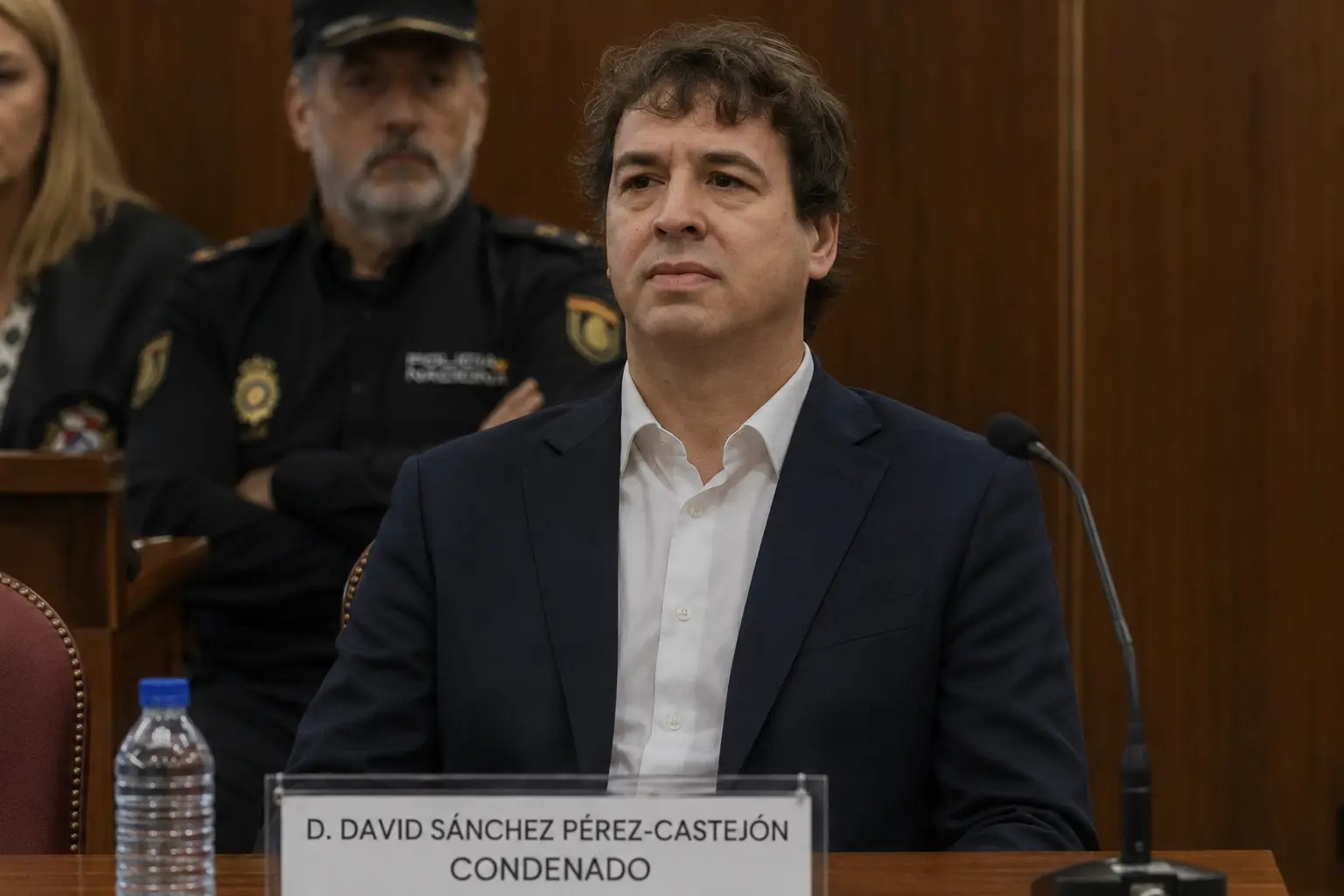
Spain has been hit by a new political storm after David Sánchez Pérez-Castejón, the brother of Prime Minister Pedro Sánchez, was sentenced by the Provincial Court of Badajoz to nine years’ disqualification from public office. The court ruled that he was involved in administrative wrongdoing linked to his role at the Provincial Council of Badajoz. However, the ruling does not include a prison sentence.
Spain Expat Press Editorial Team
by Marlon Gallego Bosbach
The ruling has sparked nationwide headlines in Spain, as it represents more than just a legal decision against an individual. It has reignited a wider political debate over transparency, influence and the handling of public appointments. The case comes at a challenging time for Pedro Sánchez, with opposition parties seizing on the verdict as another opportunity to criticise the Socialist government.
What Was the David Sánchez Case About?
At the centre of the case was a position at the Diputación de Badajoz, the provincial authority in Spain’s Extremadura region. David Sánchez, a professional musician and conductor, was appointed in 2017 to a role linked to the province’s musical activities.
The investigation centred on whether the position had been created and filled through a standard recruitment process, or whether it had been specifically designed to suit David Sánchez’s profile. Prosecutors argued that the procedure failed to meet the principles of impartiality expected from public administration.
The court found that a decision had been taken that did not adequately serve the public interest. David Sánchez was considered a necessary participant in the alleged administrative wrongdoing.
No Ruling on Abuse of Influence
A key aspect of the ruling is that the allegation of abuse of influence was not proven. David Sánchez was cleared of this charge, meaning that the legal consequences are limited to issues surrounding the administrative decision-making process and the appointment procedure.
Pedro Sánchez himself was not found guilty in the proceedings. The court did not establish any personal criminal liability on the part of the Prime Minister. However, the political debate surrounding the case continues, with opposition parties arguing that Sánchez’s position and name were relevant in the context of the decisions taken at the time.
What Does the Nine-Year Ban Mean?
The penalty imposed is not a prison sentence. Instead, the so-called disqualification order prevents David Sánchez from holding public office or taking on certain public roles for a period of nine years.
Miguel Ángel Gallardo, the former president of the Diputación de Badajoz and a former PSOE figure in Extremadura, was also convicted in relation to the case. He received a multi-year ban from holding public office as part of the ruling.
The Controversy Surrounding the Public Appointment
The key question at the centre of the trial was whether David Sánchez’s position was a genuine public appointment or whether it had been created specifically for him.
Investigators drew on findings from the Guardia Civil and its specialist UCO unit as part of their case. According to their assessment, there were indications that the position may have been designed around David Sánchez’s profile before the official recruitment process began.
The defence rejected this interpretation, arguing that the position was necessary and that the recruitment process had been conducted in accordance with the law. Media reports also indicated that prosecutors had called for David Sánchez to be acquitted.
Political Fallout for Pedro Sánchez
Although the verdict does not directly concern the Prime Minister himself, it carries significant political consequences.
The conservative opposition views the case as reinforcing its criticism of the Prime Minister’s political circle. Parties including the Partido Popular and Vox have accused the government of a lack of transparency and are using the ruling as further ammunition against Pedro Sánchez.
The PSOE rejects this interpretation, with Socialist representatives emphasising that the ruling can be appealed and describing the case as politically motivated. The government has said it remains convinced of David Sánchez’s innocence.
Another Pressure Test for the Spanish Government
The case arrives at a challenging political moment for Pedro Sánchez. Previous legal proceedings and controversies involving his inner circle have already fuelled public debate in recent years. Opposition parties are seeking to present these issues as evidence of a broader pattern, while the government accuses its critics of waging a political campaign against the Prime Minister.
For many in Spain, the issue has moved beyond the legal questions surrounding David Sánchez’s appointment. The case has become a symbol of a broader debate about political power, accountability and public confidence in institutions.
What Happens Next in the Case?
The verdict is not yet final. The defence has the option to appeal, which means the case could continue through additional stages of the legal process.
Until a final ruling is issued, David Sánchez remains convicted under the current judgment, although he can seek a review of the decision through higher courts.
A Verdict with Significant Political Impact
Legally, the conviction of David Sánchez concerns a public appointment in Badajoz. Politically, however, the significance of the case reaches far beyond the details of the recruitment process.
For the opposition, the verdict is proof of wider problems within Pedro Sánchez’s political circle. The government, however, argues that the case is being used for political gain and stresses that the legal process is not yet over.
One thing is certain: The David Sánchez case is set to remain a major issue in Spain for some time, both within the legal system and across the wider political debate.