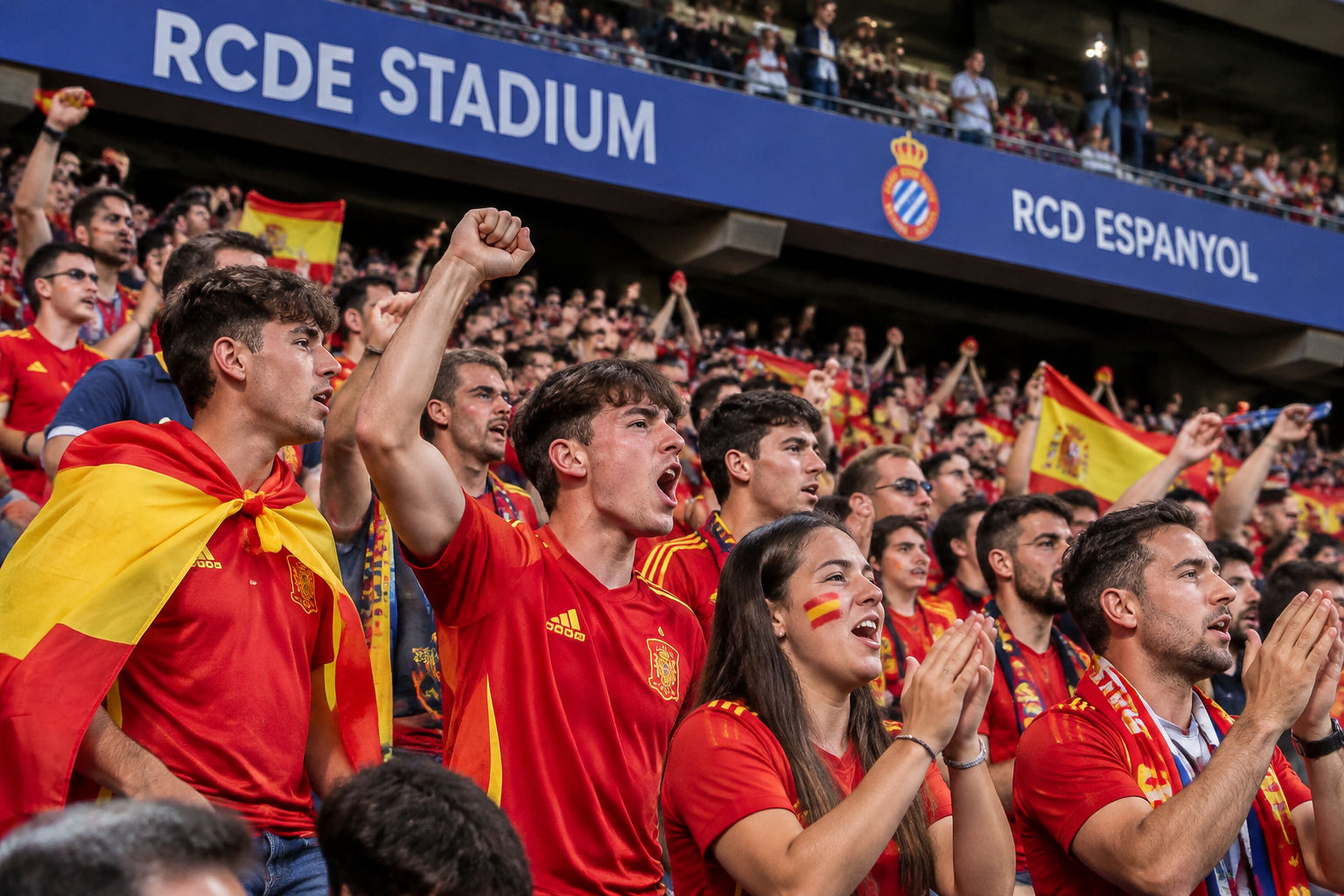
FIFA has imposed a fine and a partial stadium closure on the Spanish Football Federation (RFEF) following anti-Muslim chants during a friendly match against Egypt. The sanctions were prompted by calls directed at Muslims from the crowd at the RCDE Stadium near Barcelona. The federation has announced that it intends to appeal the decision.
Spain Expat Press Editorial Team
by Marlon Gallego Bosbach
Chants during the friendly match against Egypt
The incidents took place on March 31, 2026, during a friendly match between Spain and Egypt at the RCDE Stadium in Cornellà-El Prat, near Barcelona. During the encounter, some members of the Spanish crowd began chanting, “Musulmán el que no bote.” The slogan translates, in essence, to: “Whoever doesn’t jump is a Muslim.”
The Egyptian national anthem had already been booed before kickoff. Discriminatory chants were also heard repeatedly during the match. At halftime, the stadium announcer and the video screens urged the spectators to put an end to this behavior. The match, watched by 35,895 spectators, ended in a 0:0 draw.
Fine and restriction of stadium access
FIFA has imposed a fine of 20,000 US dollars – equivalent to approximately 18,000 euros – on the RFEF. Furthermore, the federation must close off at least 15 percent of the available seating for the next relevant home friendly match played by the Spanish men’s national team.
The seats in question should preferably be located in the areas behind the goals. Alternatively, subject to prior approval by FIFA, the association may reserve them for specific groups, such as families, schoolchildren, students, or anti-discrimination organizations. In such cases, additional anti-discrimination measures – for example, the use of specific T-shirts or banners – must be implemented. A plan detailing this must be submitted to FIFA for approval no later than 15 days before the match.
FIFA rejects the Spanish federation’s line of reasoning
The RFEF had already condemned the chants during the match, using the stadium’s public address system and video screens to call on the spectators to stop. In the subsequent disciplinary proceedings, however, the federation took the position that the word “Muslim,” in and of itself, is neither offensive nor derogatory.
FIFA did not accept this line of reasoning. It argued that the context in which a statement is used is the decisive factor. Even terms that might not be offensive when viewed in isolation can have a discriminatory or derogatory effect depending on how they are used.
Lamine Yamal criticizes the chants
Spanish international Lamine Yamal also spoke out regarding the incidents. The Muslim footballer criticized the chants heard after the match as disrespectful and condemned the behavior of the spectators involved. His reaction brought further attention to the debate, as the discriminatory chants occurred during a match involving his own national team.
Following the incident, the Catalan police force, Mossos d’Esquadra, launched an investigation. The inquiry focused both on the anti-Islamic chants and the jeering directed at the Egyptian national anthem.
RFEF intends to challenge the decision
The Spanish Football Federation intends to challenge the FIFA sanction before the Court of Arbitration for Sport (CAS). It has not yet been confirmed that the penalty will be overturned.
The decision underscores that football associations can be held accountable under sports law for discriminatory behavior by spectators. At the same time, the case demonstrates that the assessment of such incidents does not depend solely on whether explicitly offensive terms are used. A crucial factor is also whether, in the given context, the chants disparage a particular religious or social group.