Africa is just across the water – yet the Rock is rarely a destination.Gibraltar sits at one of the narrowest points between Africa and Europe. Yet migrants attempting the dangerous crossing from North Africa overwhelmingly head for Spain rather than the British Overseas Territory. Why?
Spain Expat Press Editorial Team
At first glance, it seems surprising. Gibraltar lies directly on the Strait that bears its name and appears on a map to be one of the most obvious gateways into Europe.
Yet migrant boats arriving on the Rock are comparatively rare. There have even been documented cases in which migrants who reached Gibraltar appear to have been trying to reach Spain instead.
There is no single proven explanation. Geography, established migration routes, onward travel and Gibraltar’s unusual political and legal position all appear to play a part.
A tiny target beside a long Spanish coastline
Geography offers perhaps the simplest explanation.
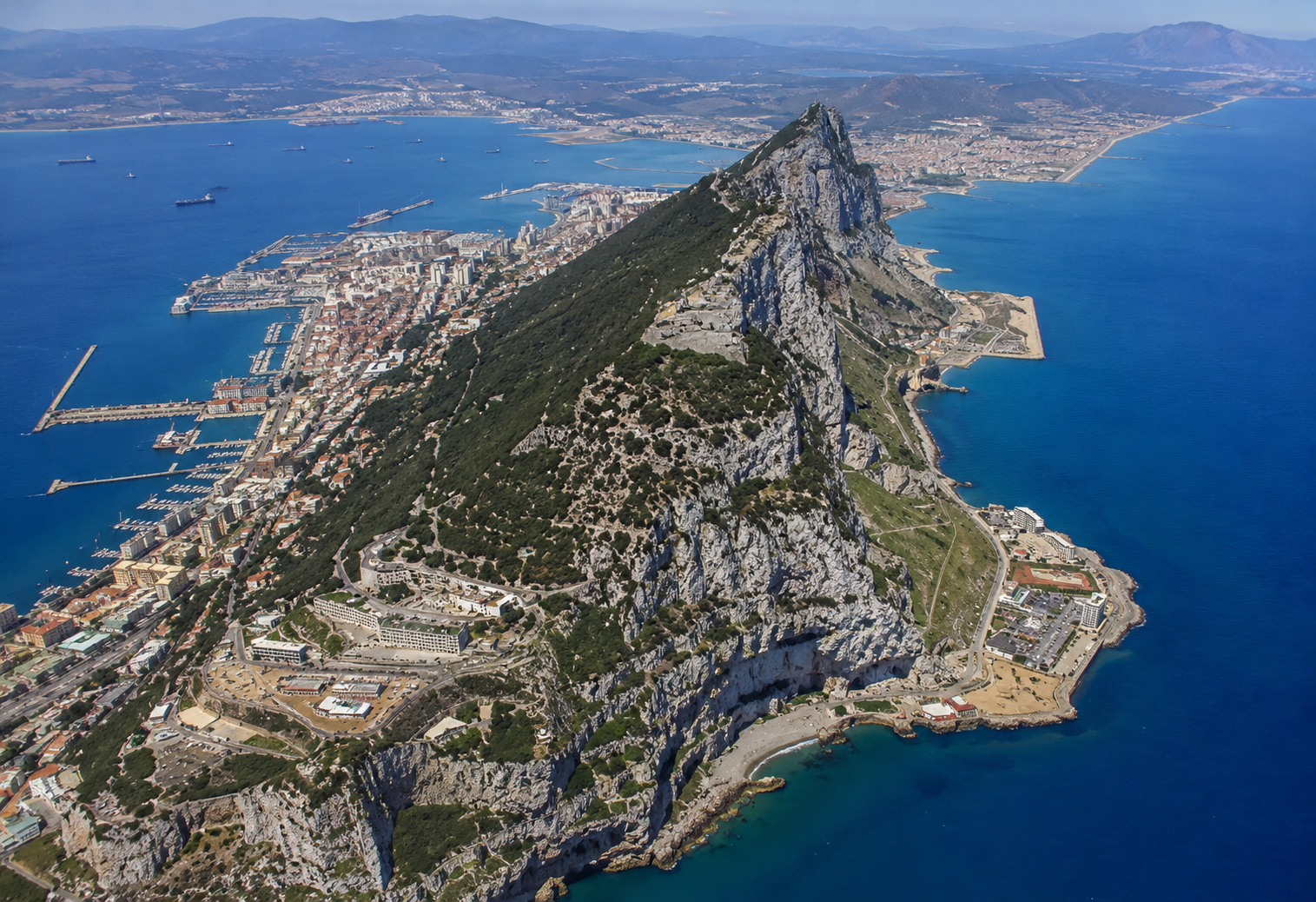
Gibraltar covers an area of less than seven square kilometres. Much of the territory is occupied by the Rock itself, while steep stretches of coastline, port facilities and dense development limit the number of possible landing points.
Immediately alongside it, meanwhile, lies the extensive coastline of southern Spain.
For a small boat crossing from North Africa, reaching a broad stretch of the Andalusian coast is considerably easier than aiming for such a small and specific target.
The Strait route itself has also declined considerably in importance. According to figures cited from CEAR’s 2026 annual report, only around one per cent of irregular arrivals in Spain in 2025 came via the Strait of Gibraltar route.
Little room to disappear
Gibraltar’s tiny size also matters once somebody has landed.
In 2016, for example, nine North African migrants reached Gibraltar’s eastern side in an inflatable boat. Some attempted to hide in the surrounding terrain.
Police, Customs, Borders and Coastguard officers and other security services launched a search. All nine were located that same day.
The Gibraltar Chronicle noted at the time that such landings on the Rock were unusual and that most migrants crossing the Strait were attempting to reach the Spanish coast.
The shortest crossing is not necessarily the preferred one
Migration routes are not determined simply by which piece of European territory is closest.
Existing routes, people-smuggling networks, family or community connections, transport links and the intended final destination can all influence where people attempt to land.
One case investigated by the Royal Gibraltar Police illustrates the point particularly well.
Working with Spain’s Policía Nacional, officers dismantled an organised network that brought migrants legally into Gibraltar before smuggling them across the border into Spain. From there, they were provided with bus tickets to destinations in Spain and elsewhere in Europe.
The case demonstrates that Gibraltar can form part of a migration route – but sometimes as a transit point rather than the final destination.
What happens when migrants do reach Gibraltar?
Gibraltar has its own immigration and asylum legislation.
Unauthorised entry can trigger immigration proceedings and, depending on the individual circumstances, a person may be arrested, temporarily detained or subject to removal procedures.
However, it would be inaccurate to suggest that every migrant entering Gibraltar irregularly is automatically sent to prison.
Gibraltar also has its own asylum system. Those seeking international protection are entitled to have their applications considered under the applicable legislation.
There is therefore insufficient evidence to claim that migrants generally avoid Gibraltar simply because its immigration laws are more punitive.
What about unaccompanied minors?
There are specific safeguards for unaccompanied minors seeking asylum in Gibraltar.
The asylum regulations provide additional protections, including the appointment of an appropriate representative or guardian to assist the child during the procedure.
There are also specific provisions concerning accommodation. Depending on the circumstances, minors should be housed with adult relatives, with a foster family or in accommodation suitable for children. Those aged 16 or over may, under certain circumstances, be accommodated in facilities used for adult asylum seekers.
Authorities should also seek to trace members of the child’s family where this can be done safely, while siblings should, as far as possible, be kept together.
Where there are doubts over a person’s age, a medical age assessment may be requested. Refusing such an examination, however, cannot on its own constitute grounds for rejecting an asylum application.
The rules therefore provide no obvious basis for concluding that unaccompanied minors avoid Gibraltar because of an exceptionally harsh asylum regime.
Gibraltar itself has acknowledged its limitations
The territory’s physical limitations have previously been highlighted by Gibraltar’s own government.
When speculation emerged in 2021 that the UK might process asylum seekers in Gibraltar, the Gibraltar Government rejected the suggestion. Chief Minister Fabian Picardo cited, among other factors, the territory’s geographical constraints.
For a territory of less than seven square kilometres, those limitations are obvious.
So why Spain rather than Gibraltar?
There is no single officially established explanation.
Instead, several factors appear to combine. Spain offers a vastly longer coastline and far more potential landing points. It also has established migration and transport routes, while Gibraltar is a tiny territory with its own police, border and immigration authorities.
Documented cases also suggest that some migrants who have reached Gibraltar did not regard it as their final destination and instead sought to continue into Spain and, potentially, elsewhere in Europe.
That is what makes Gibraltar’s position so intriguing.
It lies just a few miles from Africa and directly on one of the world’s most famous maritime crossings – yet major migrant arrivals largely pass it by.
Geographically, Gibraltar looks like an obvious gateway into Europe. In practice, however, Spain remains the far more significant destination.