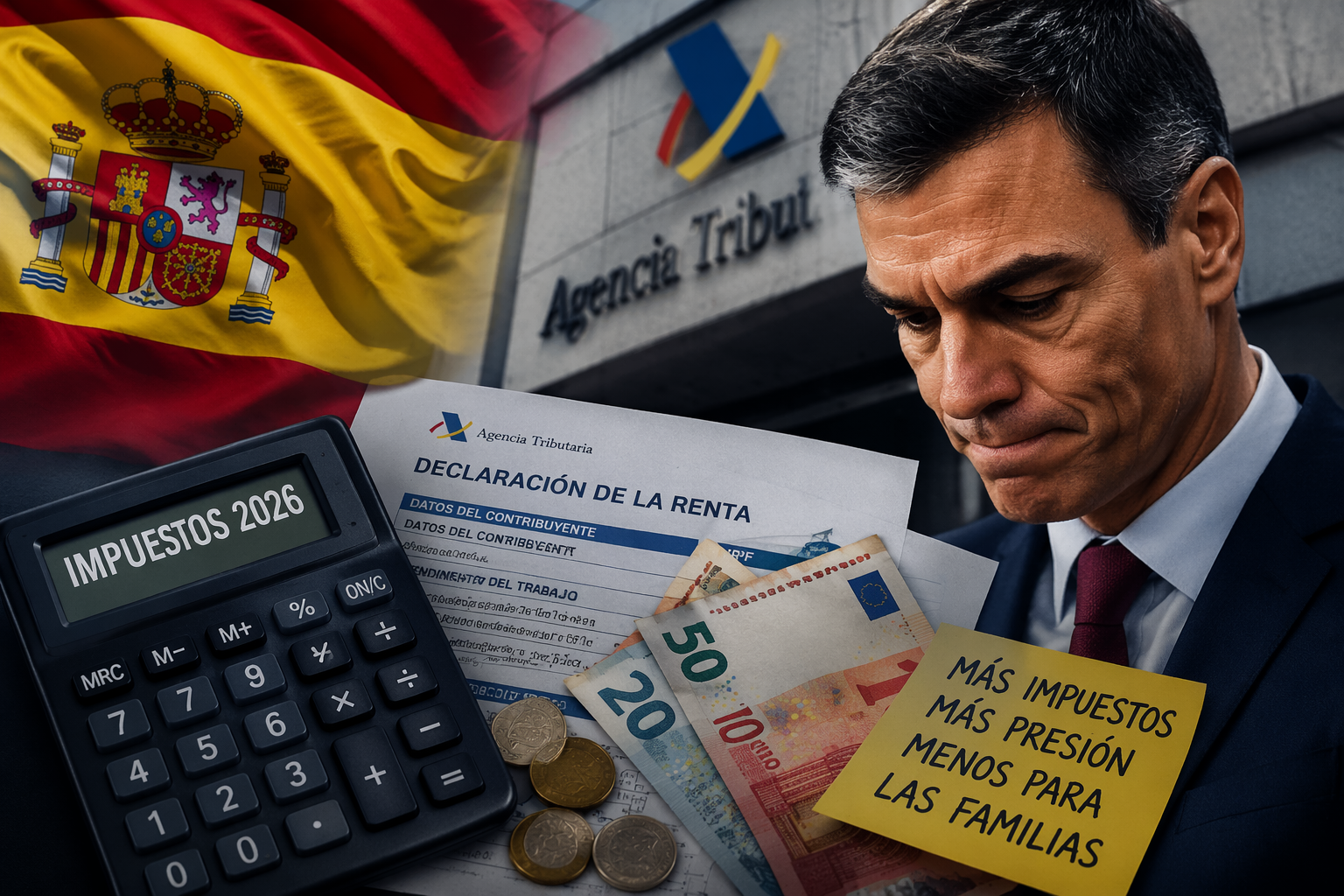
Spain is entering a new tax campaign with a reality that is increasingly difficult to ignore: the country’s fiscal burden has reached record levels. Since Pedro Sánchez came to power, government revenues have consistently risen, marking an unprecedented period in recent economic history.
According to recent estimates, total tax revenues and social security contributions have already exceeded €591 billion, representing more than 37 per cent of GDP. Projections suggest this figure could climb close to 38 per cent in the coming years, confirming the current period as one of the most significant fiscal expansions in modern Spain.
Spain Expat Press Editorial Team
More revenue for the state, greater pressure on households
Behind these record figures lies a much more tangible reality for millions of citizens: households are paying more than ever before. Since 2018, the direct tax burden on families has increased significantly, driven primarily by income tax (IRPF) and social security contributions.
In practical terms, this means less disposable income. Importantly, the rise has not been solely due to explicit tax increases. Inflation has played a key role, as income tax brackets have not been fully adjusted, pushing many taxpayers into higher bands without a corresponding increase in real purchasing power.
The result is what many analysts describe as a “silent” tax increase, affecting primarily workers and the middle classes.
Labour at the centre of the tax burden
A defining feature of Spain’s rising fiscal pressure is its strong link to employment. Most of the increase in recent years has come from taxes and contributions tied directly to labour income.
This means that an increasing share of earnings is absorbed by the state. Spain’s tax wedge — the difference between what employers pay and what employees take home — remains among the highest in Europe.
In practice, this translates into lower net salaries for workers and higher costs for businesses.
Spain diverges from European trends
While Spain has been increasing its tax burden, several other European countries have taken a different path. In recent years, a number of EU economies have slightly reduced their tax pressure in an effort to support households and businesses.
Spain, by contrast, has moved in the opposite direction. Its convergence with Europe has been driven not by rising income levels, but by higher taxation. This implies a growing relative fiscal effort for Spanish taxpayers compared to their European counterparts.
A lifetime tax bill
The impact of this trend extends far beyond the present. Over the course of a lifetime, an average citizen in Spain is expected to pay a substantial amount in taxes.
This total often equates to decades of full income. Moreover, the tax burden does not disappear upon retirement, as a significant share of taxes continues to be paid after the age of 65.
Rising revenues and expanding public spending
The increase in tax revenues has been accompanied by a notable rise in public expenditure, which now exceeds €725 billion.
Pensions account for the largest share of this spending, followed by healthcare and economic items such as subsidies and infrastructure. A considerable portion of the additional expenditure in recent years has been allocated to sustaining the pension system.
A system at its limits?
Overall, the picture is clear: Spain is operating at historic highs in both tax revenue and fiscal pressure. The system is running at full capacity, driven by economic growth, inflation and a tax structure heavily reliant on labour income.
The key question remains: how sustainable is this model in the long term — and who will ultimately bear the greatest share of the burden?