Hundreds of rallies are planned across the country on 2 September in solidarity with Ceuta. But Spain’s governing Socialist party has instructed its public representatives not to attend, arguing that the demonstrations have been politically exploited by the conservative opposition.
Spain Expat Press Editorial Team
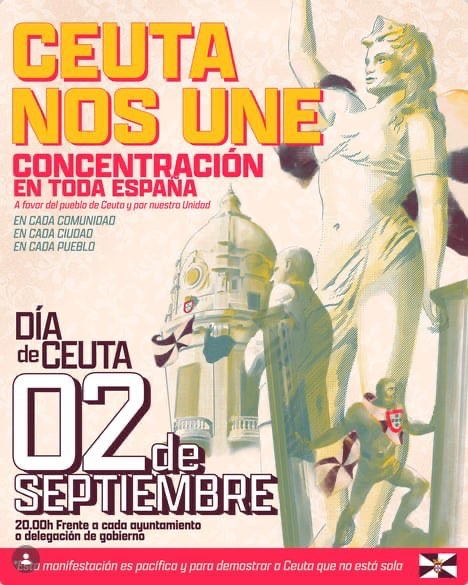
Spain is preparing for a nationwide show of solidarity with Ceuta on Wednesday 2 September, with hundreds of gatherings expected to take place from Andalusia and Madrid to Valencia, Catalonia and the Balearic Islands.
The citizens’ initiative Ceuta nos une says 317 rallies have now been confirmed across 46 of Spain’s 52 provinces, most of them scheduled for 8pm outside town and city halls.
The choice of date is deliberate: 2 September marks Ceuta Day, the annual celebration of the Spanish autonomous city on the north African coast.
After weeks of mounting tension surrounding the migration crisis in Ceuta, organisers say the demonstrations are intended to send a simple message to its residents:
Ceuta is not alone.
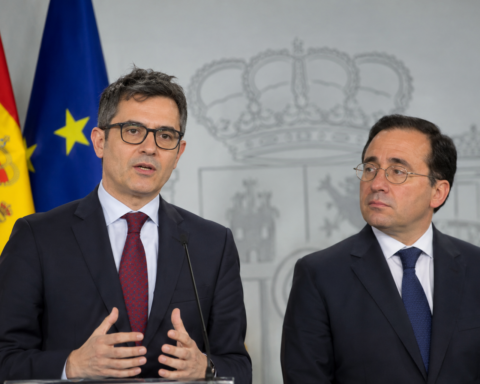
Yet the initiative has become embroiled in an increasingly bitter political dispute after the Spanish Socialist Workers’ party (PSOE), led by the prime minister, Pedro Sánchez, instructed its representatives not to take part.
Socialists told to stay away
The PSOE’s national headquarters in Madrid sent a circular on 29 August to regional party leaders, organisational secretaries, municipal representatives and other senior officials setting out its position.
The message was clear: Socialist representatives should not participate in the demonstrations on 2 September.
The party insists its decision should not be interpreted as a refusal to support Ceuta. Instead, it accuses the conservative People’s party (PP) of turning the demonstrations into a political weapon against Sánchez’s government.
Socialist officials argue that María José García-Pelayo, the PP politician who heads Spain’s Federation of Municipalities and Provinces (FEMP), backed the initiative without first securing agreement among the other political groups represented within the organisation.
The PSOE has accused the PP of using both the FEMP and regional municipal organisations to increase pressure on the government over its handling of the situation in Ceuta.
Its position has been summed up in the phrase:
“Ceuta sí. Su utilización partidista, no.”
Or, in English: “Yes to Ceuta. No to its partisan exploitation.”
But who owns a demonstration of solidarity?
That argument lies at the heart of the controversy now surrounding Wednesday’s rallies.
Calls for people to show their support for Ceuta did not initially emerge from the headquarters of a political party. They spread through social media and among Ceutans living elsewhere in Spain before being formally backed by the FEMP.
García-Pelayo subsequently called on Spain’s 8,132 municipalities to show their solidarity by gathering outside their town halls at 8pm on 2 September.
The citizens’ platform Ceuta nos une describes the events as peaceful, free and open to everyone, under the slogan:
“For the people of Ceuta and for our unity.”
More than 300 locations have now confirmed gatherings, according to the organisers.
From Madrid to Marbella
The geographical scale of the initiative is striking.
Earlier counts put the number of municipalities backing demonstrations at more than 260, while organisers subsequently raised the figure to 317 confirmed events.
Madrid, Barcelona, Valencia, Seville, Málaga, Marbella, Alicante, Murcia, Bilbao, San Sebastián, Vitoria, Valladolid, Salamanca, Santander, Oviedo, Gijón, Palma and Ibiza are among the cities where gatherings have been announced.
Most will take place outside town and city halls.
In Madrid, however, the main gathering is due to be held outside the Congress of Deputies, the lower house of the Spanish parliament.
Signs of unease within the PSOE
The decision taken by the Socialist leadership is potentially awkward for the party because not all of its local representatives appear equally willing to follow Madrid’s line.
In Ceuta itself, Socialist politicians have indicated that they intend to participate despite the position adopted by the national leadership.
There have also been signs of disagreement at municipal level.
In Espartinas, near Seville, where the PSOE governs the town council, a solidarity gathering under the banner Espartinas con Ceuta had already been announced.
It raises an uncomfortable question for the party leadership: what happens if Socialist mayors, councillors and other elected officials decide to stand alongside their residents on Wednesday regardless of the instructions from Madrid?
Feijóo urges Spaniards to attend
While the Socialists have chosen to keep their distance, the PP leader, Alberto Núñez Feijóo, has publicly encouraged Spaniards to take part.
Feijóo himself is expected to attend the gathering in Ceuta.
His involvement inevitably gives a political dimension to an initiative that organisers present primarily as a civic expression of solidarity.
For the PSOE, that reinforces its argument that the demonstrations have been appropriated by the opposition.
The PP, by contrast, argues that the issue goes beyond party politics and that Spain should stand behind one of its cities at an exceptionally difficult moment.
The FEMP itself describes the gatherings as an expression of solidarity and support for Ceuta and its people.
Solidarity or party politics?
Spain therefore approaches 2 September with an unusual political divide.
On one side, people in hundreds of towns and cities are being encouraged to gather peacefully outside their town halls in support of Ceuta.
On the other, the country’s governing Socialist party is asking its own representatives to stay away.
The PSOE maintains that it supports Ceuta while refusing to participate in what it regards as the political exploitation of the crisis.
Its critics see a more fundamental contradiction: if hundreds of communities are gathering in solidarity with a Spanish city, should party politics determine who stands among them?
That question is likely to become more prominent as Wednesday approaches.
The true scale of the mobilisation will only become clear on the evening of 2 September.
And so too will the political consequences of a day intended to unite Spain around Ceuta, but which has instead exposed yet another dividing line in Spanish politics.