Paella, tortilla, jamón ibérico and tapas are familiar to almost anyone who has spent time in Spain. Yet another stalwart of Spanish cooking remains surprisingly overlooked beyond the country’s borders: the empanada. Golden from the oven, generously filled and made in countless variations, it is one of Spain’s great culinary traditions – and arguably one of its most underrated.
Spain Expat Press Editorial Team
Ask a visitor to name the dishes they associate with Spain and the answers are fairly predictable: paella, tortilla de patatas, gazpacho, perhaps a plate of jamón and, inevitably, tapas.
The empanada rarely makes the list.
That is curious, because in northern Spain – and above all in Galicia – it has been part of the culinary landscape for centuries.
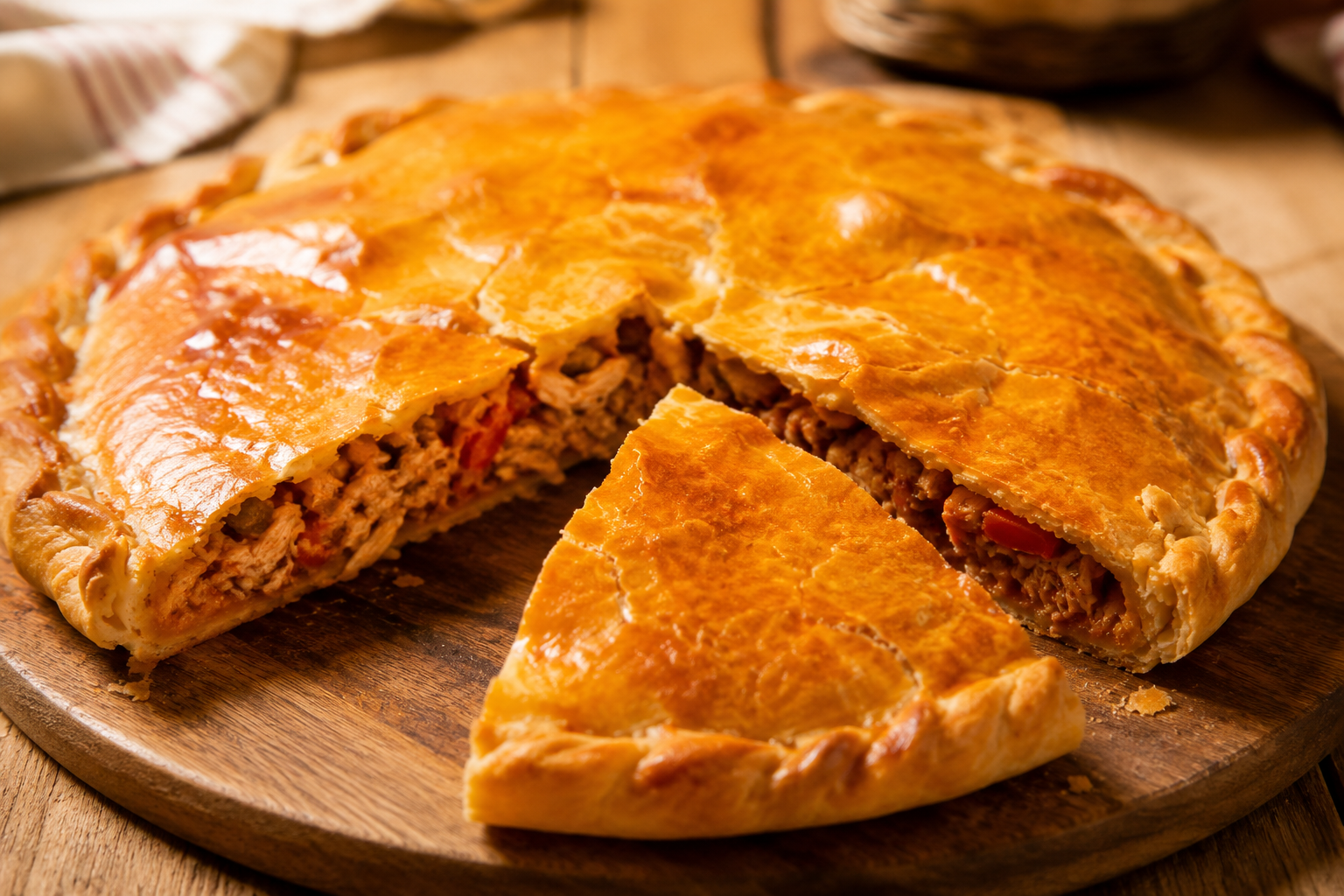
At its simplest, an empanada is wonderfully uncomplicated: a savoury filling enclosed between layers of pastry and baked until golden. Yet that simplicity conceals an extraordinary variety of ingredients, textures and regional traditions.
Galicia, the Spanish home of the empanada
No part of Spain is more closely associated with the empanada than Galicia.
Filled pastries have existed on the Iberian peninsula for centuries, but in Galicia the empanada developed into something distinctly its own.
Historically, it was an eminently practical food. Empanadas could be found in inns and monasteries and provided a convenient meal for travellers and pilgrims making their way towards Santiago de Compostela.
The pastry protected the filling, the finished dish travelled well and, perhaps most importantly, it could feed several people.
That communal quality remains fundamental to the way the empanada is eaten today.
A large one is placed on the table, cut into pieces and shared.
From tuna to octopus: there is no single empanada
Outside Spain, those who have encountered a Spanish empanada may well associate it with the familiar combination of tuna, tomato, onion and peppers.
It is a classic, certainly. But it barely scratches the surface.
In Galicia, the contents of an empanada often reflect the landscape surrounding the kitchen in which it was made.
Along the coast, fillings can include sardines, mussels, cockles, scallops, cuttlefish, cod or octopus.
One of the more striking versions is made with chocos, or cuttlefish. Its ink can give the filling – and sometimes the pastry itself – a dramatic dark appearance.
Away from the sea there are versions filled with pork, beef, chicken, chorizo or vegetables.
The pastry changes too. Wheat flour is common, but traditional empanadas can also be made using maize or rye flour.
It is, in other words, a dish shaped by its surroundings: seafood beside the Atlantic; meat and vegetables further inland.
Food made for sharing
Part of the empanada’s charm lies not simply in what is inside it, but in how it arrives at the table.
A traditional Spanish empanada is not usually an individual portion. It is baked large and then divided.
It appears at family lunches, village celebrations, picnics and gatherings, but is equally at home on the counter of an ordinary Galician bakery.
Its cultural importance is such that it even has festivals devoted to it.
In Bandeira, in the Pontevedra province, the Festa da Empanada has been held since 1974. Restaurants and home cooks compete with their recipes in a celebration that has been officially recognised as a Festival of National Tourist Interest.
In Galicia, the empanada is not merely something to eat.
It is part of the region’s identity.
Empanada or empanadilla? They are not the same thing
This is where things can become confusing for visitors.
An empanada and an empanadilla are not simply two names for the same food.
A traditional Spanish empanada – particularly the Galician variety – is generally a large, round or rectangular pie. A layer of pastry forms the base, the filling is spread across it and another layer seals the top. It is baked whole and cut into portions afterwards.
An empanadilla, by contrast, is much smaller. A single piece of pastry is filled, folded over and sealed, usually forming a half-moon shape. In Spain, versions containing tuna, tomato and egg are particularly familiar, and they can be either baked or fried.
Then there are the celebrated Argentinian empanadas, which belong to the same broad family of filled pastries but have developed into a culinary tradition in their own right, with recipes varying considerably from one region of Argentina to another.
Order an empanada in a traditional Galician bakery, therefore, and what arrives is likely to be quite different from the small, crescent-shaped pastries many international diners associate with the word.
So how should you eat it?
Fortunately, there is very little ceremony involved.
A large empanada is usually cut into squares, rectangles or triangular slices before being served on a platter or brought to the table.
Nor does it need to be eaten piping hot.
Indeed, a good empanada can be excellent warm, at room temperature or even cold. That versatility is precisely what has made it such practical food for journeys, celebrations, picnics and days at the beach.
Smaller pieces are perfectly acceptable to eat with your hands. For a particularly generous or juicy filling, however, a plate, knife and fork may save your shirt.
It can be served as a starter or as part of a larger shared meal, while a substantial slice accompanied by a salad can easily become lunch in its own right.
Perhaps the best way to eat it, though, is also the simplest: place a large empanada in the middle of the table and let everybody help themselves.
And what should you drink with it?
For that, it makes sense to stay in Galicia.
Few things accompany a Galician seafood empanada better than a chilled local white wine.
An Albariño from Rías Baixas is an excellent partner for empanadas filled with tuna, bonito, octopus, scallops or other seafood. Its freshness and acidity work particularly well with flavours from the Atlantic.
A Godello can be a fine match for cod, while a fresh Ribeiro is another excellent option.
With richer fillings of pork, chorizo or other meats, a young red can work beautifully. A Mencía from Ribeira Sacra has enough character to stand alongside the filling without overwhelming it.
And wine is hardly compulsory.
A cold Spanish beer and a slice of empanada on a hot summer afternoon can be every bit as satisfying.
An empanada, a glass of Albariño, somewhere shady to sit and nowhere urgent to be: Spanish cooking does not always need to be complicated.
Why do so few visitors know about it?
That may be the most surprising part of the story.
Millions of people visit Spain every year. They eat paella, order tapas, try jamón ibérico and sooner or later find themselves drawn into the eternal debate over whether a tortilla de patatas should contain onions.
Yet the empanada remains relatively unknown internationally.
Perhaps that is because it has never become a stereotypical tourist-restaurant dish. You are often more likely to encounter a good one where Spaniards themselves shop and eat: in bakeries, markets and traditional food shops, or on the table at a family gathering.
And that may also be precisely why it is worth seeking out.
Few dishes express the pleasures of Spanish food quite so simply: good ingredients, local produce, recipes passed between generations and something substantial placed in the middle of a table for everyone to share.
One to remember for your next trip to Spain
Anyone hoping to explore Spanish food beyond its internationally famous dishes should not stop at paella, tapas and tortilla.
And in Galicia, trying a proper empanada ought to be considered essential.
Choose one filled with tuna and peppers, octopus, sardines, scallops or perhaps slow-cooked meat. Add a glass of Albariño or a cold beer and you have something that can be surprisingly difficult to find in the restaurants designed primarily for visitors: an uncomplicated taste of everyday Spanish food culture.
Sometimes the dishes that tell us most about a country are not the ones that became famous abroad.
The empanada is undoubtedly one of them.