A duchess with a German name, one of Spain’s most famous aristocratic houses with English roots, palaces filled with art – and a younger generation increasingly at home on Instagram. Spain’s aristocracy may have lost most of its old privileges, but that does not mean it has become irrelevant. Spain Expat Press takes a closer look at a remarkably enduring world.
Spain Expat Press Editorial Team
Walk past Madrid’s Palacio de Liria or visit the Palacio de las Dueñas in Seville and it quickly becomes apparent that Spain’s aristocracy does not exist only in history books.
The houses are still there. The families are still there. In some cases, works of art have hung on the same walls for generations. And names such as Alba, Medinaceli, Osuna and Híjar continue to resonate in Spain.
Of course, this world is no longer what it was 300 years ago.
A duke cannot tell anyone what to do simply because he is a duke. A count enjoys no special political rights. Nor does being a Grande de España place somebody above their fellow citizens before the law.
But it would be equally misleading to conclude that these names no longer matter at all.
History leaves behind more than titles.
It can also leave houses, land, art, education, connections – and networks built up over generations.
And occasionally, a rather unexpected surname.
A Spanish duchess called von Hohenlohe-Langenburg
One of the first surprises can be found at the very top of one of Spain’s most important aristocratic houses.
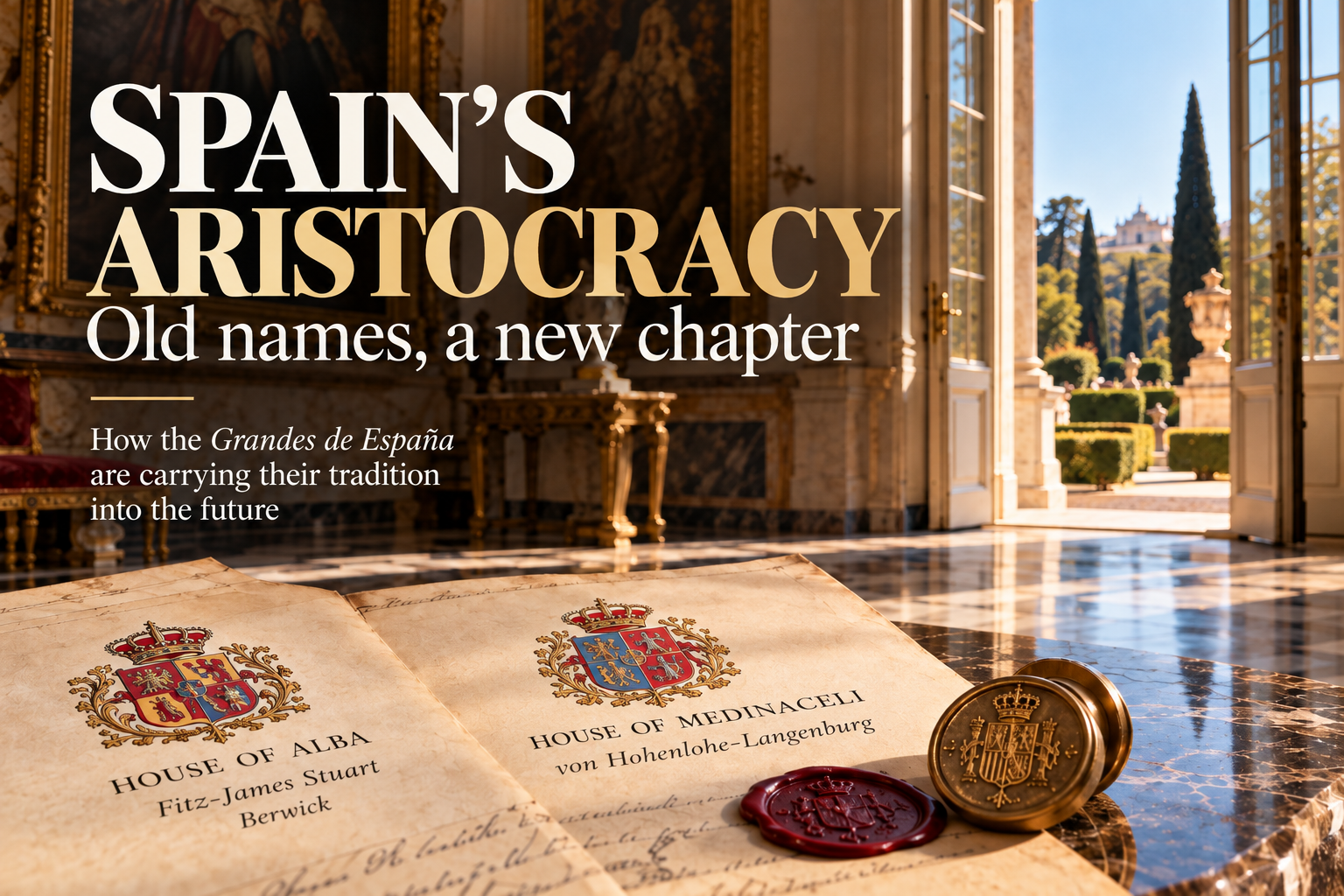
The current Duchess of Medinaceli is Victoria Elisabeth von Hohenlohe-Langenburg.
It is hardly the name one might expect to find attached to one of Spain’s most historic dukedoms.
Her paternal family name comes from the old German princely house of Hohenlohe-Langenburg.
In other words, one of Spain’s great historical dynasties is today headed by a woman carrying one of the classic names of the German aristocracy.
The House of Alba is no less international.
Its current head is Carlos Fitz-James Stuart y Martínez de Irujo, Duke of Alba.
Fitz-James Stuart sounds rather more British than Castilian – and for good reason.
The story leads back to England.
The title Duke of Berwick was created in the 17th century for James FitzJames, an illegitimate son of King James II of England. His descendants eventually established themselves in Spain, and the histories of the Berwick and Alba families became intertwined.
That is why the Duke of Alba still carries the Fitz-James Stuart name today.
Spain’s highest aristocracy was European long before anyone spoke about European integration.
For centuries, Spanish families married into German, British, French and Italian dynasties. Titles, surnames and fortunes crossed borders with them.
So who actually sits at the top?
Trying to understand Spain’s aristocratic hierarchy can become confusing remarkably quickly.
In simplified terms, the traditional order is:
Duque – Marqués – Conde – Vizconde – Barón.
Duke, marquess, count, viscount and baron.
It would therefore be reasonable to assume that a duke automatically occupies the very top.
Almost.
Because Spain has another distinction that many foreigners have never heard of:
Grande de España – Grandee of Spain.
The Grandeza de España is not simply another rung on the aristocratic ladder. It is a specific historical dignity, traditionally regarded as the highest within the Spanish nobility.
And this is where things become interesting.
A duke may be a Grandee of Spain, but a marquess or a count can hold the dignity too.
Among the best-known historic houses and titles associated with the Grandeza are Alba, Medinaceli, Infantado, Osuna, Híjar, Frías, Fernán Núñez, Villahermosa and Arcos.
There are also numerous marquessates and counties carrying the Grandeza de España.
These names run through Spanish history.
The Mendozas and the Infantado. The Osunas, famously painted by Goya. The Fernández de Velasco family and the Dukes of Frías. Alba, Medinaceli and Híjar.
Centuries ago, names such as these could mean genuine political power.
Today, things are rather different.
No privileges – but no advantages either?
Legally, the position is fairly straightforward.
An aristocratic title provides no special political authority in modern Spain. A Grandee does not get an extra vote, a duke cannot claim governing powers on the strength of his title, and aristocrats do not enjoy a separate legal status simply because of their ancestry.
The old legal privileges have largely disappeared.
But this is where the story becomes more complicated.
Losing legal privileges does not necessarily mean losing everything that generations of privilege left behind.
For centuries, many of these families had access to exceptional education, royal courts, diplomacy, the military, business and international social circles.
Networks like these do not simply disappear when the law changes.
And then, of course, there is wealth.
Not every Spanish aristocrat is rich. That is worth stressing.
Some families have lost substantial parts of their fortunes. Estates have been divided, properties sold and inheritances split between descendants. Maintaining a vast historic palace can itself become more of a financial burden than a luxury.
Others, however, have preserved a remarkable amount.
The House of Alba is perhaps the most famous example.
The family is associated with some of Spain’s best-known aristocratic residences, including the Palacio de Liria in Madrid and the Palacio de las Dueñas in Seville, as well as historic archives, furniture and an important art collection.
In houses like these, history is not abstract.
It literally hangs on the walls.
And that is perhaps where the distinction lies between an aristocratic title and everything that may accompany it.
A title alone no longer makes anybody powerful.
But a famous surname, an excellent education, an international network and perhaps a fortune accumulated over generations can undoubtedly open doors.
That is not unique to aristocrats.
In their case, however, that social capital can be several centuries old.
Why is Leonor a princess while Sofía is an infanta?
Then there is Spain’s Royal Family – and a question that regularly confuses foreigners.
King Felipe VI has two daughters.
So why is one a princess and the other not?
Leonor is Princess of Asturias.
Her younger sister Sofía is Infanta of Spain.
It has nothing to do with Leonor being considered the “more important” daughter.
The title Prince or Princess of Asturias belongs to the heir to the Spanish throne.
Leonor is currently the heir and therefore Princess of Asturias.
Sofía is also the King’s daughter, but she is not the current heir. She is therefore Infanta Sofía of Spain.
The same explains why Felipe VI’s sisters, Elena and Cristina, are infantas rather than princesses of Spain.
The word infanta can sound unusual to British ears, but it is a traditional and specific Spanish royal dignity.
And then comes another surprise.
The children of an infanta do not automatically become infantes themselves.
That is why Victoria Federica and Felipe Juan Froilán, the children of Infanta Elena, are neither princess and prince nor infanta and infante.
Under Spain’s rules, however, the children of infantes have the consideration of Grandes de España, together with the style of Excelencia.
Aristocratic titles are still inherited today
This also surprises many people.
Spanish titles do not simply survive as words beneath portraits of long-dead ancestors.
When a title holder dies, succession to the title can still be formally requested, and the corresponding procedures continue to appear in Spain’s official state gazette, the Boletín Oficial del Estado.
The system has changed with the times, however.
Since 2006, men and women are generally treated equally in succession to Spanish hereditary titles.
A younger brother can therefore no longer take precedence over his older sister simply because he is male.
Even a centuries-old aristocratic system has had to modernise.
Beltrán, Rodrigo, Jacobo, Casilda and Mencía – even the names sound different
There is another small detail that becomes difficult to ignore if you regularly read Spain’s society pages.
The first names.
There are, of course, no official “aristocratic names”.
And not every Rodrigo or Jimena comes from an aristocratic family.
Yet certain traditional names appear remarkably often among old Spanish families.
For men:
Beltrán, Rodrigo, Jacobo, Íñigo, Álvaro, Gonzalo, Alonso, Pelayo, Tristán and Luis.
For women:
Casilda, Mencía, Jimena, Cayetana, Inés, Beatriz, Blanca and Constanza.
Read enough Spanish society magazines and you could occasionally be forgiven for thinking that half of Madrid is populated by men called Beltrán and Íñigo and women called Casilda and Mencía.
That should, of course, be taken with a smile.
But there is a tradition behind it.
Old families often pass down the names of grandparents, great-grandparents, godparents and historical ancestors from one generation to the next.
The result can be family naming traditions almost as recognisable as the surnames themselves.
One particularly famous example is Cayetana.
In Spain, the name became closely associated with Cayetana Fitz-James Stuart, the famously charismatic Duchess of Alba.
And somehow it suits this world.
It is not only houses, paintings and titles that are passed down.
Sometimes it is a Rodrigo, a Beltrán, a Casilda or a Mencía too.
From the palace to Instagram
And this brings us to perhaps the most unexpected transformation of all.
Part of the younger generation has discovered something their great-great-grandparents would probably have found completely baffling:
Instagram.
Some members and descendants of well-known families now attract public attention not because of court appointments or diplomatic positions, but through fashion, jewellery, art, interior design, travel and lifestyle.
One prominent example is Victoria Federica de Marichalar, granddaughter of former King Juan Carlos I and daughter of Infanta Elena.
She has developed a significant public profile in Spain’s fashion and lifestyle world.
Casilda Finat, meanwhile, has combined a traditional family background with modern entrepreneurship, building her own jewellery business.
Other descendants of old families work in art, design, agriculture, hospitality or the management of historic family estates.
And something interesting happens in the process:
the old surname itself can become a brand.
People want to see how these families live. Which antiques they keep. How they set a table. Which houses they restore. How they combine inherited furniture with contemporary art.
And surprisingly often, it is not ostentatious luxury that attracts the attention.
Quite the opposite.
The appeal lies in a difficult-to-define mixture of tradition, taste and effortless refinement.
A table that belonged to the grandparents.
A painting that was not bought to match the sofa but has hung in the family home for 150 years.
A house whose interior was not created in a single shopping season, but evolved over several generations.
That aesthetic happens to work remarkably well on social media.
Of course, this does not mean the entire Spanish aristocracy has suddenly become a collection of influencers.
Many old families remain extremely private and actively avoid publicity.
But a visible part of the younger generation has understood that social capital can now also become media reach.
So how powerful is Spain’s aristocracy today?
Perhaps “powerful” is no longer quite the right word.
A duke cannot make laws because he is a duke.
A Grandee of Spain has no additional political rights.
And a famous surname guarantees neither intelligence nor professional success.
But it would be equally unrealistic to pretend that background no longer matters.
Someone who begins life with a recognised family name, an excellent education, international contacts, established social networks and perhaps assets accumulated over generations is not necessarily starting from zero.
And perhaps that is the real story of Spain’s aristocracy in the 21st century.
The legal privileges have largely disappeared. Some of the social capital has remained.
Sometimes it has simply changed form.
In the past, a great name might open the doors of the royal court.
Today, that same name might open the door to a business, a fashion brand, a magazine – or hundreds of thousands of followers.
Alba, Medinaceli, Berwick, Hohenlohe: behind these names lies far more than Spanish nostalgia.
They tell the story of a European world in which families have crossed borders for centuries, married into other dynasties, inherited titles, lost or preserved fortunes and repeatedly adapted to changing times.
Spain’s aristocracy has lost much of its old power.
Its fascination, quite clearly, has not.