Hundreds of tents have appeared in the heart of the Spanish capital as campaigners demand indefinite rental contracts and a freeze on rents. Meanwhile, Pedro Sánchez’s government is scrambling to secure support for a new housing decree – as property prices continue to climb and landlords grow increasingly wary of the long-term rental market.
Spain Expat Press Editorial Team
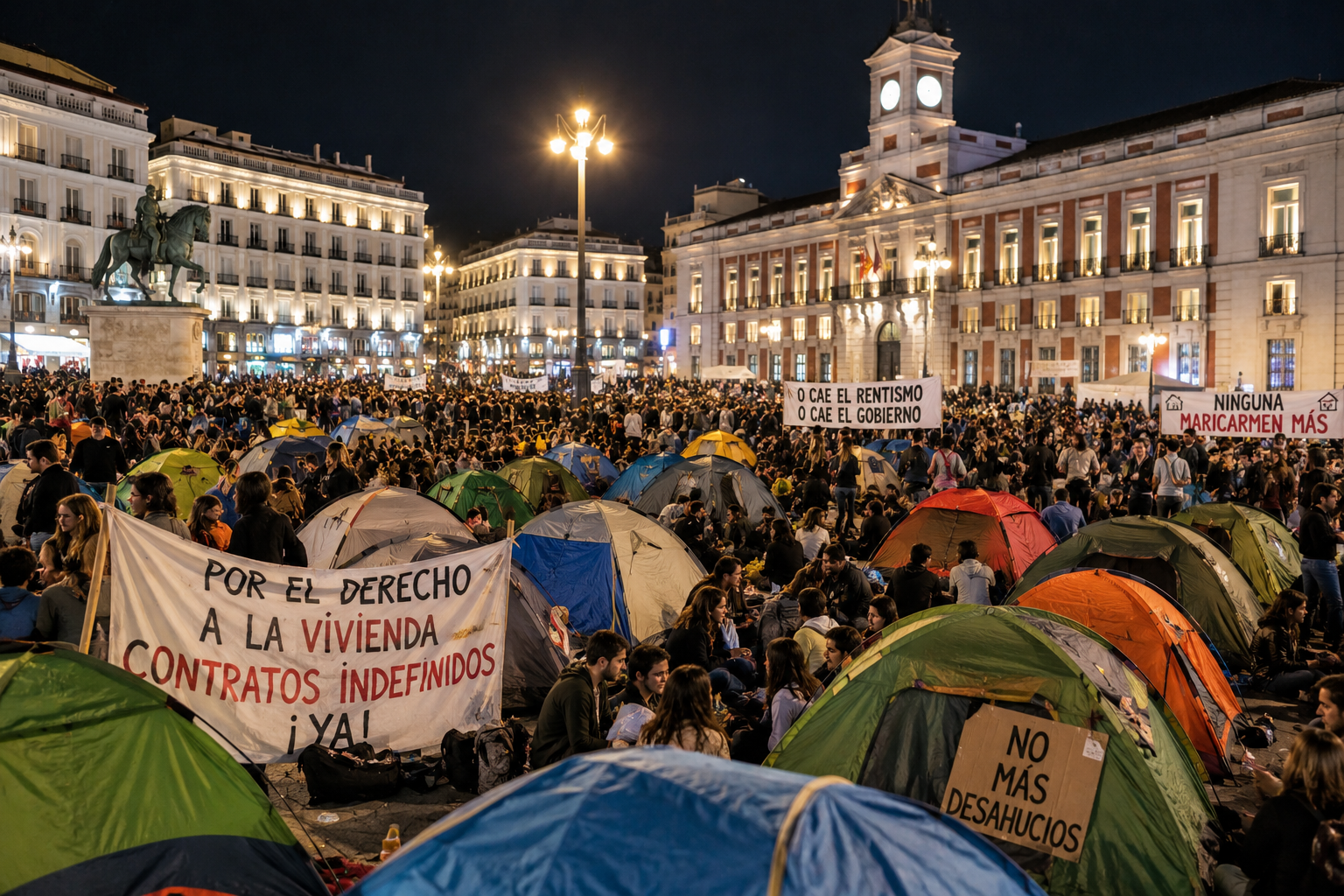
Madrid is witnessing scenes reminiscent of the indignados movement that occupied Puerta del Sol 15 years ago.
Hundreds of tents have been pitched in the square, where housing campaigners have vowed to remain as pressure mounts on the Spanish government ahead of a crucial cabinet meeting on Tuesday.
The immediate catalyst was the case of Maricarmen Abascal, an 87-year-old woman who was evicted from the Madrid home in which she had lived for about 70 years after a lengthy legal dispute.
Within days, her case had become a symbol of a much broader and increasingly bitter debate over housing in Spain: who should be protected, what rights landlords should retain and how far the state should intervene in the rental market.
Puerta del Sol becomes the centre of the protest
The Sindicato de Inquilinas, the tenants’ union behind the mobilisation, is demanding measures that go considerably further than those so far proposed by the government.
Among them are a freeze on existing rents and the automatic renewal of rental contracts – effectively allowing tenants to remain indefinitely provided they meet their contractual obligations.
Campaigners are also demanding tighter regulation of seasonal and room rentals and permanent mechanisms to prevent evictions.
Similar protests are spreading beyond Madrid. Demonstrations have also been announced in Barcelona, where tenants’ organisations have increased pressure on the government to include automatically renewable contracts in any new housing legislation.
But there is an important distinction: these are demands from the protest movement, not measures that have already been agreed by the Spanish government.
Indeed, the protesters are camping in Sol precisely because they want the government to go substantially further.
Sánchez faces a difficult political equation
While protesters sleep in tents a few hundred metres from Spain’s political institutions, negotiations behind the scenes are proving complicated.
Pedro Sánchez’s government hopes to approve a new package of housing measures at Tuesday’s cabinet meeting. But securing enough parliamentary support for it is another matter.
An earlier attempt involving an extraordinary extension of rental contracts was defeated in Congress in April after the conservative People’s party (PP), the far-right Vox party and the Catalan separatist Junts voted against it, while the Basque Nationalist party (PNV) abstained.
The same political divisions remain.
Junts has called for greater tax incentives for landlords and has questioned price controls, arguing that they do nothing to create additional housing.
Podemos is pushing in the opposite direction, demanding much greater intervention in the housing market and measures aimed particularly at large investment funds.
The PNV has argued that any extension of rental contracts should be subject to conditions, including tenants being up to date with their payments, while also insisting that the powers of Spain’s autonomous regions must be respected.
Finding a proposal capable of satisfying enough of these parties is proving extremely difficult.
And while politicians argue, property prices keep rising
Perhaps the most striking contradiction in Spain’s housing crisis is unfolding away from parliament and the protest camps.
While politicians and campaigners debate rent controls, evictions and contract extensions, Spain continues to face a fundamental shortage of housing.
According to Spain’s National Statistics Institute (INE), the price of existing homes has risen by 12.9% over the past year, compared with a 7.4% increase for newly built properties.
Existing homes are therefore rising in price at a rate roughly 74% higher than new-build properties.
Behind those figures lies a substantial imbalance between supply and demand.
The Bank of Spain estimates that between 2021 and 2025 the country accumulated a housing shortfall of as many as 750,000 properties compared with the number of new households being created.
More than 200,000 new households are being formed each year on average, while little more than 100,000 new homes are started annually.
In simple terms, Spain is creating households considerably faster than it is building homes.
Landlords become increasingly cautious
There is another element to the crisis that receives less attention: the response of property owners themselves.
It would be misleading to suggest that Spanish landlords as a whole are refusing to rent to vulnerable tenants. There is, however, evidence that owners are increasingly focused on reducing financial and legal risk.
Industry surveys suggest that avoiding non-payment and lengthy legal disputes has become a greater priority for many landlords than maximising their rental return.
Property professionals have also reported cases of owners choosing to sell rather than continue renting their homes on the conventional long-term market.
This presents policymakers with an uncomfortable dilemma.
If landlords believe that signing a long-term contract could ultimately leave them with less control over their property, selling, using the property themselves or choosing other legally permitted forms of rental become more attractive.
If that reduces the supply of permanent rental homes, competition for those remaining on the market become even more intense.
That does not mean stronger tenant protection inevitably reduces supply. But the potential reaction of landlords is one of the factors the government must consider when designing new rules.
Eight years on, the housing crisis remains
Sánchez has been Spain’s prime minister since June 2018. More than eight years later, housing has become one of the country’s most politically charged domestic issues.
It would be too simplistic to blame the entire crisis on the government.
Population growth, migration towards economically successful regions, tourism, years of insufficient construction, slow planning procedures, higher building costs and intense demand in cities and coastal areas have all contributed.
But the figures also point to an uncomfortable reality: despite successive interventions in the housing market, Spain has yet to resolve the fundamental imbalance between the number of homes available and the number of people looking for somewhere to live.
And the consequences are increasingly visible on both sides of the rental relationship.
Tenants fear they will no longer be able to afford their homes or will find nothing affordable when their contracts expire.
Landlords fear further restrictions, compulsory extensions and potentially lengthy legal disputes.
Meanwhile, housing continues to become more expensive.
Tuesday could prove crucial
For now, the tents remain in Puerta del Sol.
Campaigners are demanding substantially stronger state intervention, while the government is trying to find common ground between political parties whose ideas about housing policy are often fundamentally opposed.
The government’s proposals have included tighter regulation of seasonal and room rentals, tax incentives for some landlords and measures intended to increase the availability of affordable housing.
The demands coming from the streets go considerably further.
Whether a decree will finally emerge from Tuesday’s cabinet meeting, what it will contain and whether it can subsequently survive a vote in Congress remain open questions.
What is already clear is that the case of Maricarmen has brought a housing crisis that has been building for years back on to Spain’s streets.
The tents are in Puerta del Sol.
The negotiations are taking place behind government doors.
And house prices continue to rise.