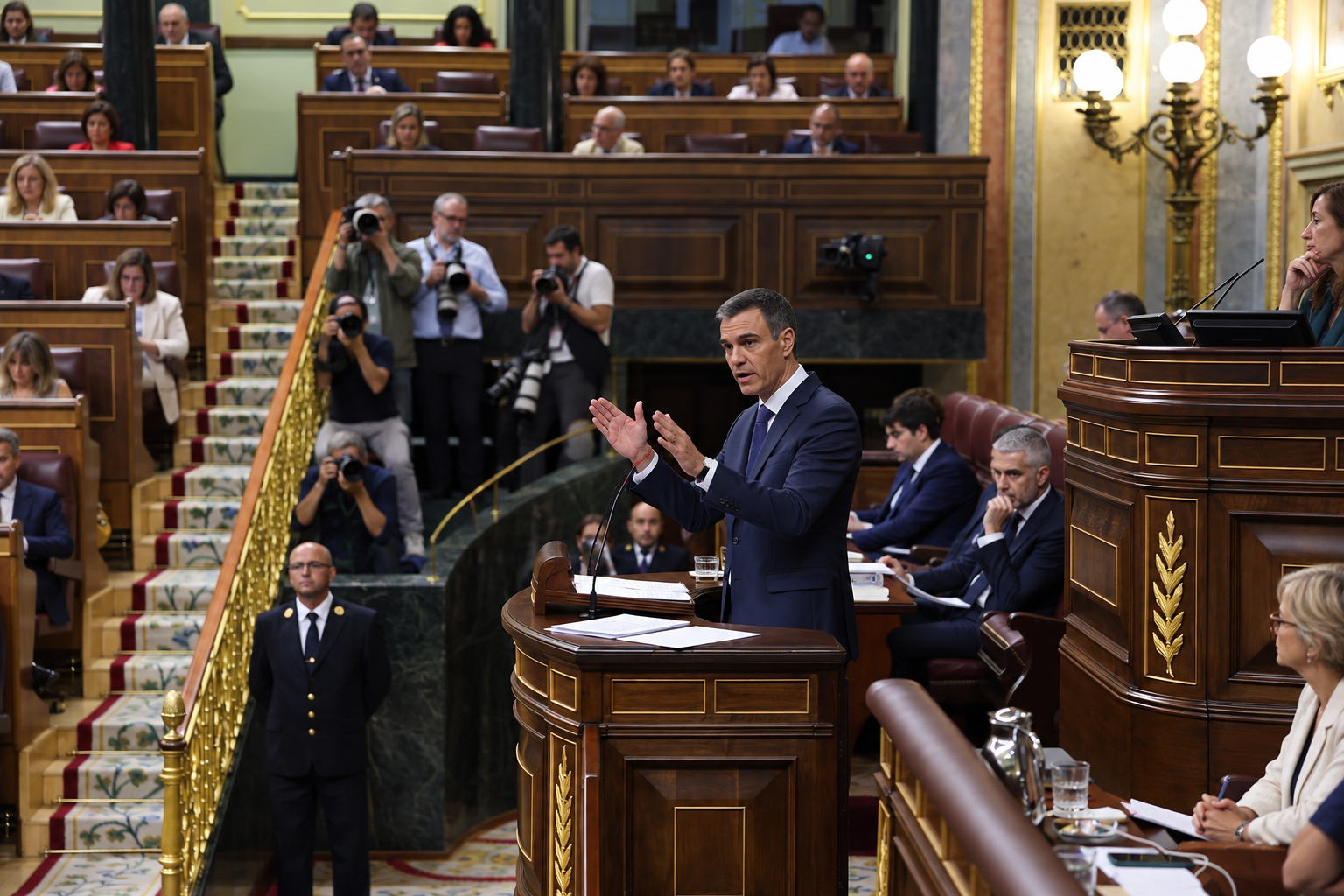
Yesterday’s debate in the Spanish parliament once again exposed just how far apart Madrid and Ceuta have become. While the government continues to frame the events primarily as a humanitarian crisis and rejects criticism of its handling of the situation, the opposition is accusing the state of a serious failure. Caught in the middle are the people of Ceuta – many angrier than ever and increasingly convinced that Madrid has failed to understand what their city has been through in recent weeks.
Spain Expat Press Editorial Team
The word that perhaps best describes yesterday’s debate is disconnect.
More than a month after the mass border crossing from Morocco, Ceuta is still struggling to return to normality. Thousands of migrants remain in the city, while residents continue to protest over the handling of the crisis.
And now, at a time when many people in Ceuta are demanding security, answers and political accountability, Madrid is debating how their fear should even be defined.
Interior Minister Fernando Grande-Marlaska once again referred in Congress to a “subjective feeling of insecurity”. He acknowledged that such feelings were understandable in the aftermath of what had happened, while rejecting the suggestion that Ceuta as a whole was unsafe or that all migrants represented a threat.
Politically, however, the choice of words could hardly have been more unfortunate.
Try telling people who have been protesting for weeks about the situation in their own city that their fear is “subjective”.
The reaction in Ceuta was hardly surprising. Residents publicly challenged the minister to come to the city himself and experience what everyday life currently feels like.
From ‘invaders’ to people fleeing hunger
The second major clash in the debate was about language – but it was also profoundly political.
Opposition politicians argued that what happened in Ceuta could not simply be described as an ordinary migration crisis. The word “invasion” was once again used by members of the Partido Popular, while Vox went considerably further in its rhetoric.
On the political left, the description could hardly be more different.
Yolanda Díaz referred to those who lost their lives during the crisis and explicitly criticised the use of the word “invaders”. She spoke instead of people arriving in Spain because of hardship and hunger. Other figures on the left similarly focused on minors, families and people living in desperate circumstances.
That humanitarian reality should not be denied.
Among those who crossed the border are minors, families and people who genuinely come from poverty, a lack of prospects or desperate circumstances.
But there is another reality that should not be allowed to disappear from the debate either: A Spanish – and therefore European – external border was overwhelmed by an exceptionally large number of people within a very short period of time and it is perfectly possible to defend the dignity of every individual who crossed that border while also expecting the state to control its borders and protect the population living behind them.
That simple distinction increasingly appears to have been lost in Spain’s political debate.
The released documents raise further questions
The publication of numerous documents relating to the Ceuta crisis has done little to settle the political controversy. If anything, it has raised further questions.
The documents indicate that, before the mass crossings took place, there had already been warnings about calls circulating on social media encouraging attempts to enter Ceuta, as well as signs of mounting migratory pressure. The government argues that this information was nowhere near sufficient to predict the eventual scale of what followed.
That distinction matters. There is, so far, no evidence that the Spanish government knew in advance that tens of thousands of people would attempt to cross the border.
But it would be equally wrong to suggest that there had been no warning signs. There were.
Pedro Sánchez himself has since acknowledged that Spain needs to improve its capacity for “anticipation and prevention” in crises of this kind and prepare more effectively for possible hybrid threats.
That inevitably raises a question. If the preparations and crisis management worked as well as the government maintains, why is it precisely anticipation and prevention that now need to be improved?
The opposition reacts with disbelief
The Partido Popular has accused the government of serious failures and is demanding political consequences. The government, meanwhile, accuses the opposition of exploiting the crisis for party-political purposes and deliberately exaggerating insecurity in Ceuta.
But reducing the entire controversy to yet another confrontation between the PP and PSOE would be far too simplistic.
The discontent does not exist only inside parliament. It exists on the streets of Ceuta.
Protests and complaints from residents show that a significant section of the population feels neither sufficiently understood nor adequately protected by Madrid.
At the same time, another deeply troubling development has emerged. Ceuta residents have reportedly been insulted or attacked after being mistaken for migrants because of their appearance. That, too, is part of the reality of this crisis and should neither be played down nor ignored.
It is precisely for that reason that Ceuta needs swift, credible solutions rather than an ever-growing collection of political slogans.