Madrid is set to be the centre of the Formula 1 world this weekend. After 45 years, the pinnacle of motorsport returns to the Spanish capital. On the new semi-urban MADRING circuit, however, it is about more than just sport: the race is expected to attract tourists, generate global exposure and establish Madrid as an international event destination for the long term. At the same time, the project has sparked debate over its costs and potential impact.
Spain Expat Press Editorial Team
by Marlon Gallego Bosbach
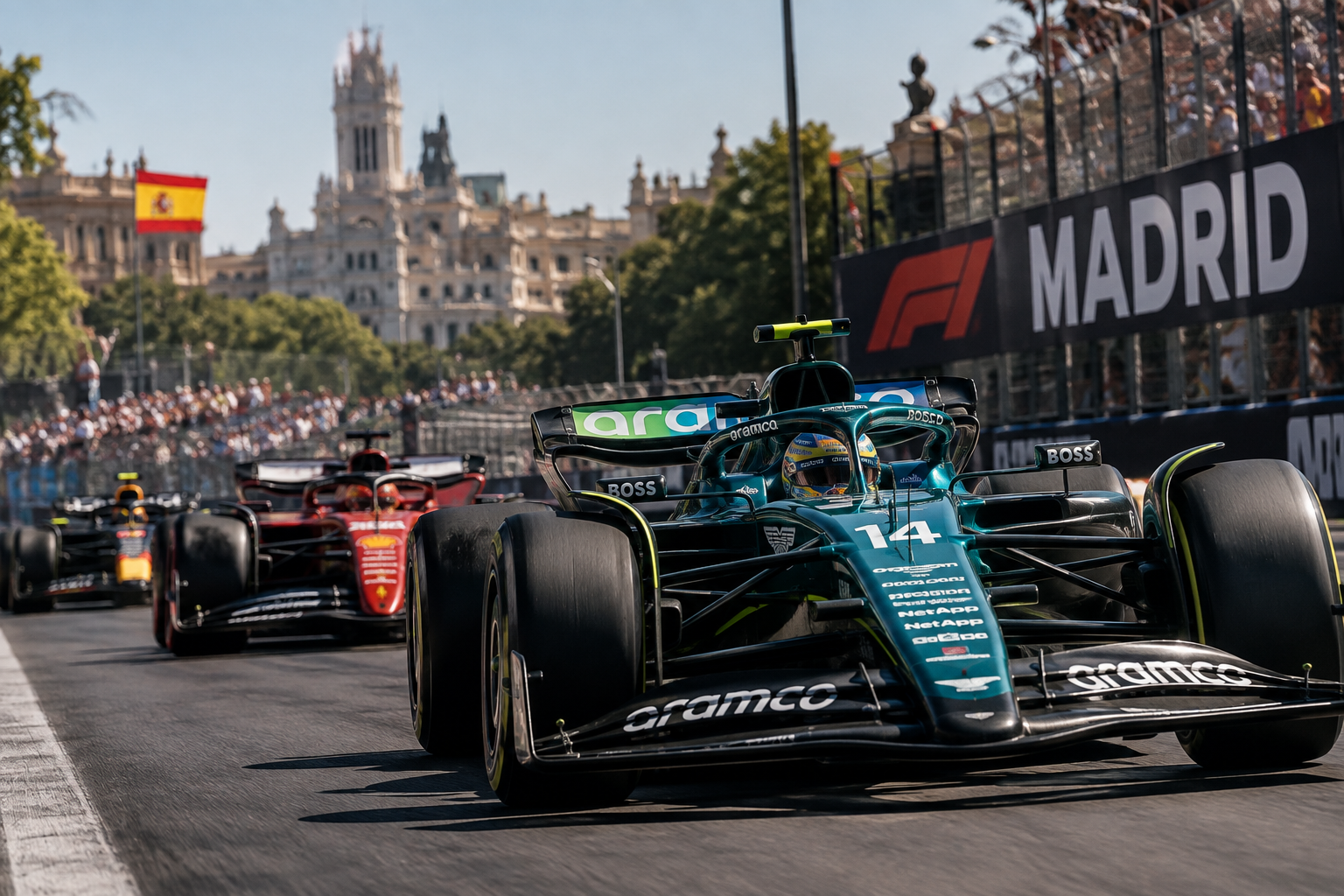
It is a comeback of great symbolic significance: for the first time since 1981, a Formula 1 race is once again being held in Madrid. Back then, the race took place at the Circuito del Jarama; today, the pinnacle of motorsport heads to the newly built MADRING circuit around the IFEMA exhibition centre.
The Spanish Grand Prix will take place from 11 to 13 September 2026. This means Spain will host two Formula 1 races this season. Alongside Madrid, Barcelona will also remain on the calendar, with the Barcelona-Catalunya Grand Prix taking place there.
A new circuit in the heart of Madrid
The MADRING is not a traditional permanent racing circuit. The track combines permanent and temporary sections and is located in the north and north-east of the capital, around the IFEMA exhibition centre.
The circuit is around 5.4 kilometres long and features 22 corners. One of its most spectacular sections is the heavily banked “La Monumental” corner. For the drivers, the track is uncharted territory: unlike established circuits, there is very little real-world experience to draw on.
For Madrid, the Grand Prix is also a major project with a long-term perspective. Under the current agreement, Formula 1 is set to remain in the capital for several years. The race is therefore not intended as a one-off spectacle, but as a permanent fixture on the international events calendar.
Hundreds of thousands of visitors expected
The economic expectations are correspondingly high. A study conducted by PwC estimates the economic impact at €467 million. At the same time, around 8,850 jobs are expected to be linked to the Grand Prix. According to the calculations, this would also generate around €83 million in taxes and social security contributions.
The benefits, however, extend beyond race organisers and the motorsport industry. The hospitality sector, restaurants, retail and transport are all expected to benefit from the additional visitors. Current estimates suggest that tens of thousands of fans will travel to Madrid from outside the region, including a large number of international visitors.
However, these figures should be treated with caution. They describe a projected economic impact and do not automatically represent additional profit for the region as a whole. Some of the spending may simply be shifted from one sector of the economy to another.
Hotels and restaurants are already benefiting
The impact of the Grand Prix on the city is already becoming apparent before the first race. Madrid is expecting a significant influx of visitors over the weekend. Demand for accommodation has risen accordingly, with hotels in some cases increasing their prices substantially. Restaurants, bars and other leisure businesses are also expecting additional revenue.
For Madrid, the race is therefore about far more than sport. The city is using Formula 1 as an international platform – much like other major cities use major sporting events to promote themselves worldwide as both a tourist destination and a business hub.
45 years after the last race
The historical connection dates back to the Jarama circuit. The last Formula 1 Grand Prix in the Madrid region was held there in 1981. Gilles Villeneuve won that race in a Ferrari.
Since then, Formula 1 has fundamentally changed. From a primarily European motorsport series, it has become a global entertainment and media product. Streaming, social networks, and series like “Drive to Survive” have significantly expanded Formula 1’s reach, especially among a younger audience.
Madrid is therefore added at a time when Formula 1 has a more prominent international presence than ever before.
Santander as a partner of the new Grand Prix
Banco Santander also plays a role in the new race. The Spanish financial institution is a founding partner of the Spanish Grand Prix in Madrid and a global sponsor of Formula 1. The connection between the bank and the racing series dates back to 2007, when Santander became a sponsor of the McLaren team.
For Santander, the race is therefore part of a long-term sponsorship strategy. For the Grand Prix itself, the partnership is an example of how strongly major sporting events are now supported by international companies.
The new Madrid GP is therefore not only a sporting event, but also a major platform for sponsors, media and the tourism industry.
Madrid vs Barcelona?
With the new race, the balance of power within Spanish motorsport is also shifting. Barcelona had hosted the Spanish Formula 1 race since 1991. While the Circuit de Barcelona-Catalunya will remain part of Formula 1, the traditional name and the race’s status are changing. Madrid now takes center stage for the Spanish Grand Prix.
Spain’s future hosting of two Formula 1 races is a significant international development. For the country, this means increased visibility and potentially further revenue from tourism and international events. At the same time, the question arises whether both locations can coexist economically and logistically in the long term.
Not just enthusiasm
As high as expectations are, the project is not without controversy. Critics point, among other things, to the costs, the burden of traffic and noise, and the question of how sustainable a major event of this magnitude actually is.
A closer look is also worthwhile when considering the economic assessment. The frequently cited figure of 467 million euros is a forecast or calculation of the economic impact. It does not mean that Madrid will receive this amount as direct profit.
In addition, there is the long-term commitment to Formula 1. Madrid is counting on the investments paying off over the years through visitors, international attention and additional economic activities.
A test for Madrid’s international ambitions
The first Grand Prix will therefore also be a test for the city itself. Will travel and traffic function smoothly? How much will hotels, restaurants, and retailers actually benefit? And will Madrid succeed in turning a sporting weekend into a lasting international competitive advantage?
Formula 1 certainly attracts enormous global attention. Around the new MADRING circuit, sport, tourism, business, and urban development converge this weekend. For Spain, the Grand Prix is therefore more than just the return of a race car to Madrid. It’s an attempt to permanently establish the capital on the international motorsport map.
And while the battle for seconds and World Championship points rages at the MADRING, a much longer race begins for Madrid: the question of whether the Formula 1 project will also pay off in the long term, both economically and socially.