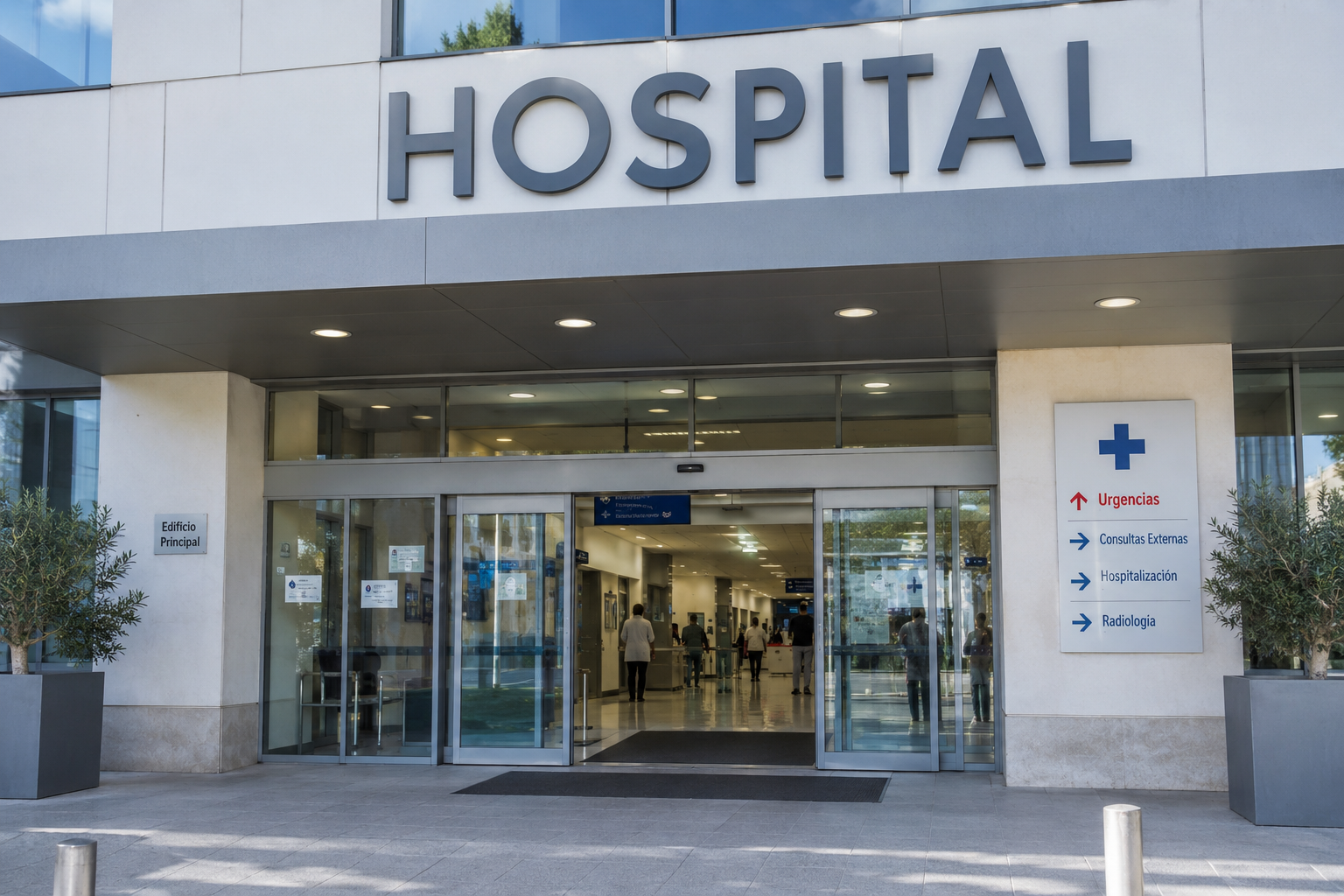
Doctors in Spain’s North African enclave say emergency services are facing mounting pressure following the large-scale arrival of migrants since late July. Health authorities reject claims of an impending collapse, pointing to hospital occupancy of about 50%.
Redaktion Spanien Press
Doctors in Ceuta have warned that the Spanish enclave’s health service is coming under increasingly severe pressure as thousands of migrants remain in the territory following the large-scale arrivals recorded at the end of July.
At the centre of the dispute is Ceuta University Hospital (HUCE), the city’s only hospital, where medical staff say the emergency department has experienced a sharp increase in demand.
Enrique Roviralta, president of Ceuta’s medical association, has warned that the system could eventually become overwhelmed unless additional resources are provided.
The concern, doctors say, is not simply how many hospital beds are occupied. It is whether a relatively small health system has enough doctors, nurses and other staff to sustain the increased workload over a prolonged period.
Roviralta says the strain is already taking a toll on staff, with two members of the emergency department on psychological sick leave and another having resigned.
Emergency attendances rise sharply
Figures cited by frontline doctors suggest a striking increase in activity.
Susana Ascaso, an emergency doctor at HUCE, said the department recorded about 9,500 attendances in August, compared with roughly 5,000 during the same month last year.
Meanwhile, between 31 July and 31 August, 10,725 healthcare attendances involving migrants were recorded across Ceuta. According to Spain’s National Institute for Health Management, Ingesa, 60% were dealt with through primary care services, while about 40% – 4,250 cases – were treated at the hospital’s emergency department.
Doctors say they are dealing with a broad range of conditions, from infections and chronic illnesses to injuries sustained in fights, fractures and stab wounds requiring treatment and follow-up care.
The location of makeshift migrant settlements close to the hospital has added to the pressure. For some migrants, the emergency department has become the most accessible route into the healthcare system, including for conditions that would ordinarily be dealt with by primary care services.
Calls for a separate medical facility
Ceuta’s medical association is calling for a more effective separation of healthcare provision.
Among the proposals are the creation of a field hospital, the reopening of the former military hospital or the establishment of another medical unit where patients could receive primary treatment, wound care and follow-up appointments.
Those requiring specialist treatment or admission could then be transferred to HUCE.
Doctors argue that such a system would prevent virtually all of the additional demand from being concentrated on Ceuta’s only hospital.
There are also concerns about the approaching autumn and winter. Lower temperatures, rain and poor conditions in makeshift settlements could increase respiratory and infectious illnesses.
Medical representatives warn that an outbreak requiring the isolation of significant numbers of patients could place further strain on an already stretched service.
Health authorities reject claims of collapse
Ingesa, however, presents a markedly different picture.
The health authority says average bed occupancy at HUCE stood at approximately 50% during August and insists that healthcare remains guaranteed for both Ceuta residents and migrants.
It also says separate treatment pathways were introduced from the beginning of the crisis in an effort to ensure that healthcare provided to migrants did not disrupt services for the local population.
More than 100 additional staff have been recruited, according to the authority.
Official figures show that an average of 133 migrants a day were treated in the emergency department during August. Overall emergency activity increased by 77 patients a day compared with the corresponding period in 2025.
One crisis, two very different assessments
The disagreement is particularly stark when it comes to hospital capacity.
Doctors argue that a headline figure showing 50% bed occupancy does not necessarily reflect the hospital’s true ability to cope. A bed may exist physically, they say, without sufficient staff being available to operate it as part of the hospital’s effective capacity.
Roviralta has said that some departments, including internal medicine, are already operating at full capacity.
There is also disagreement over September’s emergency figures. Medical representatives say the department is seeing about 300 patients a day, roughly twice the number recorded a year ago. Ingesa’s published daily figures are considerably lower.
Long-standing struggle to attract doctors
The current crisis has also exposed a deeper problem facing healthcare in Ceuta: recruiting and retaining medical professionals.
Doctors have criticised working conditions and pay, while the city’s limited housing supply can make recruitment from mainland Spain more difficult.
Ingesa disputes the suggestion that Ceuta is unable to attract medical staff. It points out that all 37 specialist training posts offered in 2024, 2025 and 2026 were filled, and says a substantial proportion of doctors who complete their specialist training in the enclave subsequently remain there.
Language has emerged as another source of concern.
Doctors have called for official Arabic interpreters, warning that communication difficulties can increase the risk of mistakes when taking medical histories, making diagnoses or explaining treatment.
Spain’s General Medical Council has also expressed concern after representatives visited Ceuta. The organisation has warned of significant physical and emotional pressure on healthcare workers and called for additional staff, greater employment stability, better pay and support with housing.
The argument goes beyond empty beds
For now, Ceuta is left with two sharply contrasting accounts of the same situation.
The health authorities point to spare beds, new recruitment and a system that, according to their figures, continues to function within its capacity.
Frontline doctors argue that those statistics fail to capture what is happening inside the emergency department, where staff are dealing with a substantial increase in patients while working within the limitations of a small healthcare system.
For Ceuta’s residents, the crucial question is therefore not simply how many hospital beds remain empty.
It is whether the only hospital in this strategically important Spanish territory can continue absorbing sustained additional demand without the quality and availability of healthcare for the wider population beginning to suffer.