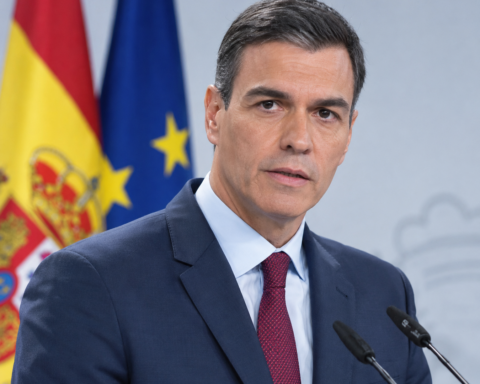
Pedro Sánchez’s Socialist government is facing another politically uncomfortable setback. Spain’s Supreme Court has intervened in the controversy surrounding the so-called “Grandchildren Law”, with the dispute now extending far beyond historical reparation. At its heart lies an explosive question: should hundreds of thousands of new Spanish citizens living abroad be able to help decide who governs Spain, even if some have never lived in the country?
Spain Expat Press Editorial Team
For many foreign residents in Spain, the Ley de Nietos – commonly referred to as the “Grandchildren Law” – may be unfamiliar. To understand why it has suddenly become such a major political issue, it is first necessary to understand what the measure actually does.
What is Spain’s ‘Grandchildren Law’?
Despite its popular name, the Ley de Nietos is not a separate law. It forms part of Spain’s 2022 Democratic Memory Law (Ley de Memoria Democrática), introduced under Pedro Sánchez’s government.
The measure opened a route to Spanish citizenship for certain children and grandchildren of Spaniards who left the country in connection with the Civil War, political persecution and the Franco dictatorship.
Demand has been particularly strong in Latin America, where generations of Spanish emigrants established new lives in countries including Argentina, Cuba, Mexico and Venezuela.
For Sánchez’s PSOE, the measure is primarily one of historical reparation: descendants of Spaniards who were forced to leave their country should have the opportunity to recover their connection with Spain through citizenship.
But the measure has acquired another dimension that is now proving considerably more controversial.
A Spanish passport can also mean a Spanish vote
Obtaining Spanish nationality is not simply about acquiring an EU passport.
Spanish citizens living permanently abroad can also participate in national elections through Spain’s overseas electoral register, known as CERA.
That means many people obtaining Spanish citizenship under these provisions can potentially become Spanish voters as well.
Some of these new citizens were born abroad and have spent their entire lives outside Spain. In certain cases, their direct family connection with the country goes back several generations.
Yet as Spanish citizens, they may in principle have a say in deciding who governs Spain.
And that is where the political battle begins.
More than 400,000 additional overseas voters
The scale of the issue becomes clearer when looking at Spain’s overseas electoral register.
By 1 July 2026, CERA contained 2,736,522 registered voters. At Spain’s 2023 general election, the figure stood at 2,328,260.
That represents an increase of 408,262 voters in just three years.
In a country where parliamentary majorities can depend on only a handful of seats, such numbers inevitably attract political attention.
Spain’s Supreme Court has described the increase as exceptional and has raised concerns over safeguarding transparency and public confidence in the electoral process while the underlying legal questions are examined.
PP and Vox ask: should people who have never lived in Spain decide its government?
This is at the heart of the criticism from the conservative Partido Popular and Vox.
Both parties question how far voting rights should extend when an individual’s connection with Spain may exist principally through their parents or grandparents.
Their argument can be reduced to a provocative question: should somebody be able to help choose Spain’s next government if they have never permanently lived in Spain – and may possibly never even have visited the country?
PP and Vox also accuse Sánchez’s government of applying the citizenship provisions too broadly, thereby contributing to a substantial expansion of the overseas electorate.
PP leader Alberto Núñez Feijóo has used the term “ingeniería electoral” – electoral engineering – and accused the government of effectively “manufacturing” new voters. Vox has made similar and, in some cases, even stronger allegations.
Behind those accusations lies an obvious political suspicion: that at least some of these new voters could ultimately benefit Sánchez and the PSOE at future elections.
However, there is an important distinction. There is currently no evidence showing that these new Spanish citizens will vote predominantly for the PSOE.
Indeed, during the final count of overseas votes in the 2023 general election, it was the PP that ultimately benefited by gaining an additional seat in Madrid.
Why the PSOE is defending the measure so strongly
The Socialist Party firmly rejects the opposition’s accusations.
For Sánchez’s government, the measure is not about creating voters but correcting a historical injustice towards Spanish families affected by exile, persecution and dictatorship.
Its argument is straightforward: if somebody legally obtains Spanish nationality, that person is Spanish.
And Spanish citizens should, in principle, enjoy the same political rights whether they live in Madrid, Marbella, Buenos Aires or Mexico City.
From that perspective, it would be contradictory to recognise somebody as a Spanish citizen, issue them a Spanish passport and then deny them the political rights associated with that citizenship.
The PSOE therefore has a clear political interest in defending both the measure and the rights derived from it.
What has Spain’s Supreme Court actually done?
Amid the increasingly heated political rhetoric, one point is particularly important: Spain’s Supreme Court has not abolished the Grandchildren Law.
Nor has it automatically stripped the people concerned of their Spanish nationality.
The legal dispute centres on whether certain individuals were correctly included on the overseas electoral register and whether the legal requirements governing eligibility were properly demonstrated in all relevant cases.
Certain electoral effects have therefore been temporarily halted while those questions are examined.
In other words, the current controversy is not principally about taking Spanish passports away from hundreds of thousands of people.
The politically explosive issue is their right to vote.
Why this is nevertheless a significant setback for Sánchez
The final legal outcome remains to be seen, but politically the intervention is uncomfortable for Pedro Sánchez.
A measure presented by his government as an act of historical justice has now become part of a much wider debate about who should form Spain’s electorate.
For PP and Vox, the Supreme Court’s intervention represents a political victory. They can argue that their concerns over how the rules were being applied were serious enough to warrant action from Spain’s highest court.
For the PSOE, meanwhile, it creates yet another political problem around an issue that could hardly be more sensitive ahead of the next general election.
Behind all the legislation, court decisions and political accusations lies one deceptively simple question:
Should someone have a say in choosing Spain’s government if they are legally Spanish but may never have actually lived in Spain?
For Sánchez’s government, the answer is based on citizenship: a Spaniard is a Spaniard and should have the corresponding rights.
PP and Vox question whether the citizenship provisions that led to this dramatic expansion of the overseas electorate have been applied too broadly.
Spain’s Supreme Court will ultimately have to clarify the legal boundaries.
For Pedro Sánchez, however, the controversy has already become another unwelcome setback at an increasingly difficult political moment.