Rarely have I seen a single story provoke such anger and division on Spanish social media. The case of 87-year-old Maricarmen in Madrid has become about far more than an eviction. She has been turned into a symbol – of Spain’s housing crisis, of the campaign against evictions and of the struggle for stronger tenants’ rights. Yet that is precisely where I believe we should be careful. Spain’s housing crisis is very real. Maricarmen’s story, however, is considerably more complicated.
Over the past few days, the arguments have been extraordinary. Friends have fallen out over the case, readers have attacked one another online and social media has divided into opposing camps.
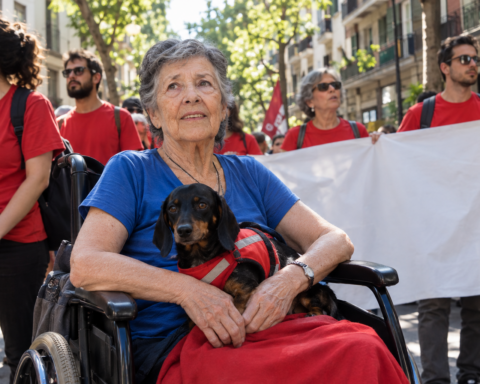
At the centre of it all is an 87-year-old woman who has had to leave the Madrid flat in which she had lived for 71 years.
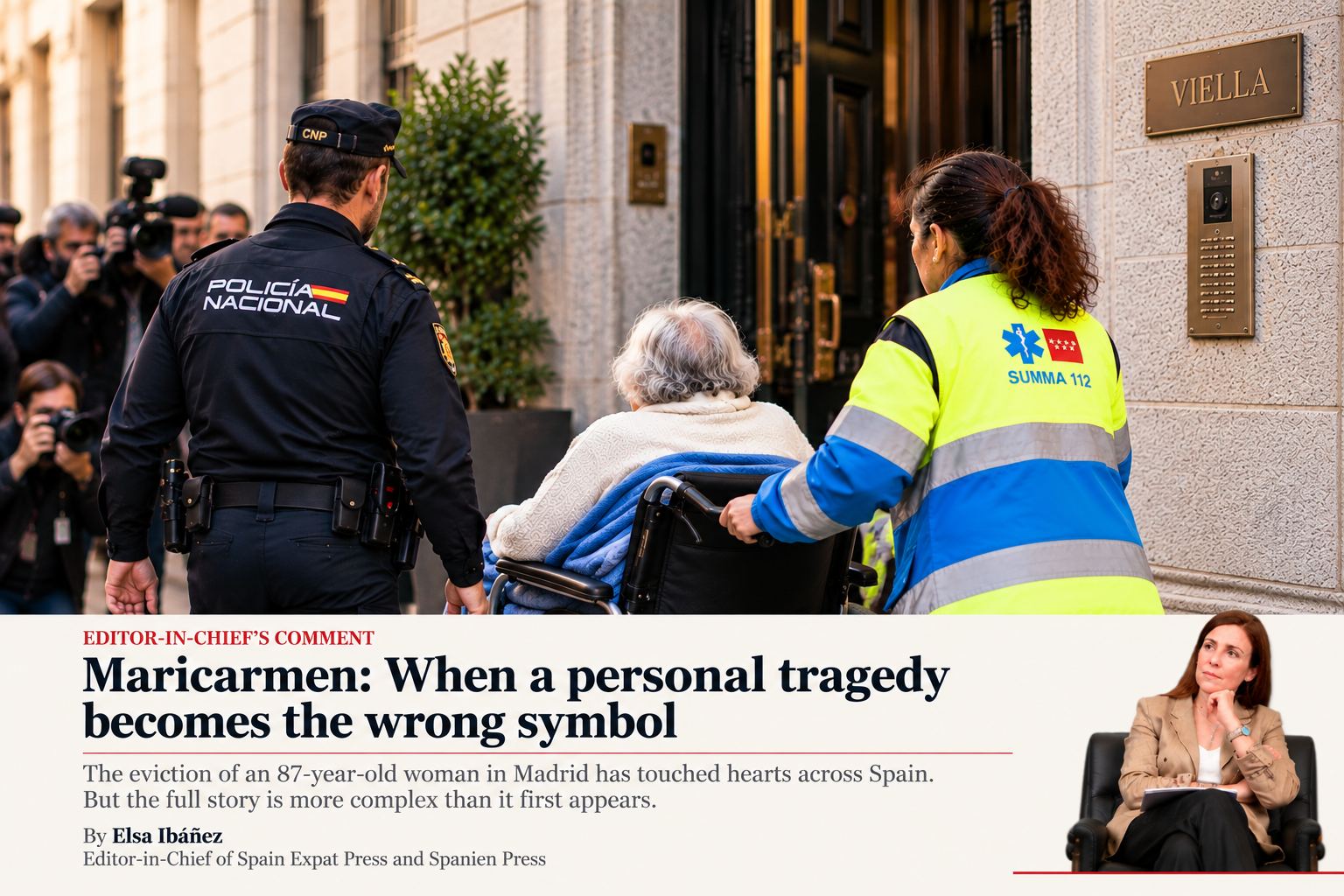
The images are upsetting. Of course they are.
Seeing an elderly woman in a wheelchair forced to leave the home in which she has spent almost her entire life is difficult to watch. Whatever one thinks about the legal arguments surrounding the case, there is a human tragedy here.
But compassion should not prevent us from looking at the whole story.
Maricarmen has become a symbol
Tenant organisations and anti-eviction campaigners have rapidly turned Maricarmen into a symbol of the fight against evictions, soaring rents and property speculation.
And one thing should be made absolutely clear: Spain has a serious housing problem.
In Madrid, Barcelona, Málaga, Marbella and many other parts of the country, rents have risen dramatically. Young people struggle to leave their parents’ homes. Families are spending an increasingly large proportion of their income simply to keep a roof over their heads. Pensioners can find themselves in an impossible position when an affordable tenancy comes to an end and they are suddenly confronted with current market prices.
That reality should not be minimised.
But precisely because the housing crisis is so serious, we should also be careful about which individual cases we use to represent it.
Maricarmen’s circumstances are not those of an ordinary tenant who has suddenly been confronted with an unaffordable rent increase.
A tenancy from another era
Maricarmen had lived since childhood in the same flat in Retiro, one of Madrid’s most desirable districts.
The original tenancy belonged to Spain’s historic system of “renta antigua” – old rent-controlled contracts that offered exceptionally strong protection to tenants and, over time, rents far below prevailing market rates.
The original contract had been signed by Maricarmen’s father. It subsequently passed to her mother and later to Maricarmen herself.
It was this further succession of the tenancy that eventually became the subject of a lengthy legal dispute.
The courts ultimately concluded that the protections attached to the original tenancy could not continue indefinitely. Spain’s Supreme Court eventually upheld the owners’ position.
That distinction matters.
This was not a case in which an 87-year-old woman woke up one morning to discover, without warning, that she was being thrown out of her home.
The eventual eviction came after years of legal proceedings and uncertainty over the future of the tenancy.
The opportunity to buy the flat
There is another important part of the story that has received considerably less attention in many of the emotional posts circulating online.
In 2020, Maricarmen was offered the opportunity to buy the flat for approximately €247,000.
She did not take up the offer and later said she could not afford to do so.
It would be unfair for outsiders to claim today that she could simply have bought the property. We do not know the full details of her financial circumstances at the time, nor whether obtaining the necessary financing was realistically possible.
But the offer does tell us something important.
Years before the eventual eviction, there were already clear indications that the housing arrangement she had relied upon for decades might not last for ever.
And for me, this raises another question.
Who was advising this woman during all those years?
Decades of security are not the same as ownership
Spain’s old rent-controlled tenancies represented an extraordinary advantage for the families who held them.
They enabled generations of tenants to remain in properties at rents that eventually bore little resemblance to prices on the open market.
For Maricarmen and her family, that meant being able to live for decades in Retiro, today one of Madrid’s most expensive and sought-after neighbourhoods.
That was undoubtedly a considerable benefit.
But it came with an important limitation: living in a property for decades does not make a tenant its owner.
That distinction seems to have become almost lost amid the emotion surrounding this case.
If someone spends 50, 60 or 70 years in the same home, it is entirely understandable that they come to feel that it belongs to them in every meaningful sense.
It contains their memories, their family history and almost an entire lifetime.
Emotionally, it is their home.
Legally, however, there remains a fundamental difference between having a home and owning the property in which that home is situated.
Was Maricarmen badly advised?
For me, this may be the most troubling part of the entire story.
Maricarmen appears to have believed for years that her exceptional tenancy arrangement could somehow continue.
Ultimately, the courts decided otherwise.
If an elderly person is encouraged to believe that a legally contested situation can simply continue indefinitely, we have to ask whether that advice genuinely serves their interests.
Perhaps the kinder and more responsible approach would have been to begin searching much earlier for a permanent alternative.
Because delaying a difficult decision does not make the underlying problem disappear.
It merely pushes it further into the future.
And eventually there comes a point when there is very little time left to solve it.
That is what makes the images we are now seeing so painful.
The human tragedy remains
None of these facts makes the final outcome pleasant.
Quite the opposite.
Watching an 87-year-old woman leave the home where she grew up is profoundly sad. Anyone can understand why the case has generated such an emotional response.
Compassion and a clear-eyed examination of the facts are not mutually exclusive.
Maricarmen benefited for decades from exceptionally favourable housing conditions. When it became apparent that those conditions might not be legally guaranteed for ever, there was a considerable period in which alternatives could be considered.
For whatever reason, a lasting solution was not found.
And the problem has now reached the worst possible conclusion.
Spain has clearer examples of its housing crisis
This is why I struggle with the decision to turn Maricarmen into the defining symbol of Spain’s housing crisis.
There are young people working full-time who still cannot afford to rent a flat.
There are families spending more than half their income on housing.
There are pensioners forced to leave neighbourhoods where they have lived for decades because a new tenancy at current market rates is beyond their means.
And there are millions of people who have never benefited from an old rent-controlled contract and nevertheless struggle every month to pay for somewhere to live.
Their experiences illustrate the structural nature of Spain’s housing crisis far more clearly.
Maricarmen’s story is different.
It is an intensely personal and deeply sad story involving an exceptional historic tenancy, decades of security, a lengthy legal dispute and decisions whose consequences became increasingly difficult to reverse.
Social media wants heroes and villains
Perhaps that complexity explains why the case has generated such extraordinary hostility online.
One side sees only a vulnerable 87-year-old woman being forced from her lifelong home.
The other sees only a tenant whose legal entitlement to remain in the property had expired.
Neither version tells the whole story.
Reality, as so often happens, lies in the detail.
Maricarmen deserves compassion.
Spain’s housing crisis demands serious political answers.
But we should be wary of simplifying an individual human tragedy until it fits perfectly into a wider political narrative.
If Maricarmen is to become a symbol, then we should at least tell her whole story.