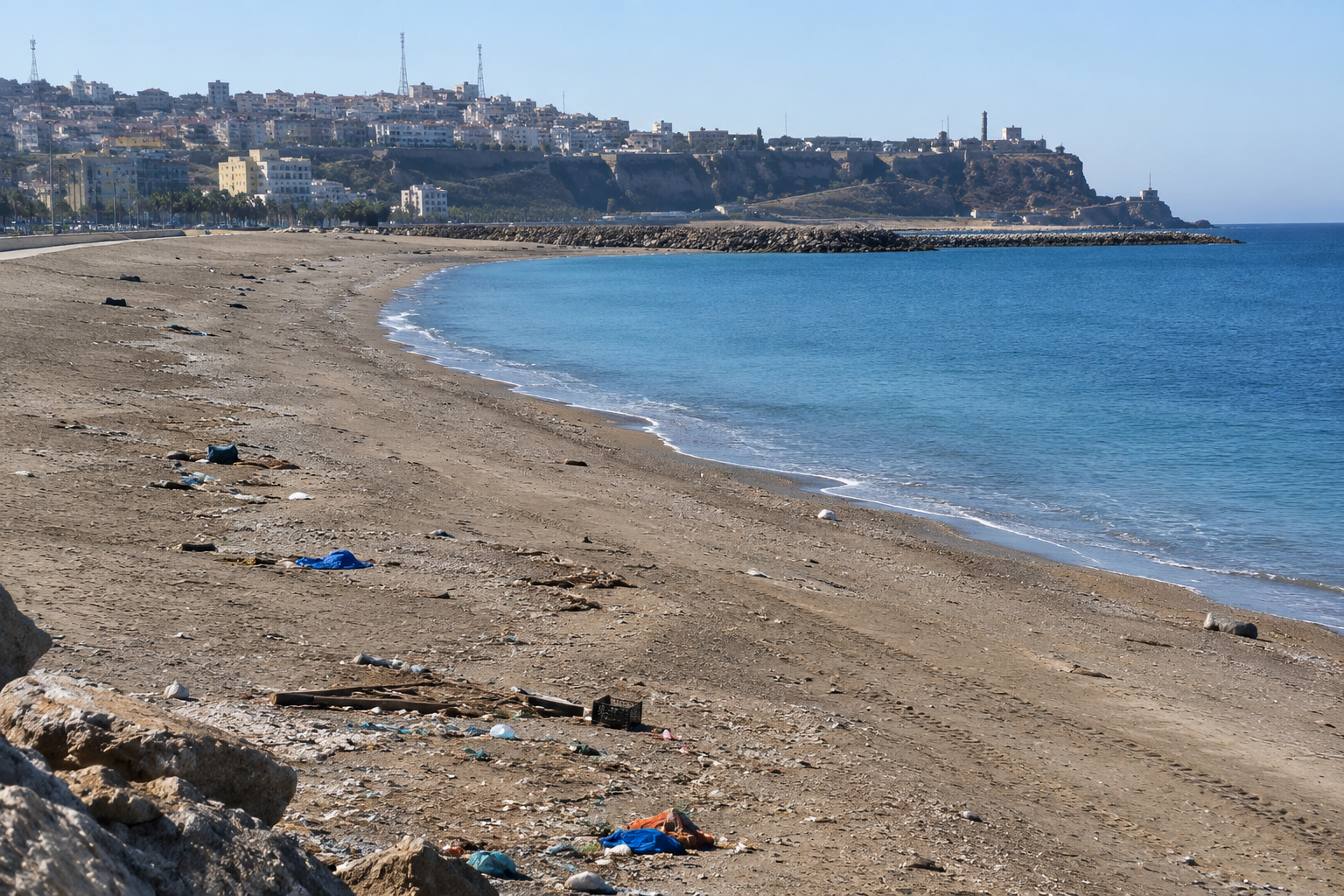
Playa del Trampolín in Ceuta currently presents an unusual sight: for the first time in about two months, the beach is completely empty. Where thousands of migrants had been living in tents and makeshift shelters until just a few days ago, only abandoned belongings, tents, and trash remain following the clearance operation.
Spain Expat Press Editorial Team
by Marlon Gallego Bosbach
The clearing of the beach was completed yesterday, Monday. The operation had begun the previous day and was carried out in two phases. According to the authorities, around 3,000 people had most recently been living in the makeshift camp; other sources estimate the number at up to 3,500.
Police operation lasting several hours
The first phase of the eviction began on Sunday morning. More than 350 personnel were involved, including units from the National Police, the Civil Guard, the local police, and other security forces.
The people were moved away from the beach and transported – by bus, among other means – to the Centro de Atención Temporal de Extranjeros (CATE) at the El Tarajal border crossing. There, they were to be registered and their individual situations assessed.
Some of those affected subsequently opted for a voluntary return to Morocco. According to various Spanish media outlets, several hundred people returned voluntarily on the very first day.
The second and final phase of the evacuation began on Monday morning and was completed after a few hours.
61 tons of trash on the beach
After two months, the camp left behind clear traces. Around 61 tons of waste had to be – or still need to be – removed from the area. This includes abandoned tents, personal belongings, and other refuse.
After the people had been taken away, cleaning crews began restoring the beach. The cleanup operations aim to return Playa del Trampolín to its original state.
Water quality was also a problem
In addition to the difficult accommodation situation, water quality also played a role. Tests conducted in late September had detected contamination of the seawater with Escherichia coli and intestinal enterococci. Consequently, contact with the water posed health risks. Nevertheless, people from the camp continued to spend time by the sea and used the water for purposes such as washing.
The authorities in Ceuta had informed the Spanish central government about the situation, as the affected stretch of coast falls under state jurisdiction.
Migration situation in Ceuta persists
However, the complete clearing of Playa del Trampolín does not mean that the migration situation in Ceuta has ended. Some of the people who previously lived on the beach remain in other areas; migrants are still present, particularly in the vicinity of the Explanada del Guano and the former guano factory.
The cleared beach thus serves primarily as a visible sign of the end of a specific camp – not the end of the overall accommodation and migration crisis in the Spanish enclave.
Eviction a few days before the royal visit
Moreover, the evacuation comes at a significant time for Ceuta. King Felipe VI and Queen Letizia are set to visit the Spanish enclave on October 13 and 14. It is a special occasion for the royal couple: this will be Felipe VI and Letizia’s first official visit to Ceuta during the King’s reign to date.
Images of the now largely cleared Playa del Trampolín thus present a stark contrast to the situation of recent weeks. A beach that had at times turned into a large, makeshift camp is now set to become a normal stretch of public coastline once again.