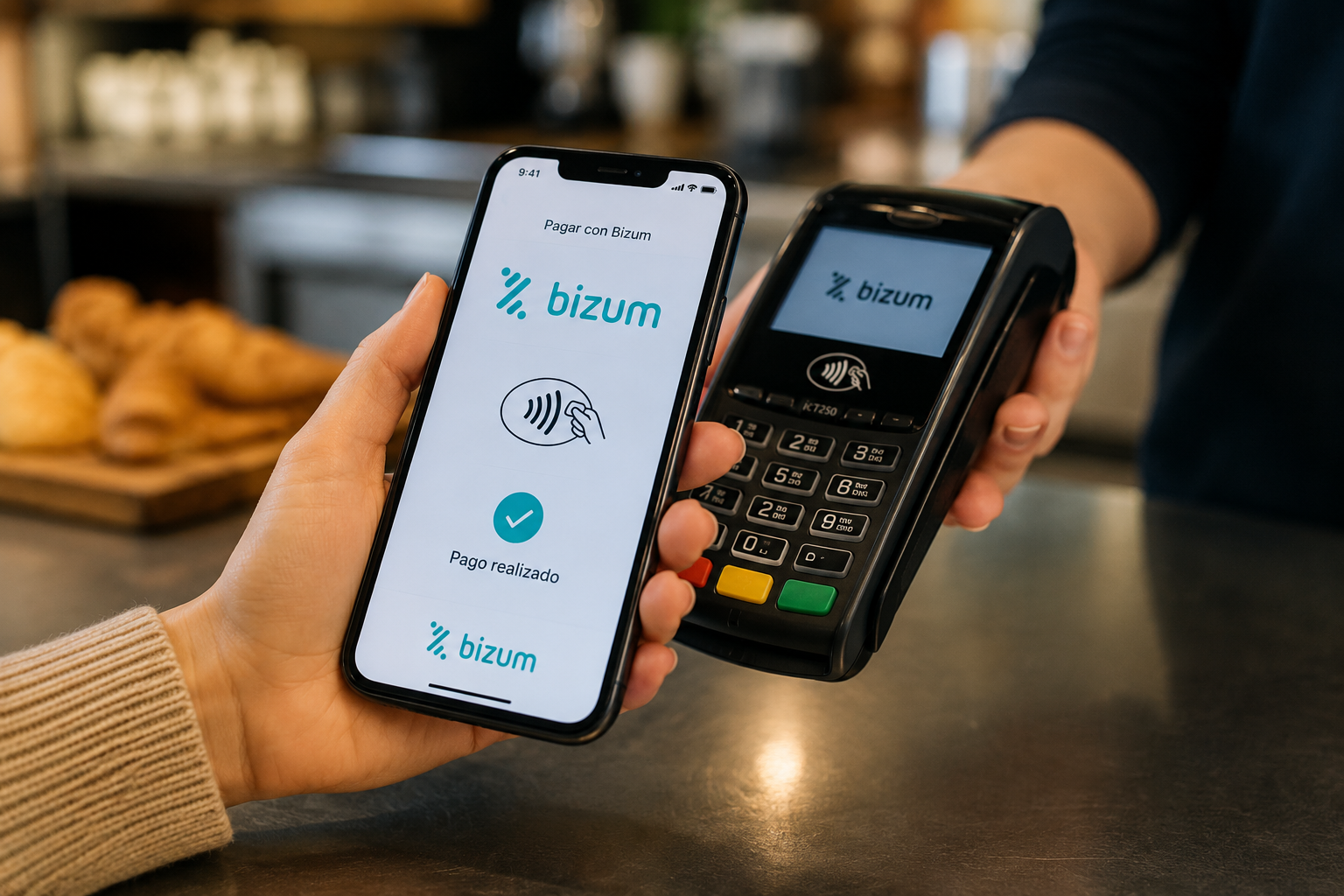
Bizum is entering a new phase of its history this Monday. After years of revolutionising instant money transfers between private individuals in Spain, the payment system is now officially moving into physical retail stores.
From today, selected customers in certain shops, cafés, restaurants and supermarkets will be able to pay directly with Bizum using contactless technology on their smartphones.
Spain Expat Press Editorial Team
The launch will initially remain limited
Despite the attention surrounding the announcement, the rollout will initially be gradual.
Not all banks have activated the feature yet, and many businesses still need to adapt their payment terminals and systems. Spanish financial media report that the full implementation could take several months.
Among the first banks supporting the new service are CaixaBank, Bankinter and Banco Sabadell.
How will paying with Bizum in shops actually work?
Until now, most people have mainly used Bizum through their mobile phone number to send money instantly to friends or relatives.
However, the system works differently in physical retail environments.
The new payments will operate through NFC technology — similar to Apple Pay or Google Pay. Customers simply hold their smartphone near the payment terminal. In most cases, there will be no need to manually enter a phone number.
At the same time, Bizum is reportedly developing its own digital wallet called “Bizum Pay”, which could eventually compete directly with Apple Wallet and Google Wallet.
Refunds are also generating uncertainty.
Bizum was originally designed as an instant transfer system between private individuals — not as a traditional retail payment network like credit card providers.
For that reason, many experts believe banks and retailers will still need to optimise procedures for refunds, complaints and payment disputes over the coming months.
A challenge to Visa and Mastercard?
Many banks increasingly see Bizum as a strategic opportunity to reduce dependence on international payment giants such as Visa and Mastercard.
For retailers, lower transaction fees and faster payment settlements could become particularly attractive.
For consumers, however, the key question remains whether Bizum genuinely offers a practical advantage in daily life — especially as millions of people already pay contactlessly with digital bank cards through their smartphones.
The coming months are likely to determine whether Bizum can truly establish itself as a new standard payment method in Spanish retail — or whether it will ultimately remain simply another digital payment option alongside traditional bank cards.