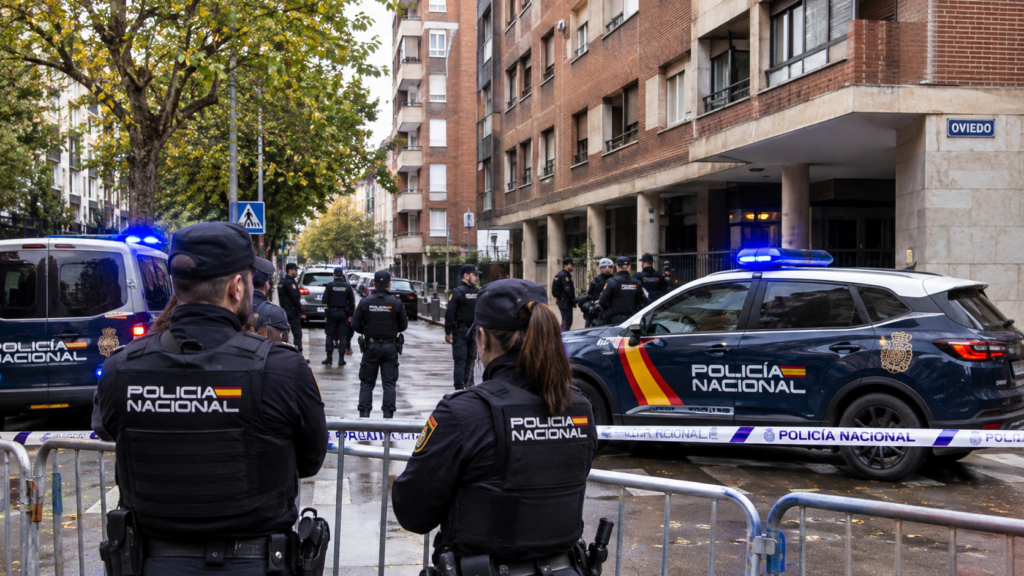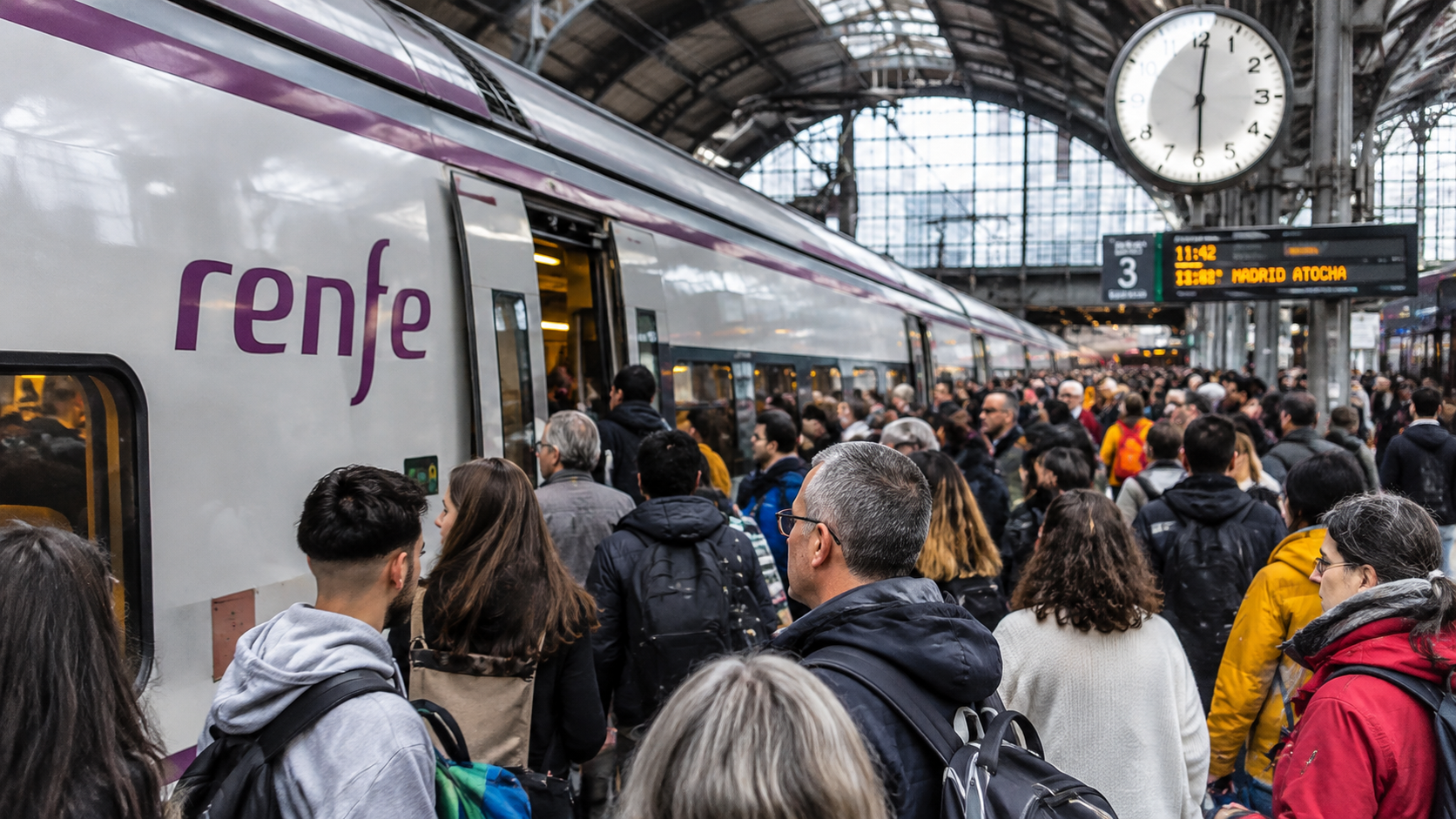
A strike by train drivers at the Spanish state railway company, Renfe, is causing significant disruptions across several parts of the country today, Tuesday. The Cercanías commuter rail services in Madrid and the Rodalies network in Catalonia are particularly affected. The Spanish Train Drivers’ Union (Sindicato Español de Maquinistas Ferroviarios – Semaf) is calling for, among other things, concrete improvements to railway safety and the implementation of measures that had previously been promised. Meanwhile, the government has approved a new package of measures on the same day aimed at enhancing safety in rail transport.
Spain Expat Press Editorial Team
by Marlon Gallego Bosbach
24-hour strike at Renfe
The current strike began overnight into Tuesday and will continue until 11:59 p.m. It was called by the train drivers’ union, Semaf, for Renfe operating staff. Another day of strike action is scheduled for this coming Thursday, November 12. However, this will not be a continuous strike; instead, it will take place during three specific time slots: from 6:20 a.m. to 9:20 a.m., from 2:20 p.m. to 5:20 p.m., and from 9:20 p.m. to 11:20 p.m.
In addition, a nationwide general strike will take place tomorrow, Wednesday. As a result, Spain is experiencing a series of consecutive work stoppages within just a few days, which are placing a significant strain on public transport.
Madrid particularly hard hit
In Madrid, the strike is causing significant problems, particularly for the Cercanías (commuter rail) network. As early as this morning, many passengers were forced to seek alternative means of transport. In light of the expected impact, Cercanías Madrid explicitly advised travelers to use other modes of transport whenever possible.
The capital’s public transport system also prepared for an influx of additional passengers. The Madrid Metro, the municipal EMT buses, and interurban bus services were coordinated to help absorb some of the extra demand resulting from the rail disruptions. Commuter traffic from the surrounding areas was among the most significantly affected.
Problems also in Barcelona
The situation in Catalonia is also tense. Specific minimum service levels have been established for the Rodalies network: 66 percent of regular services are to operate during peak hours, and 33 percent during off-peak hours.
According to Renfe, however, these requirements were not fully met on Tuesday. Early in the morning, the company reported that 14 of the 25 trains designated for minimum service had failed to depart. Consequently, Renfe stated that the mandated minimum services had not been fulfilled.
The Generalitat had established minimum service levels for the periods in question. Nevertheless, for passengers, the situation resulted in significant wait times and last-minute cancellations.
Minimum services apply nationwide
To limit the impact of a strike in public transport, the Ministry of Transport has established mandatory minimum services. For the current strike, the Cercanías (commuter rail) services are required to operate at 75 percent capacity during peak hours and 50 percent capacity outside of these periods.
For medium-distance long-haul trains, the minimum service level is set at 65 percent, while for high-speed and long-distance trains, it is 72 percent. In freight transport, the figure is 20 percent.
At the same time, Renfe has announced that affected travelers will be able to make changes or cancel their bookings at no additional cost. Passengers whose booked trains are affected will be notified using the contact details provided at the time of reservation.
Safety is at the heart of the strike
Semaf cites safety concerns as the primary reason for the work stoppage. The union accuses the government and the railway companies of failing to implement promised measures for structural safety improvements quickly enough.
A key factor in this regard is the serious accident in Urda, in the province of Toledo, on October 28, which claimed the lives of 69 people. The accident has further intensified the debate concerning the technical and organizational safety of the Spanish railway system.
Following the accident, Semaf had already announced further strikes. Among other things, the union is demanding clear and binding procedures for situations in which technical safety systems fail, as well as reliable rules for communication between train drivers and the relevant control centers.
The demands also include issues regarding the working hours and rest periods of train drivers. The union sees a connection between working conditions, excessive strain, and the safety of railway operations.
Government adopts new security package
On the same day that train drivers are striking, the Council of Ministers has adopted a new Real Decreto-ley (royal decree-law) concerning railway safety and the protection of employees. In doing so, the government is responding, among other things, to the demands of the trade unions. The package is intended to strengthen safety inspections, clarify the working conditions of train drivers, and provide better protection for employees who report safety risks.
An important change concerns the calculation of driving and rest periods. In the future, it will be more precisely defined which activities and interruptions count as driving time. This is intended to prevent varying interpretations by companies and to better ensure that actual rest periods are observed.
Train drivers are permitted to stop trains in the event of serious danger
Of particular relevance is a new provision regarding a so-called “just culture” – a safety culture in which employees can report risks without automatically facing employment-related consequences. Employees with safety-critical responsibilities should be able to report risks through confidential internal or public reporting channels. At the same time, they are explicitly granted the right to take necessary and proportionate measures in the event of a serious and imminent threat to safety.
This may also mean that a train driver stops a train or chooses not to begin a journey at all. Any such decision must be reported immediately. However, protection against sanctions does not apply in cases of intentional conduct, acting in bad faith, or gross negligence.
More powers for the railway safety authority
The government is also strengthening the oversight powers of the Agencia Estatal de Seguridad Ferroviaria (AESF). Railway sector companies will be required to grant inspectors access to their facilities, trains, and technical equipment whenever necessary for a safety inspection. This measure is intended to bolster state supervision of railway operations.
Furthermore, an assessment should be made as to which other professional groups within the railway sector might benefit from earlier retirement, given working conditions that are particularly strenuous, hazardous, or detrimental to health.
New regulation for retirement provision
The new decree also provides for an expansion of the regulations concerning so-called pension reduction coefficients. The objective is to ensure more uniform treatment of employees who perform comparable tasks on interoperable lines or within the network of general railway interest.
The intention is to ensure that employees with identical duties and comparable levels of strain do not have different options for early retirement solely based on who their employer is. Furthermore, an assessment will be conducted to determine whether other professional groups within the railway sector should also be included in this arrangement.
Government also aims to provide greater support to accident victims
Along with the safety measures, the government is also deciding to establish a Defensor de Víctimas de Accidentes de Transporte Colectivo – an ombudsman for victims of accidents in public transport.
The new office is intended to provide long-term support to those affected and their relatives. This includes, among other things, psychological, social, and legal assistance. Its remit is to cover not only railway accidents but also serious accidents in commercial aviation, maritime transport, and bus transport. The office is tasked with coordinating victim support beyond the immediate emergency phase and collaborating with the relevant investigative and judicial authorities.
Wave of strikes in the rail sector continues
However, the conflict does not end with today’s strike. Following another partial strike by train drivers on Thursday, the next major mobilization is already on the horizon.
Trade unions at Renfe and Adif have announced another strike for November 17. The action is directed against recent developments in the railway sector and calls, among other things, for additional measures regarding safety and staffing. Employees of private operators such as Ouigo and Iryo may also join the mobilization. Consequently, rail transport in Spain is set to remain affected by industrial action and potential disruptions in the coming days.
Travelers must prepare for further restrictions
For rail passengers, the current situation means one thing above all: further disruptions are to be expected, even after today’s strike. Following this Tuesday’s 24-hour walkout, a general strike will take place tomorrow, Wednesday, and Renfe train drivers are set to stop work again on Thursday during several specific time slots.
At the same time, the government is attempting to address a key criticism raised by the trade unions through the security measures it has now adopted. Whether this will be sufficient to defuse the conflict in the railway sector, however, remains an open question. Consequently, the dispute concerning safety, staffing, and working conditions is likely to continue to occupy Spain beyond this week.