Madrid’s famous San Isidro festivities have officially begun — and for around ten days, the Spanish capital once again transforms into a huge mix of traditional celebrations, street parties and open-air fiestas.For many Spaniards, these are the most important days of spring. And for many foreigners, they are the perfect opportunity to discover the “real” Madrid.
Spain Expat Press Editorial Team
When are the festivities taking place?
This year, the San Isidro celebrations officially run from 7 to 17 May 2026. The main public holiday itself falls on 15 May, the feast day of Madrid’s patron saint, Saint Isidore the Labourer.
The celebrations already began on 7 May at 8pm with the traditional “Pregón” opening speech at Plaza de la Villa. From that moment on, Madrid effectively celebrates every day and late into the night.
Los gigantes y cabezudos en la plaza de la Villa, llegando para el pregón de las fiestas de San Isidro pic.twitter.com/l6Vh7kvhcl
— Martín Casariego (@MCasariegoCor) May 7, 2026
Where does everything happen?
The main festival locations are:
- Pradera de San Isidro
- Plaza Mayor
- Las Vistillas
- Matadero Madrid
- numerous streets and squares across the city.
The Pradera de San Isidro in particular becomes packed every afternoon and evening, with thousands of Madrileños gathering for picnics, food, dancing and celebrations.
Typical schedules: Spain starts late
For many foreigners, one thing can feel unusual at first: during San Isidro, daily life often begins much later.
- Family activities and markets usually start around 11am.
- Traditional dances and folklore performances take place during the afternoon.
- Concerts frequently begin between 8pm and midnight.
- Street celebrations often continue until the early hours.
On 15 May, the most important day of the festival traditionally ends with a large fireworks display shortly before midnight.
Why everyone suddenly looks like they stepped out of another century
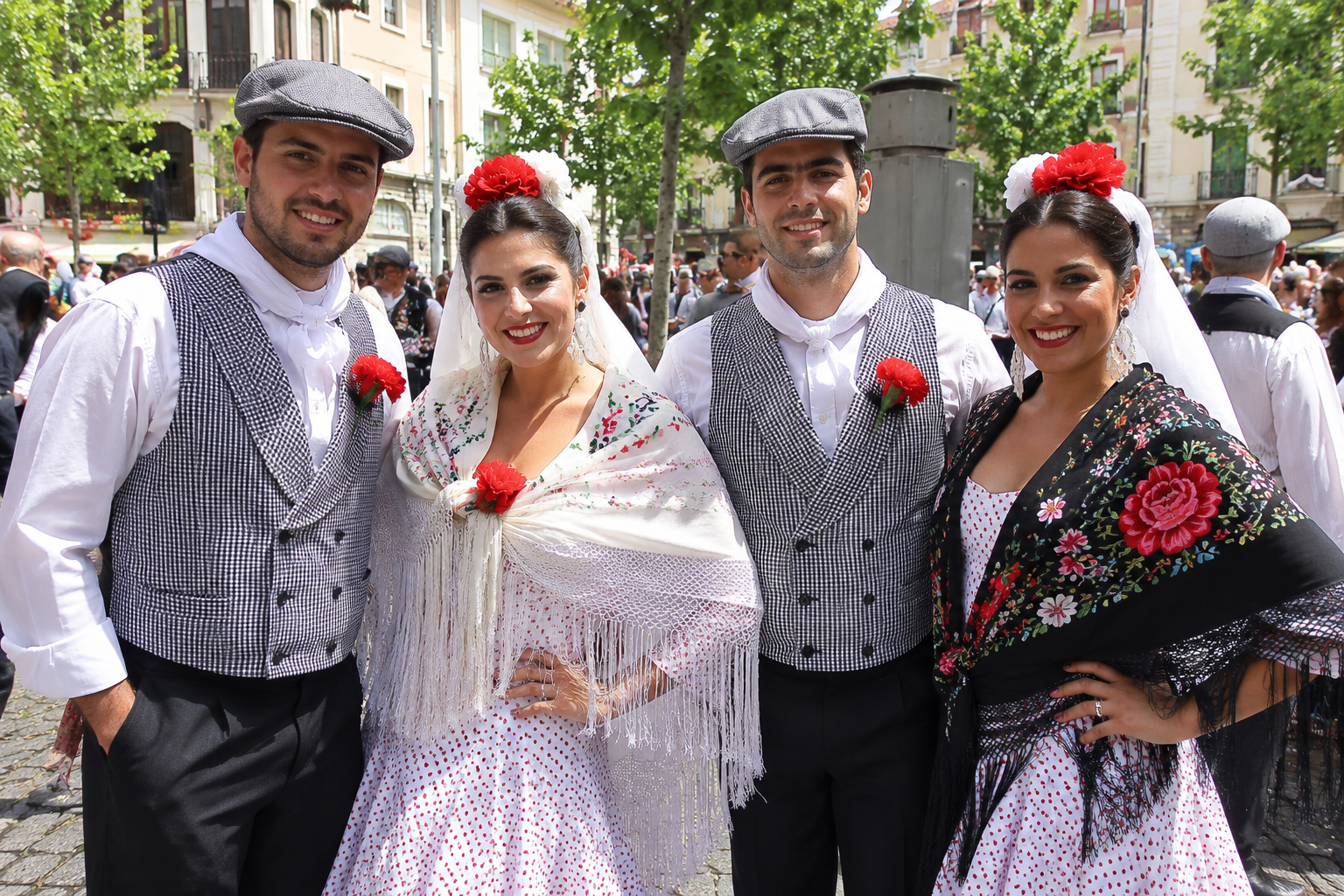
First-time visitors to San Isidro are often surprised by the traditional clothing seen throughout the city.
The classic Madrid festival outfits are known as “Chulapo” for men and “Chulapa” for women. They originally date back to 19th-century Madrid.
Men typically wear:
- a flat cap,
- a waistcoat,
- a white shirt,
- and a neck scarf.
Women usually wear:
- tight polka-dot dresses,
- traditional shawls, ( Mantón de Manilva)
- flowers in their hair,
- and often carry a fan.
Many families dress entirely in traditional outfits — from grandparents to children. For many visitors, this is exactly what makes the atmosphere feel so special.
The famous Chotis dance
San Isidro is also closely linked to Madrid’s traditional dance, the “Chotis”. During the dance, the man usually moves almost on the same spot, while the woman elegantly dances around him.
In many parts of the city, spontaneous dancing takes place throughout the festivities, accompanied by old Madrid music and traditional barrel organs.
Bailando por Madrid ha partido de la Puerta del Sol hasta la plaza de Oriente, llenando las calles de tradición, color y ritmo, con más de 450 chulapos y chulapas https://t.co/3X8HiNsGwO
— Telemadrid (@telemadrid) May 11, 2025
What do people eat during San Isidro?
Food naturally plays a huge role in the celebrations
Typical favourites include:
- Spanish tortilla,
- ham and olives,
- park picnics,
- vermouth enjoyed outdoors.
And above all, the famous “Rosquillas” — small ring-shaped pastries sold all over Madrid during the festival.
There are several traditional varieties:
- “Tontas”
- “Listas”
- “Santa Clara”
- “Francesas”
Many Madrileños buy them every year as part of the San Isidro tradition.
Concerts and long nights
San Isidro is no longer just about tradition. Across Madrid, free open-air concerts take place every night — ranging from flamenco and pop to indie and electronic music.
Especially around Plaza Mayor, Las Vistillas and Matadero, the city remains alive until very late at night.
Why so many foreigners fall in love with San Isidro
Many tourists and international residents discover the festivities almost by accident — and are surprised by how different Madrid suddenly feels.
During San Isidro, the city becomes:
more traditional,
more family-oriented,
more chaotic,
but at the same time incredibly vibrant.
Or, as many Madrileños would say:
“During San Isidro, Madrid shows its true soul.”
- traditioneller,
- familiärer,
- chaotischer,
- aber gleichzeitig unglaublich lebendig.
Oder wie viele Madrilenen sagen würden:
„Während San Isidro zeigt Madrid seine wahre Seele.“