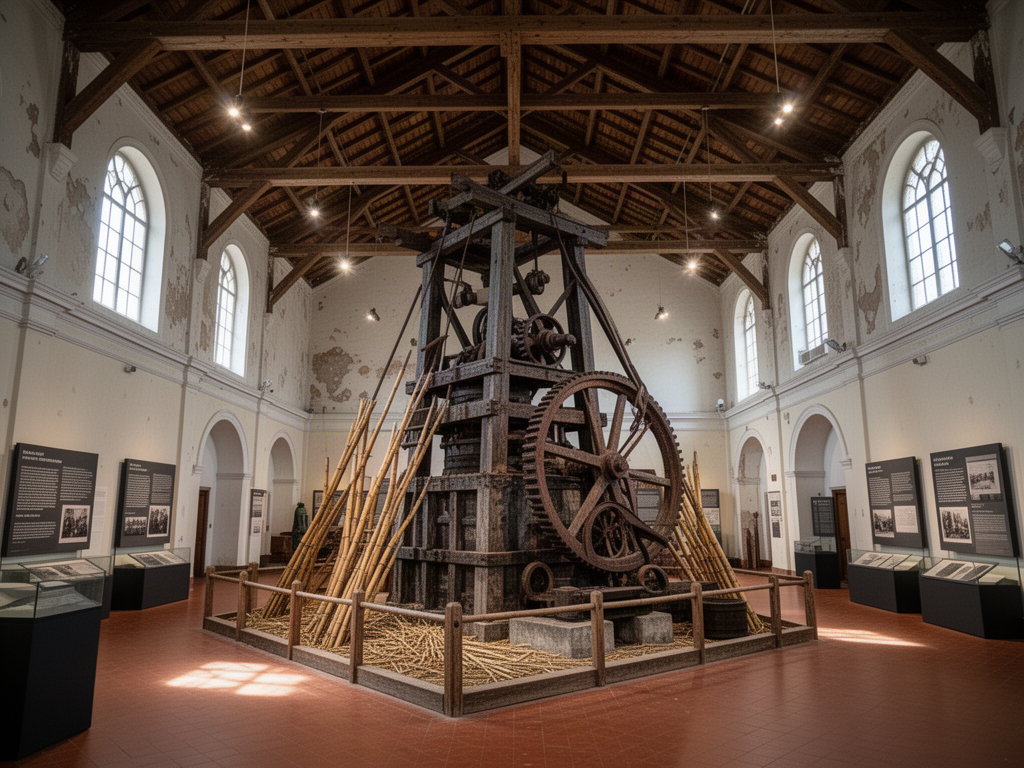
Marbella plans to transform the historic Trapiche del Prado into a museum dedicated to the history of sugarcane production. Once restoration work is complete, the building will showcase the city’s economic and industrial past to visitors. The municipal administration has launched a tender worth approximately 233,000 euros for the setup of the exhibition areas.
Spain Expat Press Editorial Team
by Marlon Gallego Bosbach
The project aims to preserve Marbella’s historical heritage while making it accessible to residents, school groups, and tourists. Several exhibition areas are planned to explain the history of the site, the processing of sugar cane, and the building’s subsequent use.
From historic production site to museum
Dating back to 1644, the Trapiche del Prado is considered a significant testament to Marbella’s pre-industrial economic history. For a long period, sugarcane processing played a key role in the region’s economic development.
As the profitability of sugar production declined, the use of the facility changed as well. Later, products such as wine and spirits were manufactured there. The surviving structural remains thus document various phases of local economic history.
The restoration of the building was completed in August 2025. Work had begun in December 2021, taking significantly longer than originally planned.
Six areas for the exhibition
The planned museum is set to comprise six areas, including five indoor sections and one outdoor area. Visitors will be able to trace the evolution of the Trapiche del Prado from its founding to its recent restoration.
Part of the exhibition is dedicated to the beginnings of sugar production and the historical figures associated with the establishment of the facility. A chronological overview aims to illustrate the key stages of its history.
Other sections explain the processing of sugarcane and the subsequent shift to other branches of production. Surviving remnants – including large containers and parts of the historic facilities – help illustrate the former work processes.
The outdoor area is designed to feature a so-called *molino de sangre*. With this type of mill, the power required to press the sugarcane and extract the juice for further processing was generated by animals.
The exhibition is to be complemented by information panels, display cases, lighting, and audiovisual materials. Multilingual content is also planned.
Restoration cost significantly more than planned
The renovation of the Trapiche del Prado involved significant cost increases. The original contract amounted to approximately 3.83 million euros, while the final costs came to around 5.71 million euros. This resulted in a cost increase of approximately 1.88 million euros, or just under 49 percent. About 80 percent of the final renovation costs were funded by European grants.
A further 233,157 euros have been allocated for the subsequent museum fit-out. This funding is intended to transform the restored building into an exhibition space that conveys the history of sugar production and its significance for Marbella.
Cultural use alongside a public senior residence
The Trapiche del Prado is located on a site where a public residence for the elderly is also being built. Both undertakings are independent projects but share the same grounds.
The restoration of the historic building aims to help preserve a long-neglected piece of the city’s history. In addition to the permanent exhibition, plans include educational programs, cultural activities, and temporary exhibitions.
A specific opening date for the museum has not yet been confirmed. The completed restoration thus represents an important step, while the outfitting of the exhibition spaces marks the next phase of the project.