An exclusive investigation by the Spanish newspaper El Confidencial has sent shockwaves through Spain’s media. According to the report, people working with the Interior Ministry under Pedro Sánchez’s government compiled an extensive dossier on dozens of working journalists, complete with photographs and assessments of their supposed political leanings. If confirmed as reported, the affair raises deeply troubling questions about the relationship between government and a free press in a European democracy.
Spain Expat Press Editorial Team
The revelation belongs to El Confidencial. That distinction matters.
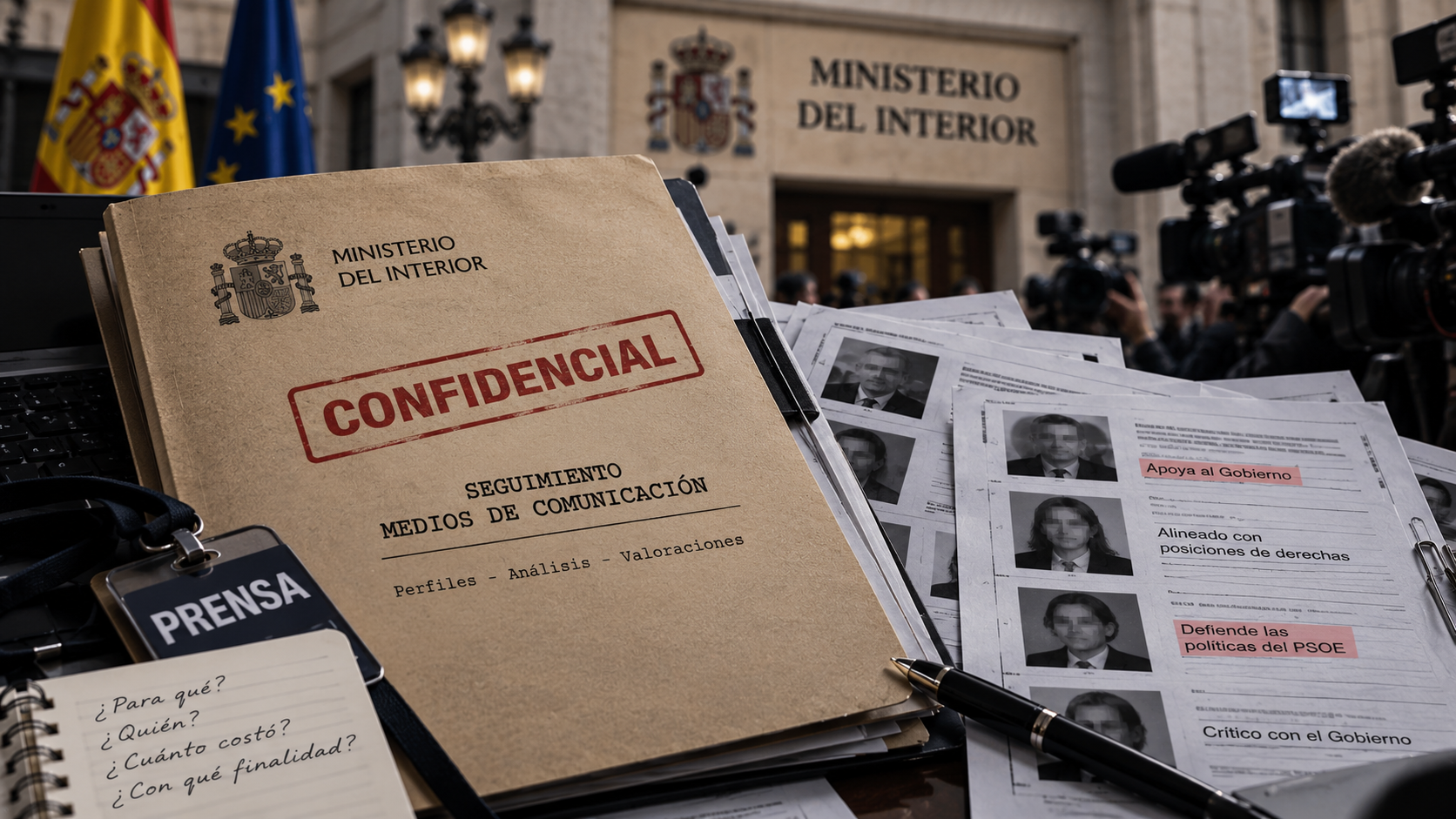
In an exclusive investigation published on Tuesday, 8 September, journalist Alejandro Requeijo reported the existence of a dossier running to dozens of pages and containing profiles of journalists working across the Spanish media.
According to El Confidencial, the document was prepared by collaborators of Fernando Grande-Marlaska, the interior minister in Pedro Sánchez’s Socialist-led government.
These were not, the newspaper reports, merely lists of names, positions or media organisations.
Individual entries allegedly contained photographs and assessments of journalists’ perceived political positions.
Among the descriptions quoted by El Confidencial are “supports the government”, “aligned with rightwing positions”and “defends PSOE policies”.
And that is where this story becomes considerably more serious.
Why would a government need to classify journalists politically?
There is one obvious question.
Why?
Why would people working within the Interior Ministry need to know whether an individual journalist was sympathetic to the government, inclined towards the political right or supportive of policies pursued by Sánchez’s Socialist party?
Who commissioned the dossier?
Who compiled the information?
How many journalists were profiled?
Who had access to it?
How long did its preparation take?
And, most importantly, what was it intended to be used for?
These are not trivial questions.
Spain’s Interior Ministry is not simply another government department. It oversees some of the state’s most sensitive security structures.
That makes the reported political classification of journalists particularly unsettling. The people being assessed are members of a profession whose democratic purpose includes scrutinising precisely those who exercise state power.
An uncomfortably authoritarian image
The picture described by the investigation is disturbing in its simplicity.
A journalist’s photograph. A name. A profile. And alongside it an assessment of whether that person supports the government or belongs to a particular political tendency.
Such practices carry an unmistakably authoritarian flavour.
There is no need to use the word “fascism” casually to recognise why political profiling of journalists by people working for the state should alarm anyone concerned about liberal democracy.
If the purpose was to distinguish between journalists considered friendly towards the government and those regarded as hostile or politically inconvenient, the implications would be more serious still.
A free press cannot function on the basis of loyalty to those in office.
A journalist may support Pedro Sánchez.
Another may oppose him.
A reporter may be conservative, socialist, liberal or politically unaffiliated. They may praise a government decision on Monday and subject the same government to devastating scrutiny on Tuesday.
That is not a problem to be managed.
It is what press freedom looks like.
And who paid for it?
There is another question that deserves attention.
A dossier running to dozens of pages, containing photographs, individual profiles and political assessments of numerous journalists, does not produce itself.
Someone had to gather the information.
Someone had to select it.
Someone had to analyse it, write it down and organise it.
That takes working hours. And working hours cost money.
There is, on the information currently available, no established figure for what the dossier cost, nor evidence that a specific budget was allocated to its preparation. It would therefore be wrong to invent one.
But if ministry employees or other publicly funded personnel were involved, taxpayers are entitled to ask what public resources were used and for what purpose.
The central question remains: what was it for?
Governments knowing which journalists cover particular departments is entirely normal.
Press offices maintain contact lists. Officials know reporters. Governments monitor media coverage and prepare themselves for difficult questions.
Political profiling is another matter.
Were these assessments intended to influence who received interviews?
To identify journalists regarded as sympathetic to the government?
To distinguish between friendly and hostile media?
To decide who should receive information or access?
Or was there some other explanation entirely?
Until the Interior Ministry provides a convincing account of why the document existed, those questions will remain.
Sánchez’s government has questions to answer
This goes beyond another confrontation between Spain’s government and its political opponents.
It touches on something much more fundamental: the relationship between democratic power and those whose job it is to scrutinise it.
Cataloguing journalists according to their presumed political sympathies is not an ordinary function of government communications.
That is why transparency is now essential.
Who commissioned the dossier?
Who prepared it?
How many journalists were included?
What public resources, if any, were devoted to it?
Who was allowed to see it?
And above all:
Why did people working within the Interior Ministry of Pedro Sánchez’s government need a document identifying whether individual journalists supported the government or held different political views?
The questions cannot simply be confined to Fernando Grande-Marlaska. They concern the Sánchez administration and the standards expected of any democratic government.
Until convincing answers are provided, the impression left by the revelations is profoundly uncomfortable.
When people working within the machinery of the state begin sorting journalists according to their presumed political sympathies, a line is being approached that democracies should watch with particular care.
That principle should apply regardless of which party happens to be in power.
The original investigation was published exclusively by El Confidencial and reported by Alejandro Requeijo on 8 September 2026.