With five days to go before Sunday’s general election, the polls paint a picture of a Spain split by age, sex and postcode. The hard-right Vox is surging among young people and men, the Socialists are holding firm among women and in the big cities, and the conservative Popular Party commands pensioners and the countryside. A bloc of undecided centrist voters may yet tip the balance.
Spain Expat Press Editorial Team
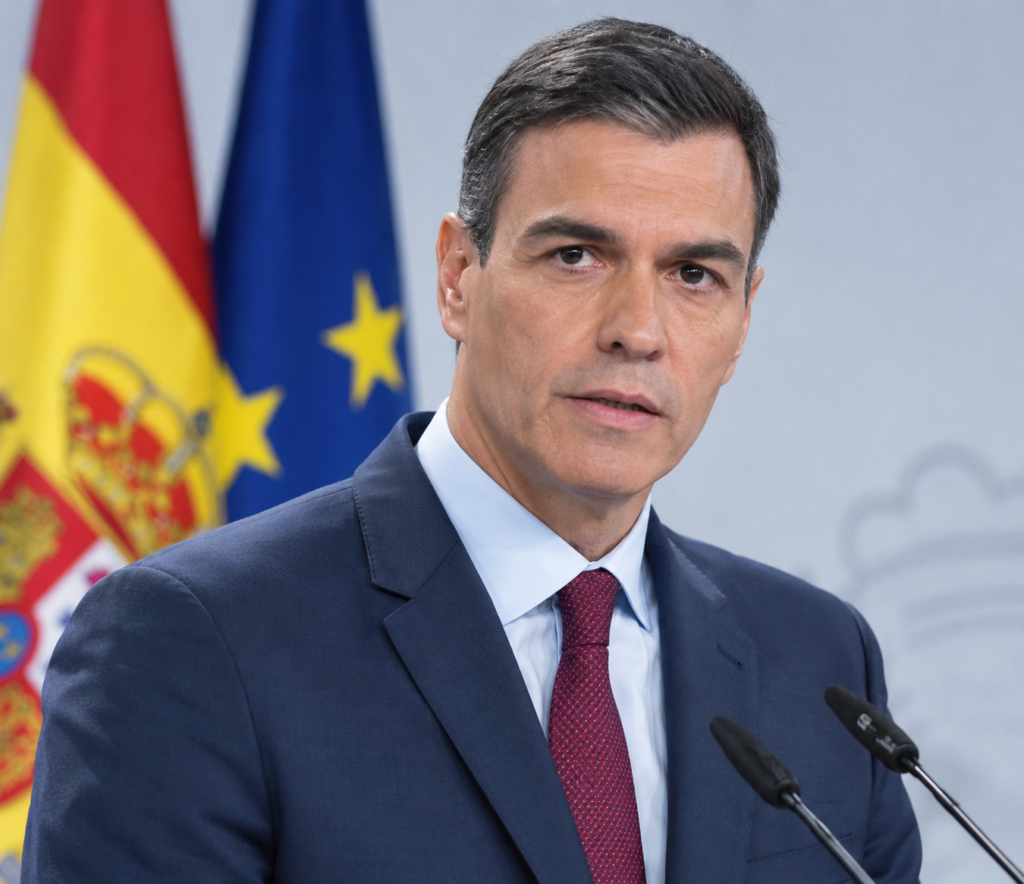
Pedro Sánchez, the prime minister, dissolved parliament in early October after Congress threw out his housing decrees, bringing forward by some eight months a vote that could have waited until summer 2027. Spaniards will elect 350 members of the lower house, the Congress of Deputies, and 208 senators.
For readers less familiar with Spanish politics: the PSOE is Sánchez’s centre-left Socialist party. The PP (Popular Party), led by Alberto Núñez Feijóo, is the main centre-right force, broadly comparable to the Conservatives. Vox, under Santiago Abascal, sits on the hard right. Frente Amplio (Broad Front) is the new left-wing alliance built out of Sumar.
The race has tightened in the final stretch. The last poll by 40dB for El País and Cadena SER, published on 23 November from 7,500 interviews, puts the PP on 31.8 per cent and 130 seats, with the PSOE on 30.9 per cent and 124. Vox would take 17.3 per cent and 57 seats, and Frente Amplio and its regional allies nine. Together the PP and Vox would hold 187 seats, comfortably above the 176 needed for a majority. The state-run pollster, the CIS, by contrast puts the Socialists ahead and the right short of that mark.
A generation apart
Age is now the sharpest dividing line in Spanish politics. Among 18 to 24-year-olds, Vox stands at 26 per cent, level with the PP and four points ahead of the Socialists — a rise of seven or eight points since 2023. Among 25 to 34-year-olds it is closing in on 30 per cent, and it leads outright among everyone under 45.
This is no marginal constituency: some 3.2 million 18 to 24-year-olds are on the electoral roll. Their chief concerns are getting on the housing ladder and finding secure work. Spain’s Youth Council reads much of their support for Vox as a protest against the established parties rather than a full ideological conversion.
At the other end of the age range the picture is reversed. Among the over-65s, the PP and PSOE are tied on 28.2 per cent each, while Vox slips to 12.1 per cent. With almost one in four adults past 65, older voters remain the bedrock of the two traditional parties.
The gender gap
The second great fault line runs between men and women. According to 40dB’s late-September survey for El País, Vox polls 22.5 per cent among men but only 15.9 per cent among women. At 6.6 points, that is the widest gender gap of any party.
The Socialists show the mirror image, with 24.8 per cent among women against 19.8 per cent among men. The PP also does slightly better with women, on 21.1 per cent compared with 18.0 per cent.
There is a twist, however: among women under 45, support for Vox has nearly doubled since 2023.
Work, class and place
Employment status and self-described social class complete the portrait. Pensioners are the PP’s core vote, at 28.0 per cent. Among people in work, the Socialists and Vox are neck and neck: the PSOE does better with civil servants and service-sector staff, Vox with manual workers and wage earners. Among the unemployed, the PP records its weakest score in any group.
| Group (40dB, Sept 2026) | PSOE | PP | Vox |
|---|---|---|---|
| Pensioners | — | 28.0% | — |
| In work | 21.8% | — | 21.0% |
| Unemployed | 17.5% | 11.5% | 17.7% |
| Upper and upper-middle class | 22.2% | 22.7% | 17.9% |
| Middle class | 20.7% | 19.1% | 23.4% |
| Lower-middle and working class | 24.0% | 15.6% | 17.2% |
Geography reinforces the pattern. The Socialists dominate cities of more than 500,000 people — Madrid, Barcelona, Valencia and Seville — with 30 to 34 per cent. The PP is the leading force in medium-sized cities of 50,000 to 250,000 and in rural Spain. Vox performs best in small towns of 10,000 to 50,000 and in the commuter belts around the big cities. Frente Amplio barely registers outside the regional capitals.
Switching sides since 2023
Data on vote transfers show how the board has shifted since the July 2023 election. At the start of the campaign, the Socialists were holding on to 68.4 per cent of their previous voters, losing 5.4 per cent to the PP, 4.8 per cent to Vox and 3.6 per cent to Sumar.
On the right, the traffic runs largely one way. Some 13.5 per cent of those who backed the PP in 2023 said they would now vote Vox, while only 1.6 per cent of Vox voters planned to move the other way. According to 40dB’s open data, that drift from the PP to Vox is concentrated among younger voters.
Since then the Socialists have narrowed the gap, rising in 40dB’s tracker from 29.9 per cent on 9 November to 30.9 per cent on 23 November. The pollster also finds some people who abstained in 2023 now ready to vote for parties of the right.
The undecided hold the key
With less than a point between the PP and the Socialists, undecided voters matter more than ever. According to 40dB, around a fifth of those surveyed have yet to make up their minds.
A poll by the Catalan daily Ara, published on 15 November, sketches who they are:
- Sex: 63 per cent are women.
- Age: mostly middle-aged; 35 per cent are aged 50 to 64 and 27 per cent 35 to 49.
- Ideology: 64 per cent place themselves in the centre, 30 per cent on the left and 6 per cent on the right.
- Party sympathy: more than half feel close to no party; among the rest, the PSOE is mentioned most often, by 19 per cent.
The CIS’s October survey points the same way. The most hesitant are those who voted in 2023 for Junts, the Catalan pro-independence party (31.1 per cent), and for Sumar (21.8 per cent), against 17.3 per cent overall.
One country, several electorates
The polls describe an electorate fractured by generation and geography. Vox draws on the young, men, the middle class and small towns. The PP relies on pensioners, medium-sized cities and the countryside. The Socialists lean on women, the big cities and working-class voters. Sunday will show which of these coalitions turns out in greater numbers — and which way the wavering centre breaks.
For British residents in Spain, note that only Spanish nationals can vote in this general election.
Methodology: breakdowns by sex, employment status, class and place come from 40dB’s September 2026 survey for El País (2,000 interviews); figures on age and vote transfers from El País analysis published in early October. Vote shares are from the 23 November poll. Spanish law bars the publication of new polls from 24 November.