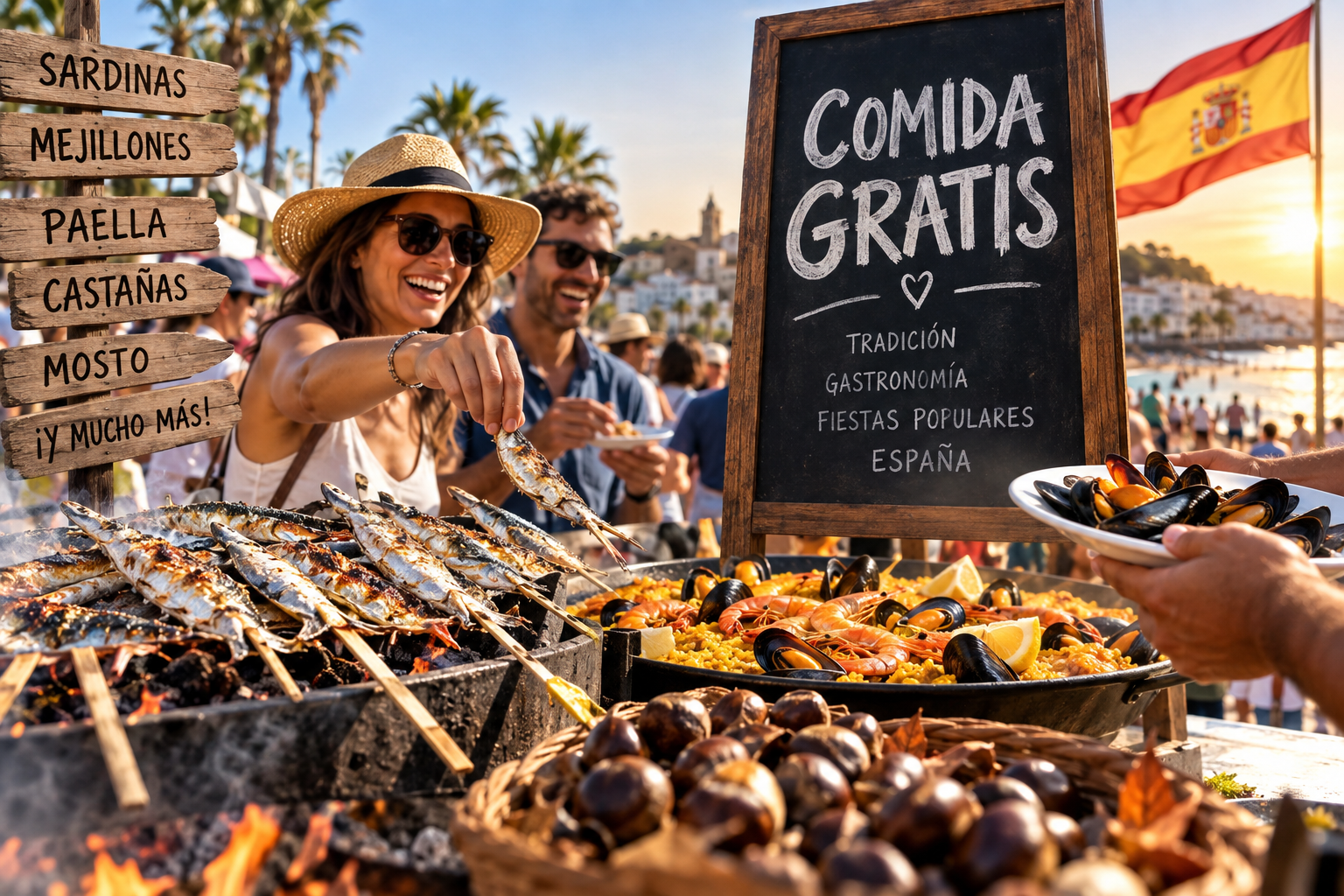
Sardines grilled on the beach, hundreds of kilos of mussels, paella, roasted chestnuts and even young wine: across Spain, some local fiestas still come with an irresistible extra – free food. Spain Expat Press takes a look at the dates still to come in 2026.
Spain Expat Press Editorial Team
Spain and food are virtually inseparable. Yet there is one tradition that many foreign residents and visitors know surprisingly little about. At numerous local fiestas populares, the celebrations are not limited to music, dancing and processions. Sometimes, everyone gets fed as well – for free.
And we are not necessarily talking about tiny samples handed out at a food fair. At some celebrations, hundreds or even thousands of kilos of food are prepared and shared among locals and visitors.
If you fancy experiencing one of Spain’s more generous traditions over the coming weeks and months, these are some of the dates worth remembering.
17 September: 1,700 kilos of sardines on Marbella’s beaches
The first opportunity comes on the Costa del Sol – and very soon.
On Thursday, 17 September 2026, Marbella will celebrate the 13th edition of its Moraga Popular. From 8pm, festivities will take place simultaneously on four beaches: La Salida in San Pedro Alcántara, Levante in Puerto Banús, La Venus in Marbella and Real de Zaragoza in Las Chapas.
The quantities involved are impressive.
Around 1,700 kilograms of sardines are due to be handed out free of charge, traditionally prepared as espetos over an open fire. They will be accompanied by around 1,000 kilograms of tomato salad, as well as bread and drinks.
Live music completes what is essentially a very Costa del Sol evening: beach, fire, sardines and a crowd gathered by the Mediterranean.
19 September: 550 kilos of free mussels in Bilbao
Just two days later, the free-food trail moves to northern Spain.
On 19 September, Bilbao’s Masustegi neighbourhood celebrates its traditional Día del Mejillón, or Mussel Day.
At the heart of the event is a huge communal meal, with 550 kilograms of mussels distributed free of charge while stocks last.
But the celebration is about far more than seafood. The event forms part of the Fiestas de San Gabriel, with games, competitions and a traditional charanga brass band during the day before a DJ takes over and keeps the party going until midnight.
There is history behind the choice of food, too. Masustegi was heavily shaped by Galician families who settled in the area during the 20th century, and traces of that Galician heritage remain part of the neighbourhood’s identity today.
23 September: free paella in Mijas
Then it is back to the Costa del Sol.
Every September, Mijas celebrates its Día del Turista, an event designed as a thank-you to the visitors who have helped make the town one of the region’s best-known destinations.
The celebrations take place around Plaza Virgen de la Peña in Mijas Pueblo, with flamenco and Andalusian traditions taking centre stage.
For hungry visitors, however, there is another attraction: a free paella tasting from around 1.30pm.
That means anyone based on the Costa del Sol has two particularly easy opportunities within a matter of days: sardines on the beach in Marbella and paella in the whitewashed streets of Mijas Pueblo.
October: free tastings in Mallorca
Mallorca is another place worth watching as autumn arrives.
Throughout 2026, the Consell de Mallorca’s “La Tramuntana es viu i es tasta” initiative has been visiting different municipalities across the island, showcasing produce from the Serra de Tramuntana.
Each stop includes a small complimentary tasting of local products.
Dates after the summer include 4 October in Alaró, 11 October in Escorca, 15 November in Es Capdellà, 21 November in Caimari, 22 November in Bunyola and 12 December in Esporles.
Do not expect an enormous free paella here. These are smaller tastings, but they offer an appealing way to discover the produce and culinary traditions of Mallorca’s spectacular mountain region.
25 October: free chestnuts and mushrooms in the Basque Country
As temperatures begin to fall, Spain’s chestnut festivals take over.
One example is the Gaztainaga Eguna in Galdames, Bizkaia, scheduled for 25 October 2026.
The celebration in Plaza San Pedro revolves around one of autumn’s most traditional ingredients: the chestnut.
Alongside a cooking competition and displays devoted to mushrooms and medicinal plants, visitors can enjoy free roasted chestnuts and a mushroom dish.
It is a very different Spain from the Mediterranean coast: mountains, autumn leaves, mushrooms and hot chestnuts rather than beaches and sardines.
1 November: chestnuts, young wine and village traditions in Extremadura
At the beginning of November, another old food tradition can be found in Herreruela, in the province of Cáceres.
On 1 November, All Saints’ Day, the village celebrates its traditional Magusto.
A large communal fire is lit in the Plaza Mayor and chestnuts are roasted for the occasion. The tasting is free, while young wine and aguardiente, traditional songs and dancing are also part of the festivities.
This is less a tourist event than a genuine village celebration – which is precisely what makes it interesting.
7 November: more chestnuts in a village with its own language
A few days later, Extremadura offers another unusual autumn celebration.
On 7 November 2026, Eljas in Cáceres holds its Fiesta das Castañas Borrallás-Magusto.
Chestnuts are roasted over a large communal fire, alongside products traditionally associated with the matanza, as well as young wine and aguardiente. Entry to the festivities is free.
Eljas has another fascinating distinction: it is one of the places where A Fala, a local Romance language variety spoken in the Jálama Valley, remains in use.
What begins as a trip for roasted chestnuts can therefore become an encounter with one of Spain’s lesser-known cultural traditions.
November: Galicia’s great chestnut tradition
The Magosto tradition is particularly closely associated with Galicia.
In Vilaboa, Pontevedra, November’s festivities in honour of San Martiño also traditionally include a free chestnut tasting, accompanied by music and family activities.
Travel through north-western Spain in autumn and one thing quickly becomes clear: chestnuts occupy almost the same place in the seasonal calendar here as grilled sardines do on the Andalusian coast in summer.
28 November: free young wine in the mountains near Ronda
One of the most interesting dates for anyone living on the Costa del Sol comes towards the end of November.
On 28 November 2026, the tiny mountain village of Atajate, in Málaga province, celebrates its Fiesta del Mosto.
After the grape harvest and fermentation, local producers traditionally open their stocks of mosto, or young wine. During the festival, large quantities are shared free of charge with residents and visitors.
The tradition was revived in 1985 and has since become one of the small village’s best-known annual celebrations. Since 2008, the young wine has also traditionally been accompanied by homemade migas.
For Costa del Sol residents, this is an especially tempting autumn excursion: head towards Ronda and into the Serranía, taste the new wine and experience a village fiesta that feels a long way from Spain’s familiar tourist resorts.
Why does Spain give away food at its fiestas?
There is more behind these events than simple generosity.
Many of Spain’s communal food traditions are closely tied to what each area produces. Along the coast, that may mean sardines or seafood. In Galicia and Extremadura, autumn brings chestnuts. In wine-growing regions, it might be mosto or wine. Elsewhere, enormous rice dishes, stews or other regional specialities take centre stage.
Sharing food has long been part of the traditional fiesta popular. The village or neighbourhood celebrates together – and outsiders are invited to join in.
For foreign residents in particular, that makes these events worth seeking out. They offer an opportunity to experience Spain away from the hotel buffet and restaurant terrace, surrounded instead by the people who actually live there.
One Spain Press tip: arrive early
There is, inevitably, a catch.
At these celebrations, “free” usually also means “while stocks last”.
In Bilbao, for example, the 550 kilograms of mussels will be served only until supplies run out.
So note the date, arrive early – and come hungry.
Because sometimes, some of the best experiences in Spain really are free.