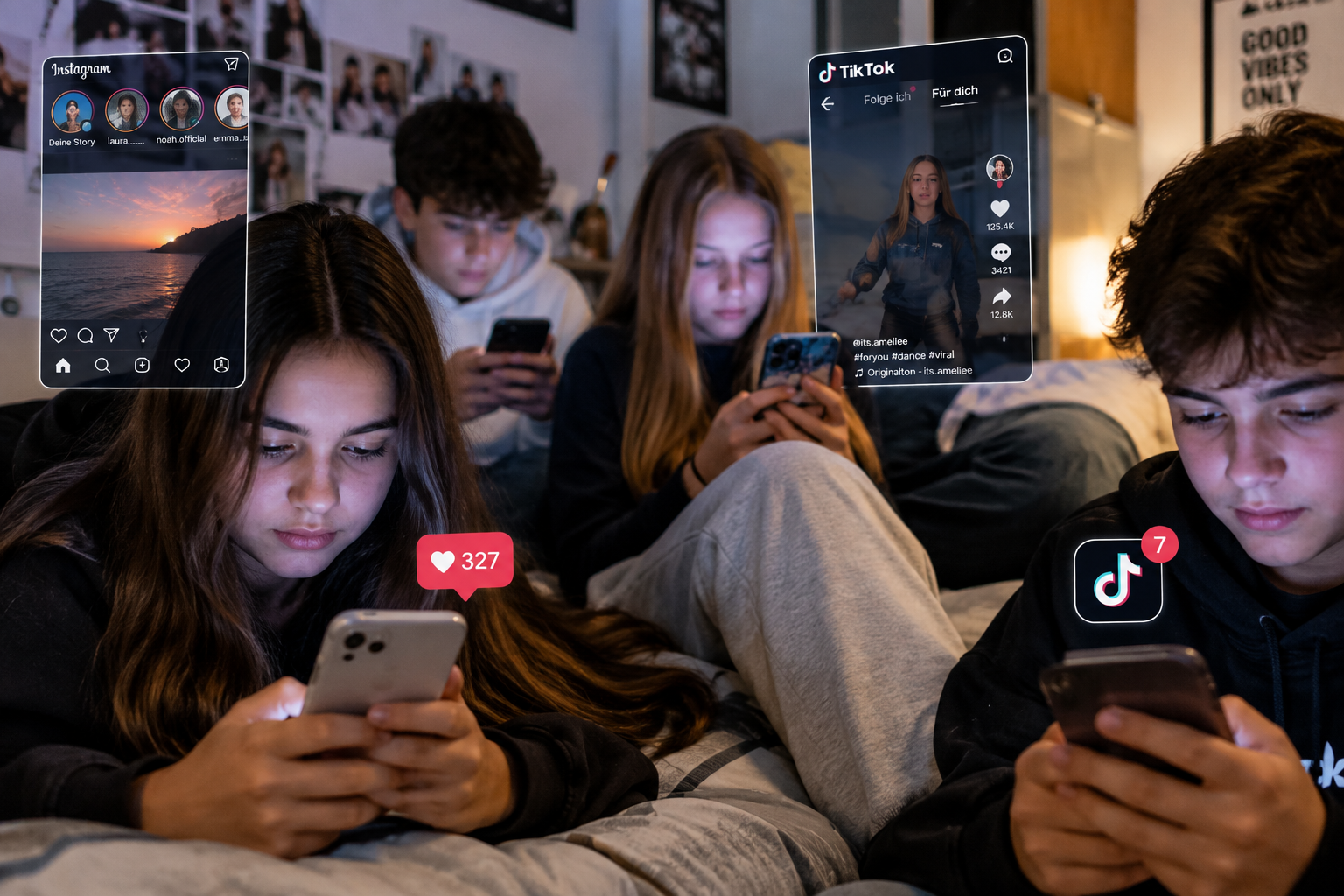
The European Commission aims to better protect children and young people from the risks associated with social networks. Commission President Ursula von der Leyen today presented a proposal for new legislation to protect minors in the digital space. The so-called “EU Kids Act” includes provisions for age limits on social networks, stricter parental control options, and restrictions on certain platform features.
Spain Expat Press Editorial Team
by Marlon Gallego Bosbach
The initiative could have far-reaching consequences for Spain. Social networks are part of everyday life for many young people—used for communicating with friends, for entertainment, and for seeking information. If the planned regulations are adopted, Spanish youths and the operators of digital platforms alike would have to adapt to new requirements.
However, this is currently a legislative proposal. The final provisions and the date of their application have not yet been determined.
No personal social media access under the age of 13
A key component of the European initiative is an age limit for the independent use of social networks. Children under the age of 13 are not to be granted their own access to such platforms.
For adolescents aged 13 to 15, however, restricted accounts subject to parental supervision are envisaged. From the age of 15, young people are to be able to use their own accounts, although special protective measures will continue to apply.
The age limits are intended to establish uniform minimum standards across Europe. This would mean that, in the future, the use of social networks by minors would be more strictly determined by age. For young people in Spain, this could mean they are no longer able to use their existing accounts without restriction. However, it remains unclear how existing profiles will be handled and what transition periods might apply.
Mini-accounts and parental controls for 13- to 15-year-olds
For the 13-to-15 age group, the proposal envisages so-called “mini-accounts.” These are intended to be managed or supervised by parents and to offer a limited range of functions.
According to the information released so far, plans include limiting daily usage to one hour. Contact options and other features are also set to be restricted.
For Spanish families, this could mean a shift in how social networks are handled. Parents would become more involved in setting up and monitoring accounts, while young people would have to adapt to additional restrictions on the use of the platforms they are accustomed to.
The specific technical requirements and the precise design of parental controls must be clarified during the further legislative process.
Put an end to endless scrolling and automatic reward mechanisms
The EU Commission aims to regulate more than just access to social networks; the design of the platforms themselves is also to be geared more strongly towards the protection of minors. The focus is on features that can cause users to stay online longer than originally intended—such as infinite scrolling, automatic video playback, and certain reward mechanisms.
Notifications sent at night are also to be restricted. The aim is to design digital services in a way that better takes into account the health and well-being of young people.
For young people in Spain, this could bring changes to the use of TikTok, Instagram, YouTube, and other platforms. Exactly how the features would change depends on the final legal requirements.
Spain is already taking action on regulation
The European initiative does not come out of nowhere. Spain, too, is already addressing stricter rules to protect children and young people online. In recent years, the country has been working on measures for age verification and the protection of minors. Spain is thus among the EU member states already exploring technical and legal solutions for a safer digital space.
A key part of this debate is the question of how platforms can reliably verify their users’ ages without collecting excessive amounts of personal data. Spain has already developed technical approaches to this and participated in preparatory work at the European level. European regulations could complement these national efforts in the future and establish common standards.
What does this mean in concrete terms for young people in Spain?
If the EU Kids Act were adopted in its proposed form, the impact on the daily lives of many young people would be palpable. For children under the age of 13, independent access to social networks would essentially be eliminated. Adolescents aged 13 to 15 would face supervised accounts and time restrictions. From the age of 15, independent use would be permitted, albeit still subject to special protective measures.
The platforms themselves would also need to adjust their offerings. For young users, this could result in changes to aspects such as how content is displayed, contact options, and notifications.
The planned rules do not apply solely to social networks in the strict sense; video platforms, online games, and AI chatbots are also set to be included in the protective framework. Consequently, the regulation could extend to a significant portion of the digital leisure activities engaged in by young people in Spain.
Age verification and data protection remain key issues
To ensure that age limits are actually observed, digital platforms are expected to verify their users’ ages more reliably. The EU Commission is banking on a common European solution for age verification to achieve this.
However, the implementation raises questions. On the one hand, children need to be effectively protected against unsuitable content and contacts. On the other hand, it is necessary to prevent the collection or storage of an excessive amount of personal data for this purpose.
For Spanish young people and their families, too, it will therefore be crucial to determine what data is collected during age verification, who can access it, and how long it is stored. The specific technical implementation is still being worked out.
Platforms face heavy fines
The proposal also outlines consequences for companies that fail to comply with the new protection requirements. In the event of violations, fines of up to six percent of global annual turnover could be imposed. The aim is to hold operators more accountable for actually implementing age verification and protective measures.
The regulations would also affect major international platforms used by young people in Spain.
EU law has yet to be adopted
The EU Kids Act is currently a proposal by the European Commission. Before the regulations can become binding, the European Parliament and the Member States must deliberate on them and reach an agreement.
Only then will it be clear which age limits and protective measures are actually adopted and when they will take effect. Until then, it remains uncertain when the planned changes might concretely impact the daily lives of young people in Spain.
However, it is clear that the protection of minors in the digital space is increasingly a subject of political and societal discussion in Spain and at the European level.