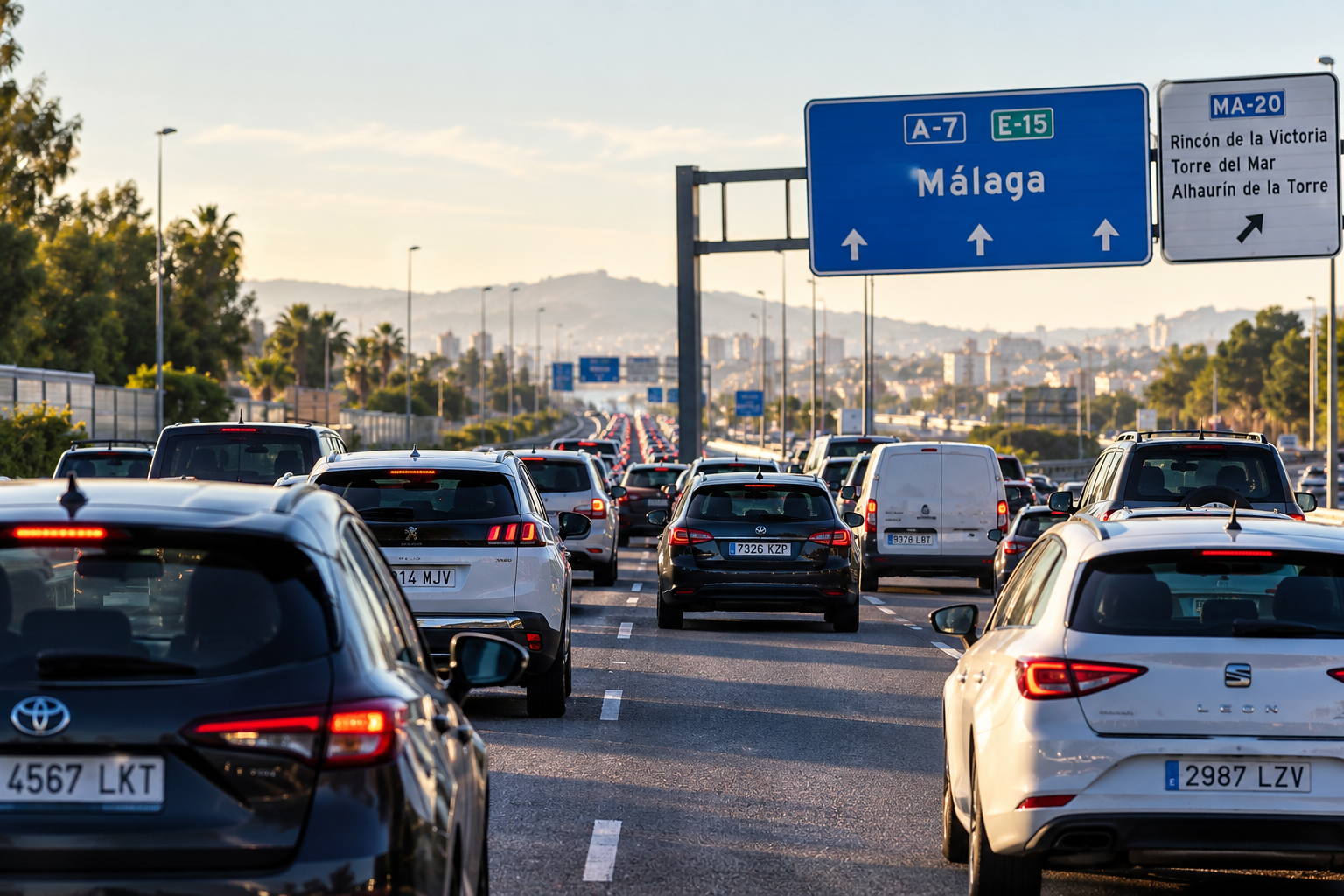
The daily commute costs employees in the province of Málaga not only time but also a significant portion of their income. According to a report by the trade union Comisiones Obreras (CC OO), workers spend an average of around 40 minutes a day commuting. Depending on where they live, travel costs can amount to several hundred euros per month – and in some cases, even up to 1,000 euros.
Spain Expat Press Editorial Team
by Marlon Gallego Bosbach
The union therefore calls for better transport connections, short-term relief measures, and travel allowances that are more closely aligned with actual costs.
The commute extends the workday and takes a toll on one’s pay
“Commuting to work takes time,” explained Fernando Cubillo, General Secretary of CC OO Málaga, at the presentation of the report. On average, the daily commute adds around 40 minutes to regular working hours. The union estimates this additional time burden at approximately 15 percent.
Commuting also poses a significant financial challenge: according to calculations by CC OO, travel costs consume around 15 percent of income on average. Low-wage workers are hit particularly hard by this.
According to figures cited by the union, 42.5 percent of wage and salary earners in the province—more than 314,000 people—have an earned income of barely more than 620 euros per month. Another 38 percent, or around 280,000 employees, earn an average of approximately 1,300 euros per month.
For low-income individuals, even a relatively short commute can consume a large portion of their available funds. “You have to think carefully about whether to accept a job under these circumstances,” said Cubillo.
Commuting costs increase with the distance to the workplace
According to the CC OO, the extent to which the commute affects the monthly budget depends primarily on where one lives. The union calculated the costs of traveling from various municipalities to the capital, basing its figures on the per-kilometer allowance of 0.26 euros set by the Spanish government for work-related travel using a private vehicle.
For example, anyone commuting to Málaga from Torremolinos, Alhaurín de la Torre, Benalmádena, Rincón de la Victoria, or Cártama can expect to pay around 200 euros per month based on these calculations. From Fuengirola, Pizarra, or Mijas, the cost rises to approximately 350 euros.
For employees commuting from Coín, Álora, or Vélez-Málaga, these costs can amount to around 450 euros. For longer distances – such as from Antequera, Marbella, Archidona, Nerja, or Campillos – the union cites a figure of around 650 euros per month. Those commuting daily from Estepona or Ronda to Málaga could spend as much as 1,000 euros on their commute.
For employees earning only around 620 euros a month, commuting costs of 200 euros represent a massive burden. In cases of longer commutes, the journey to work can consume a large portion of their income.
High housing costs exacerbate the commuting problem
CC OO sees a close link between rising housing costs and the increasing burden of commuting. Many people can no longer afford to live in Málaga or in towns heavily shaped by tourism and are therefore forced to move to more distant locations.
At the same time, a large proportion of jobs in the province is concentrated in the capital and along the Costa del Sol. According to the trade union, around 82 percent of employment is located there. Furthermore, 79 percent of the jobs created last year were generated in these areas.
The result: Many workers have to commute from other parts of the province. Commuters come particularly frequently from the Antequera and Guadalhorce regions, but also from the Axarquía and the area around Ronda.
Cubillo criticized the fact that employees forced to move away from Málaga due to high rents subsequently spend a significant portion of their salaries on their daily commute back into the city. This turns the housing issue into a matter of both mobility and social strain.
Union demands higher travel allowances
CC OO identifies another issue in collective bargaining agreements. According to the union, most agreements do not provide for travel allowances. Where such benefits do exist, they are often too low or are paid out as a flat-rate sum to all employees—regardless of how far they live from their workplace.
CC OO Málaga therefore intends to place greater emphasis on this issue during this year’s collective bargaining negotiations. A concrete example is the ongoing negotiation regarding the collective agreement for the automotive sector; the union is calling for monthly allowances of 300 or 450 euros, depending on where the employees live.
From the perspective of employee representatives, travel allowances should take actual costs more fully into account, rather than treating all employees the same despite their widely varying commutes.
Commuting also takes a toll on health
In addition to time and money, the daily commute also affects employees’ health, Cubillo emphasized. The union cites figures from the Junta de Andalucía in this regard.
According to the data, 2,309 workplace accidents occurring on the way to or from work were recorded in the province of Málaga this year. Around 85 percent of these took place in the city of Málaga and the municipalities of the Costa del Sol. Furthermore, Málaga accounts for approximately one in four such commuting accidents in Andalusia.
Cubillo illustrated the impact that long commutes and inconvenient working hours can have on daily life by citing the example of a waitress who works at a restaurant in the Soho district and commutes from Vélez-Málaga. According to him, she pays around 450 euros a month for her commute and an additional 100 euros for a parking space. When working split shifts, she is sometimes forced to spend her break in her car.
Málaga is growing – transport infrastructure is not keeping pace
The union also views the mobility problems as the result of a development in which the city and its employment hubs have grown significantly, while transport connections and infrastructure have not been expanded to the same extent.
Trinidad Salcedo, Secretary for Social Policy and the Environment at CC OO Málaga, pointed to the high number of employees at the Málaga Tech Park; a total of 29,018 people worked there in 2025. At the same time, according to figures cited by the union, the A-357 – on the approach to Málaga – handles around 74,000 vehicles daily.
Rail transport also plays an important role: the Cercanías network recorded more than 15.5 million passengers in 2025. According to CC OO, almost half of these traveled on the C-1 line between Málaga and Fuengirola, which continues to operate on a single-track line.
For the trade union, these figures demonstrate that mobility planning must not be limited to individual companies alone; rather, joint solutions are needed for entire business and employment hubs.
Companies should develop joint mobility plans
CC OO points out that companies with more than 200 employees are required to draw up mobility plans. The trade union is calling for these requirements to be properly implemented in Málaga, with planning that extends beyond individual businesses.
It identifies the Málaga Tech Park, the airport area and El Viso-Guadalhorce as key locations. These areas should have coordinated plans involving businesses, public authorities, transport authorities and workers’ representatives.
The planning should be based on surveys of employees. These should determine where they live, the routes they travel, their working hours, and whether a private vehicle is available to them.
Salcedo emphasized that while Málaga has grown significantly, mobility and infrastructure have not kept pace. The city has become a highly sought-after yet exclusive location.
Union pushes for immediate relief
CC OO is calling for both long-term infrastructure projects and measures that can be implemented as quickly as possible. Workers cannot simply be told to wait a decade for improvements while already suffering from long and expensive commutes.
Long-term demands include the expansion of the Cercanías network, progress on the railway corridor along the Costa del Sol, and an assessment of a rail link between Coín and Marbella. In addition, the union cites further measures for the A-357, the development of the western distributor road, and improvements to key transport hubs.
In the short term, CC OO proposes, among other measures, more buses, extended operating hours, and express services. Feeder buses to Cercanías and the metro, dedicated bus and carpool lanes, employer-organized group transport, and the promotion of carpooling are also intended to help.
Furthermore, the union calls for better coordination of working hours and more opportunities for remote work.
Commuting is becoming a social and economic challenge
The CC OO report makes it clear that mobility problems in Málaga extend far beyond congested roads. For many workers, the commute entails additional working time, high monthly expenses, and a reduced quality of life.
Particularly affected are people who can no longer afford to live in the city of Málaga and are therefore forced to move to surrounding municipalities, while remaining dependent on jobs in Málaga or on the Costa del Sol.
The union therefore calls for a combination of improved public transport services, long-term infrastructure expansion, and greater consideration of commuting costs in collective agreements. The aim is to provide immediate relief to employees and make the daily commute more affordable and easier to plan.