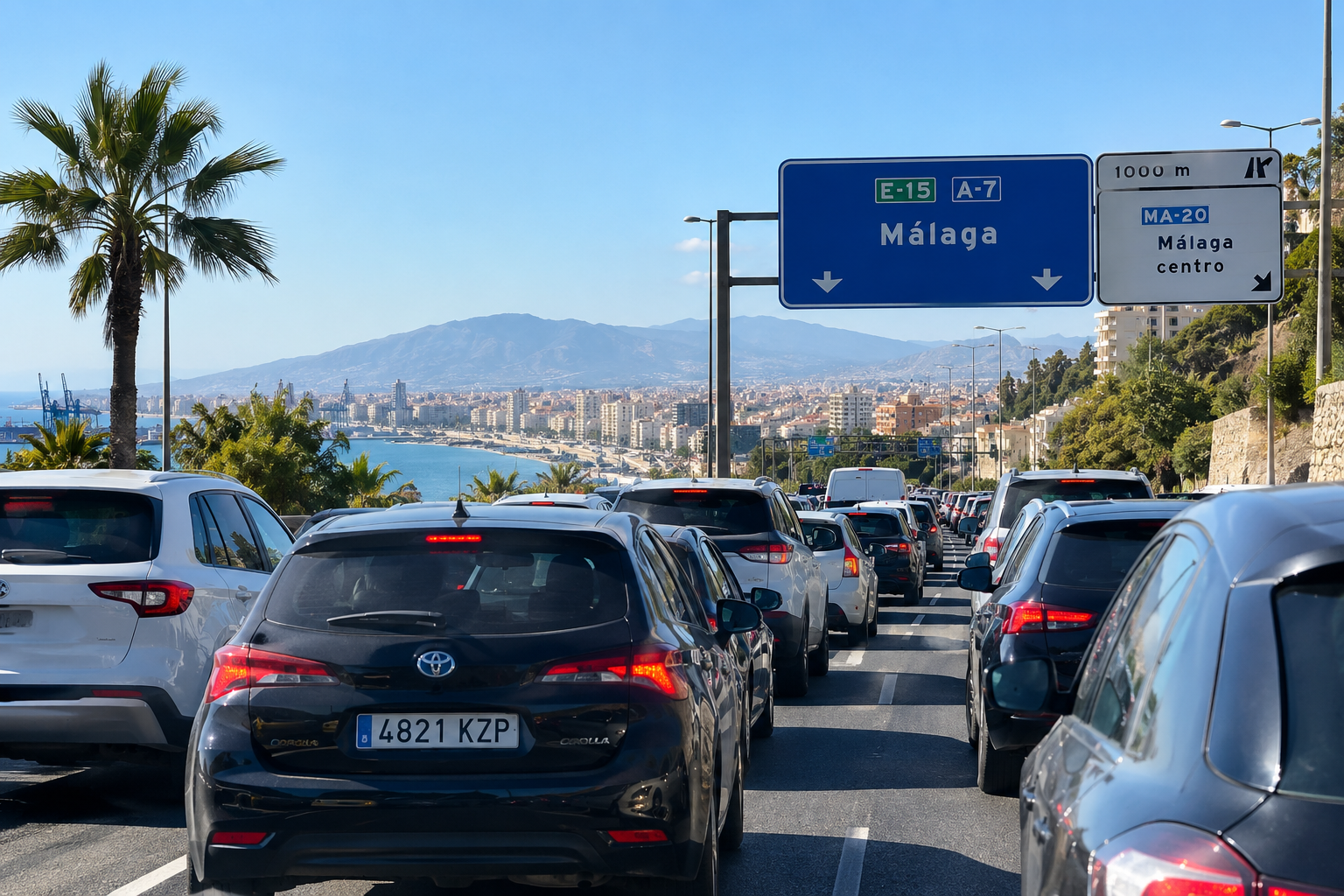
With the start of the new school year, not only does everyday life return to Málaga, but so does the daily traffic congestion. While children and teenagers flock back to schools and universities, and many employees return from their summer break, the province’s transport infrastructure remains overloaded in many places. Numerous planned road construction projects are intended to alleviate the situation – but many of them are still stuck in the planning or approval phase.
Spain Expat Press Editorial Team
by Marlon Gallego Bosbach
The tense situation was recently demonstrated on the A7 motorway between Fuengirola and Torremolinos. Following a multi-vehicle accident, a traffic jam of approximately 13 kilometers formed. As a result, drivers needed about an hour for a journey that normally takes only ten minutes.
However, the problems are not solely due to accidents or tourist traffic. Daily journeys within the province also strain the road network. In many places, the infrastructure is not keeping pace with population growth, economic development, and increasing mobility needs.
Málaga–Rincón de la Victoria: More traffic, but no quick solution
The situation is particularly evident on the eastern approach to Málaga, heading towards Rincón de la Victoria and Axarquía. The provincial government and the city councils of Málaga and Rincón de la Victoria submitted a proposal to the Spanish Ministry of Transport over a year ago for improvements to seven interchanges. The estimated cost is just over €15 million. A response is still pending.
The last additional lane on this section was added in 2011 in the tunnel area between San José and Cerrado de Calderón. Since then, traffic has continued to increase. The eastern bypass between Málaga and Rincón de la Victoria has now been in operation for 23 years. During this time, daily traffic volume has increased by approximately 20 percent.
On certain sections and at specific junctions in El Palo and Rincón de la Victoria, more than 95,000 vehicles per day are now counted. At the same time, the bus routes are no longer fully adapted to the current traffic situation.
A possible eastward extension of the metro also remains unresolved. It is still unclear whether a connection to Rincón de la Victoria or another route, such as via the PTA technology park or Ciudad Jardín, will be pursued.
Two years ago, the Spanish government commissioned a study on possible solutions for the A-7 motorway between kilometers 962 and 989. The study was to examine, among other things, whether a new outer ring road could be built inland or whether the existing motorway could be widened. No concrete implementation is yet in sight.
A-7 motorway between Málaga and Torremolinos: Expansion costing around 190 million euros
The traffic situation is also strained west of the city. For years, there has been discussion about an additional bus and carpool lane on the route between Málaga and Torremolinos. A corresponding proposal was already included in the budget 17 years ago, but was later abandoned in favor of widening the motorway.
A roughly nine-kilometer expansion project has now been submitted. It has been undergoing an environmental impact assessment for over a year. The estimated costs amount to approximately 190 million euros. Among other things, the plans include a redesign of the Guadalhorce Viaduct, which will run further north.
According to the Spanish traffic authority DGT, the daily traffic volume on this section is more than 125,000 vehicles. That is around 10,000 more than 20 years ago.
Costa del Sol: Solutions between Torremolinos and Guadiaro are still pending
Along the Costa del Sol, the Ministry of Transport is investigating possible measures for the section between Torremolinos and Torreguadiaro in the province of Cádiz. The contract for the alternatives study was awarded for €689,000 plus VAT. The allotted one-year processing time has already expired.
In 2019, more than 65,000 vehicles per day were recorded on the A-7 motorway between Fuengirola and San Pedro de Alcántara. Near San Pedro, the figure was 93,945 vehicles per day.
The ministry acknowledges that the A7 motorway’s capacity no longer corresponds to the actual traffic volume. Options under consideration include additional lanes, a reorganization of access roads, collector and parallel roads, and modifications to interchanges. Bypasses in densely populated areas and new or improved connections between the A7 and AP-7 are also being discussed.
However, a comprehensive expansion could prove difficult. In densely populated areas, this might require extensive expropriations, which would not only be expensive but also involve significant interventions in the existing environment.
Northern access road to the airport: In planning since 2005
Another project concerns the northern access road to Málaga Airport. Initial planning began on December 7, 2005. Despite construction contracts already being awarded, the project was restarted in 2018. One reason for this was the necessary coordination with the planned Vial Distribuidor (distributor road).
The project has now received environmental approval, but a start date for construction is still not in sight. The current design envisions a large, elliptical roundabout at the exit of the outer A-7 ring road near Alhaurín de la Torre. It is intended to separate the connections to the new northern airport access road and the western Vial Distribuidor.
The new access road is intended to handle a significant portion of the road traffic to the airport in the future. This traffic is approaching an annual passenger volume of 30 million visitors.
Vial Distribuidor: A planned relief for industry and airport
The so-called Vial Distribuidor is also intended to relieve the burden on the road network. The planned connection is primarily designed to provide heavy goods traffic with a route from the Centro de Transporte de Mercancías (CTM) towards Churriana, thereby connecting several industrial areas.
The Andalusian regional government had already awarded the project in 2009. However, work was halted as a result of the economic crisis.
The road could eventually connect Alhaurín de la Torre, Churriana, Campanillas, the airport, the PTA technology park, Mercamálaga, the CTM industrial park, and the university. This would primarily relieve traffic congestion on access roads to the industrial parks. Businesses and employers’ associations from these parks have been calling for such a connection for years.
Pressure is also increasing within the city itself
It’s not just the highways that are affected. Within the city of Málaga itself, traffic planning is increasingly reaching its limits. New construction and development projects raise questions about future traffic volumes. These include the area around the Plaza Mayor and potential tunnel or traffic measures along the Valle Inclán axis.
At peak times, more than 60,000 vehicles per day are counted on the Valle-Inclán road. The planned commercial development of the former Salyt site could also generate additional traffic in the future.
At the same time, the planned park-and-ride facilities are still missing. Such facilities were planned, among other places, near the Palacio de Deportes José María Martín Carpena and in the Arroyo Totalán area. They would allow commuters to park their cars outside the city center and switch to public transportation.
Public transport is already heavily used: the metro and EMT together serve more than 70 million passengers per year. The use of Cercanías trains and intercity buses is also increasing.
Individual projects are making progress
Despite the numerous delays, there has been progress. Last year, the Andalusian regional government opened a bus and carpool lane heading into the city near the police station.
Furthermore, extensive expansion work is underway on the A-404 near Alhaurín de la Torre. Work has also begun on the Autovía del Guadalhorce between Casapalma and Cerralba. The project for the subsequent section to Zalea is still in the planning phase.
These measures can alleviate individual traffic problems. However, they will not provide comprehensive relief for the entire region.
No fundamental relief is in sight in the short term
The traffic situation in Málaga demonstrates the heavy strain on the road network caused by population growth, tourism, and economic activity. Numerous projects have been announced for years but are still undergoing feasibility studies, environmental impact assessments, or other administrative procedures.
Furthermore, a number of projects require coordination between state, regional, and local authorities. A lack of budgetary resources and lengthy approval processes further complicate implementation.
As the new school year begins, the scene remains familiar: full roads, long traffic jams, and large infrastructure projects whose impact on road users will be delayed for the time being.