Following the release of Spanish intelligence documents regarding the migration crisis in Ceuta, Rabat rejects any responsibility. At the same time, Morocco poses an uncomfortable question to Madrid: Why have illegal migrants and unaccompanied minors still not been repatriated?
Spain Expat Press Editorial Team
by Marlon Gallego Bosbach
The dispute over the migration crisis in Ceuta is intensifying further. After Spain released new documents from the intelligence agency CNI, Morocco has now gone on the offensive. Rabat rejects allegations that Moroccan authorities might have facilitated or supported the mass border crossings in late July—while simultaneously accusing Spanish politicians of making Morocco a scapegoat for domestic political conflicts.
The Moroccan government is particularly clear on the issue of repatriation. In a published statement, the Foreign Ministry emphasizes that Morocco has repeatedly demanded the return of those who entered Ceuta illegally. This also applies to unaccompanied minors.
Morocco is reportedly ready to readmit its nationals. The government in Rabat is therefore asking why the returns have not yet been fully implemented.
Rabat rejects allegations of involvement
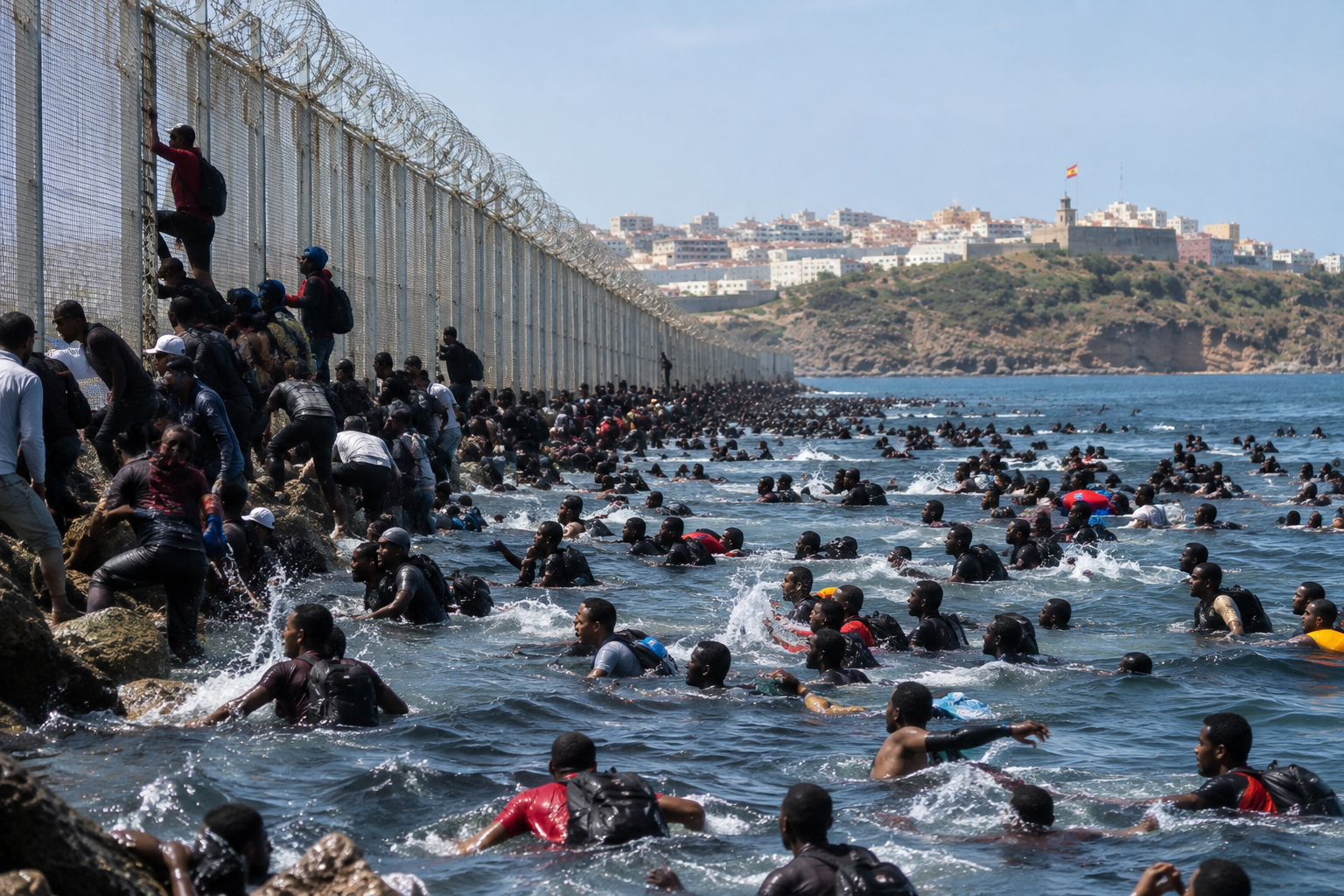
The statement comes at a time when events in Ceuta are once again sparking heated political debate in Spain. In late July, tens of thousands of people set out for the Spanish enclave; by some estimates, more than 70,000 people attempted to reach Ceuta’s border or coastline. These events triggered one of the most severe migration crises in the city’s history.
Increasingly, the focus has shifted to the question of whether the mass movement actually emerged spontaneously or whether it was—at least in part—organized or deliberately steered.
Morocco categorically rejects any suggestion of state involvement. According to the Foreign Ministry, there is no concrete evidence that Moroccan authorities were behind the border crossing. At the same time, Rabat criticizes political and media voices in Spain that have raised such allegations.
New CNI documents are creating additional pressure
The timing of the Moroccan statement is no coincidence. Spain has since released documents from the Centro Nacional de Inteligencia (CNI). These reveal that Spanish security agencies had received indications of planned actions even before the mass border crossing took place. The CNI had informed Moroccan intelligence services, among others, of potential attempts to reach Ceuta en masse by sea and across the border fence.
The publication has sparked a new political debate in Spain. At the heart of the matter is the question of whether the government took the warnings seriously enough—and what role Moroccan security forces played during the crisis.
However, there is no conclusive finding that the Moroccan government organized the migration movement. This is precisely the point Rabat makes as well.
Repatriation is becoming the next point of contention
While the political discussion has so far focused primarily on the causes of the migration movement, another question is now taking center stage: What happens to the people who remain in Ceuta?
The Spanish government is working on returns. At the same time, authorities must first identify the individuals concerned and examine the relevant legal requirements. According to the Spanish government, 4,516 people had already returned voluntarily to Morocco by September 8, and a further 278 individuals were deported. Meanwhile, around 3,400 places for care and accommodation have been created in Ceuta; this capacity is set to be expanded to approximately 6,000 places.
This makes it clear: there can be no talk of complete repatriation so far. This is precisely where Rabat’s criticism comes in.
The situation of minors is particularly complicated
The issue of unaccompanied minors is even more complex. Numerous children and adolescents who arrived without their parents or other legal guardians remain in Ceuta. Their situation is subject to special protection regulations. Consequently, their return cannot be ordered solely on the grounds of their Moroccan nationality.
Spanish authorities must verify, among other things, identity, family circumstances, and the child’s well-being. At the same time, pressure on the city is mounting. Reception facilities have been under immense strain since the crisis began.
Consequently, the first unaccompanied female migrant minors left Ceuta for the Spanish mainland yesterday, Thursday. Navarre took in the first five girls; two of them were due to arrive that same day. According to Spanish media reports, around 700 girls are in registered facilities, while other minors have not yet been fully identified.
For Rabat, this particular point is politically highly sensitive. The Moroccan government argues that the minors could return to their families, whereas Spain points to its legal obligations to protect unaccompanied children.
Morocco warns against a political game
However, the tone of the Moroccan statement goes far beyond the specific issue of repatriation. Rabat accuses Spanish politicians of exploiting relations between the two countries for domestic political purposes. Morocco, it asserts, has no desire to become a “political pawn” in the run-up to Spanish elections or to serve as a scapegoat for political disputes.
This criticism is thus indirectly aimed at the Spanish opposition as well. The Partido Popular, in particular, has sharply attacked Pedro Sánchez’s government over its handling of the Ceuta crisis. The release of the CNI documents provides the opposition with further ammunition for its criticism. Rabat, for its part, warns against turning these events into a political dispute with Morocco.
A difficult relationship of great strategic importance
Underlying the dispute over Ceuta is a much broader relationship. Spain and Morocco have been cooperating closely for years on migration, border security, and counter-terrorism. This cooperation has intensified significantly, particularly since 2022.
For Madrid, Morocco is a key partner in controlling migration routes to Spain. This makes the current conflict particularly delicate. An escalation between the two countries could affect not only the situation in Ceuta and Melilla, but also cooperation on migration and security.
Morocco therefore signals a willingness to cooperate further on the one hand, but draws a clear political line on the other.
Rabat does not want to become a scapegoat
The message from Rabat is therefore twofold: Morocco denies responsibility for the events in Ceuta—while simultaneously reminding Spain that it cooperates in the repatriation of its nationals.
This creates a difficult balancing act for Pedro Sánchez’s government. On the one hand, it must account for its political handling of the crisis, while on the other, it must prevent damage to relations with Morocco. At the same time, pressure is mounting from the opposition to take tougher action against irregular migration.
Ceuta is thus no longer merely the scene of a migration crisis. The city has become the focal point of a political conflict between Madrid and Rabat in which migration, border security, intelligence, and Spanish domestic politics are inextricably linked.
And Morocco is making it unequivocally clear: Rabat now views the responsibility for the migrants who have not yet been returned as lying primarily with the Spanish side.