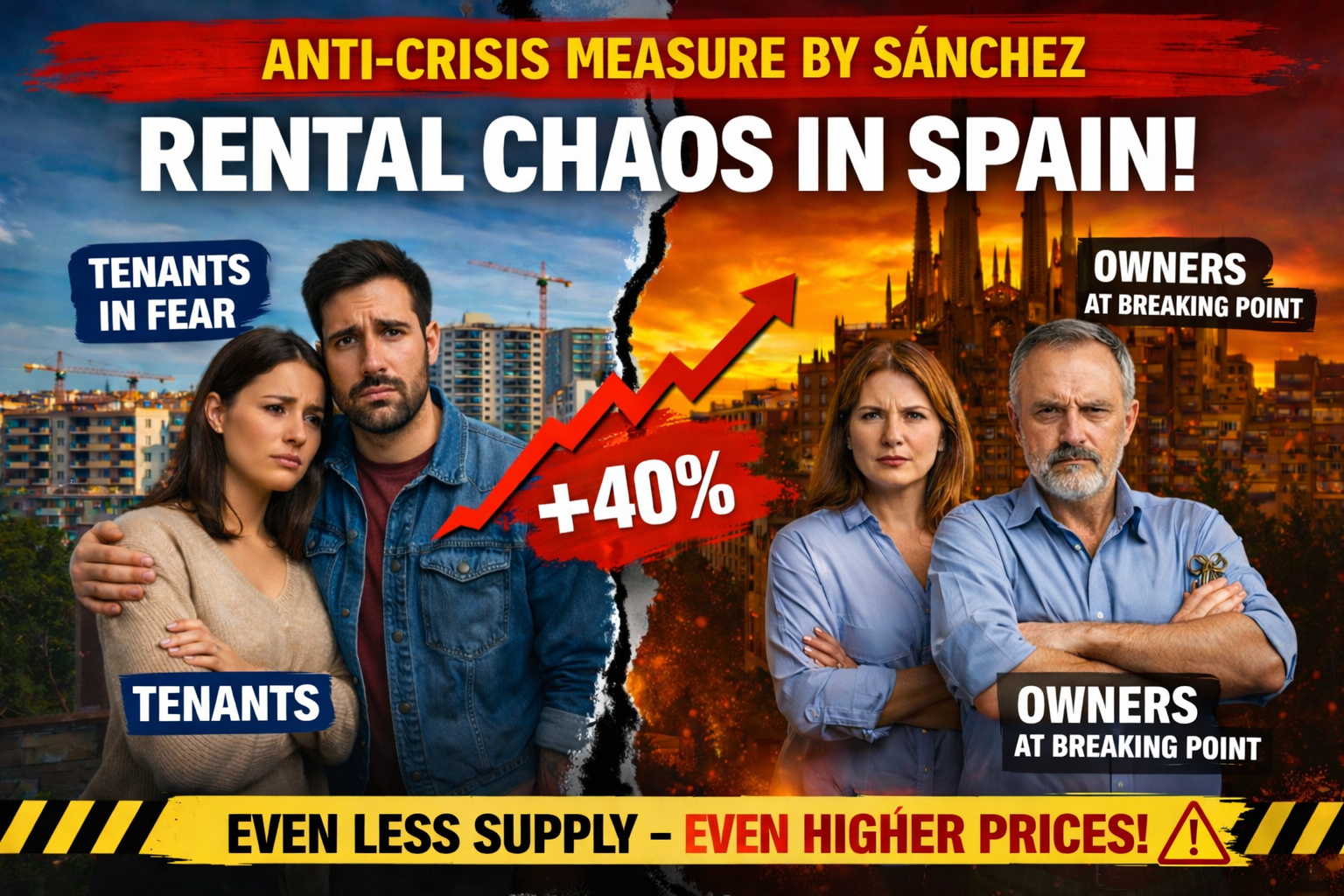
Spain’s government, led by Pedro Sánchez, has once again intervened in the rental market—this time as part of its broader anti-crisis package responding to the economic fallout of the Iran conflict.
Under pressure from its left-wing coalition partner Sumar, the government has approved a measure to extend rental contracts by an additional two years. The move is intended to protect tenants amid rising costs, but it has already sparked intense political and market reactions.
Spain Press Editorial Team
A Measure That May Not Last
Despite its immediate impact, the policy’s longevity is highly uncertain.
Opposition parties, including the Partido Popular, Vox and Junts, have signalled their intention to reject this part of the decree in Parliament.
As a result, the measure could remain in force for only a matter of weeks unless the government manages to secure additional support—particularly from Junts, whose position will likely prove decisive.
A Crucial Year for Spain’s Rental Market
The timing of this intervention is particularly sensitive. In 2026, a significant number of rental contracts—introduced under the government’s mandatory five-year extension framework—are due to expire.
This would have marked a turning point in the market:
- Around 600,000 rental agreements reaching their end
- Landlords regaining control over their properties
- Rents increasingly aligning with current market levels
In many cases, this could have led to rent increases of up to 40%, especially in high-demand areas.
Landlords Push Back
The reaction from property owners has been swift and, in many cases, severe.
Frustration, uncertainty and clear rejection
Many landlords argue they have effectively acted as a “social buffer” over the past five years, while their own costs have steadily increased:
- Property tax (IBI)
- Community fees
- Waste collection charges
At the same time, their ability to adjust rents or reclaim their properties has been heavily restricted.
Tenants Caught in a Tight Market
On the other side of the equation, tenants face a stark reality.
Rental prices have risen sharply in recent years, and finding a new home has become increasingly difficult in many parts of Spain. For many households, the extension offers a temporary safeguard against displacement.
Without it, thousands could be forced into an already strained market with limited supply and rising prices.
- Over the past five years, rents have risen sharply.
- Finding a new home has become a real challenge in many cities.
- Supply is scarce — demand is soaring.
For many, this means one thing in very real terms: without the extension, they risk losing their home — with no realistic alternative.
Properties Disappearing from the Market
However, the policy may be triggering unintended consequences.
A growing number of landlords who are regaining control of their properties are choosing to: Rent to family members, shift to short-term or seasonal lets, target student rentals, sell, or simply withdraw their properties from the market altogether
Many describe the past five years as economically unsustainable, with rising costs and limited flexibility.
Spain’s rental market remains deeply unstable.
Short-term political solutions, combined with structural imbalances, are leaving both tenants and property owners without long-term certainty—while the pressure on the system continues to build.