Christmas has arrived early in Spain’s supermarkets. Alongside turrón, chocolates and festive treats, the country’s traditional mantecados and polvorones are back on the shelves. But what makes these crumbly Christmas delicacies so special? Why is the small Andalusian town of Estepa famous for them? And where can you find the finest varieties, including exclusive handmade sweets produced by Spanish nuns?
Spain Expat Press Editorial Team
It may only be November, but Christmas is already making its presence felt in Spain.
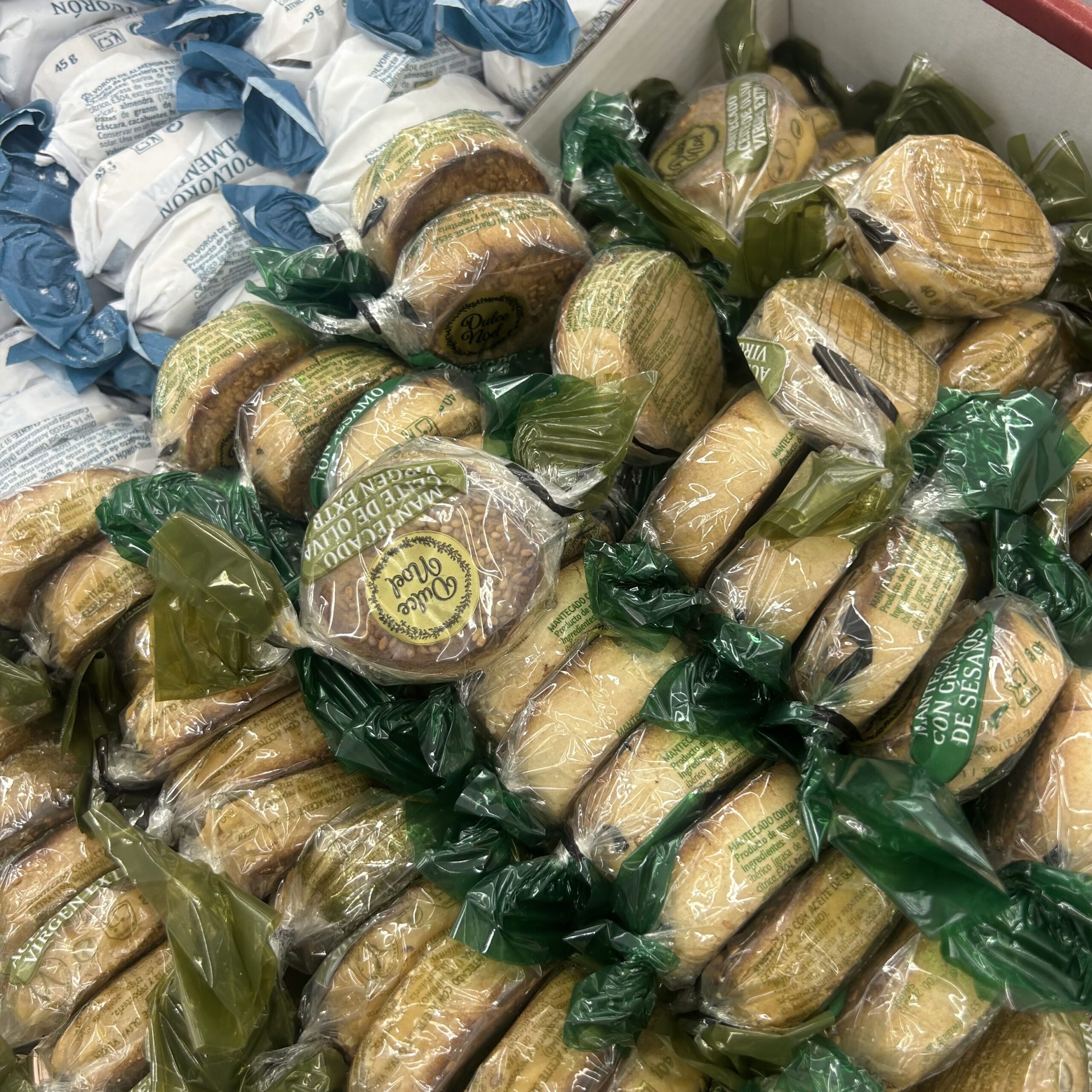
Supermarket shelves are filling up with turrón, marzipan, chocolates and those familiar little sweets, individually wrapped in colourful paper, that have become an essential part of the Spanish festive season.
Mantecados and polvorones have returned.
And with them comes the unmistakable taste of Spanish Christmas: toasted almonds, cinnamon, sesame seeds, vanilla and the delicate, crumbly texture of traditional festive biscuits.
For British residents and other international visitors spending Christmas in Spain, these sweets are one of the country’s most distinctive seasonal traditions.
While British households stock up on mince pies, Christmas pudding and shortbread, Spanish families reach for mantecados and polvorones.
And behind these modest-looking treats lies a fascinating story of convents, family businesses, centuries-old recipes and an entire Andalusian town whose identity is closely tied to Christmas.
Estepa: Spain’s unofficial Christmas capital
No story about mantecados would be complete without Estepa.
This small Andalusian town, in the province of Seville, lies approximately an hour’s drive from the regional capital.
Here, Christmas is far more than a festive celebration. It is an essential part of the local economy, culture and identity.
Long before Christmas lights illuminate Spanish streets, production is already under way in Estepa’s bakeries and factories.
During the autumn months, the smell of toasted flour, cinnamon, almonds and freshly baked sweets drifts through parts of the town.
Estepa is one of Spain’s most important centres for the production of traditional Christmas confectionery.
The industry employs thousands of people during the festive season, and many businesses have remained in the same families for generations.
For local residents, making mantecados is not simply a commercial activity. It is part of their heritage.
A tradition dating back to the 16th century
The origins of mantecados stretch back several centuries.
By the 16th century, simple sweet biscuits made from wheat flour, sugar and pork lard were already being prepared in the region.
The Convent of Santa Clara in Estepa also played an important role in the development of the town’s traditional confectionery.
However, the mantecados of those days were very different from the carefully packaged Christmas delicacies found in shops today.
The decisive step towards commercial production came in the 19th century, thanks to a woman named Micaela Ruiz Téllez, better known as La Colchona.
She refined the traditional recipe, introducing techniques that improved the biscuits’ texture, shelf life and suitability for transport.
Her husband, who travelled regularly between Estepa and Córdoba, began selling the sweets along his route.
What started as a small family enterprise gradually developed into a thriving industry.
Today, La Colchona remains an important figure in the history of Spanish Christmas confectionery.
Mantecados or polvorones: What is the difference?
To anyone unfamiliar with Spanish Christmas sweets, mantecados and polvorones may appear almost identical.
They are closely related, and a polvorón is generally considered a particular type of mantecado. Nevertheless, there are differences in their ingredients, shape and texture.
Mantecados are traditionally round and slightly more compact.
Their main ingredients are flour, sugar and fat, traditionally pork lard, known in Spanish as manteca de cerdo. This is where the name mantecado originates.
Depending on the recipe, they may also contain cinnamon, sesame seeds, lemon, chocolate or other flavourings.
They have a delicate, crumbly texture but tend to hold their shape a little better when bitten into.
Polvorones, by contrast, are particularly dry, delicate and powdery.
They typically contain toasted flour and almonds, which give them their characteristic flavour. They are also commonly oval rather than round.
Their name comes from the Spanish word polvo, meaning dust or powder.
And that is precisely what happens when you bite into one: it almost dissolves into a fine, sweet powder.
There is even a charming Spanish tradition associated with eating them.
Many people gently squeeze a polvorón while it is still wrapped, compressing it slightly before opening the packaging. This helps prevent it from crumbling into pieces.
For generations of Spanish families, this small ritual has been part of Christmas.
In short, all polvorones belong to the mantecado family, but not all mantecados are polvorones.
From cinnamon to chocolate: A flavour for everyone
The variety available today is surprisingly extensive.
Traditional cinnamon and sesame mantecados remain firm favourites, but manufacturers now offer an impressive selection of flavours.
Almond, chocolate, lemon, coconut, hazelnut and vanilla are among the popular choices.
There are also varieties made with extra virgin olive oil instead of traditional pork lard.
In Andalusia, where olive oil is central to the local cuisine, these versions offer an interesting alternative.
Polvorones are also available in different varieties, although the classic almond version remains particularly characteristic.
And alongside them, shoppers will find other traditional Spanish Christmas treats.
Roscos de vino are small, ring-shaped biscuits made with wine, while alfajores often combine almonds, honey and aromatic spices.
There is certainly enough choice to keep anyone exploring Spanish Christmas confectionery throughout the festive season.
From supermarket bargains to luxury Christmas delicacies
One of the most striking things about mantecados is the enormous range of prices.
In Spanish supermarkets, inexpensive family-sized assortments sit alongside more elaborate products from established manufacturers.
Traditional confectioners and specialist producers, meanwhile, offer premium varieties made with carefully selected ingredients, traditional recipes and attractive gift packaging.
The differences can be considerable.
Budget products generally benefit from large-scale manufacturing, efficient production methods and lower packaging costs.
More expensive versions may contain a higher proportion of almonds, carefully selected spices or ingredients processed using traditional techniques.
Production methods also vary. While some factories are highly automated, other producers continue to carry out certain stages by hand.
Packaging, brand reputation and distribution costs can also influence the final price.
Beautifully presented gift boxes can cost considerably more than ordinary supermarket assortments.
However, a higher price does not automatically guarantee better flavour.
Some inexpensive mantecados are excellent, while certain premium products owe part of their price to their presentation.
The best advice is to check the ingredients, compare prices per kilogram and, above all, discover which varieties you personally enjoy.
Spain’s convent sweets: Some of the most sought-after Christmas treats
There is another, particularly fascinating way to buy traditional Spanish Christmas sweets.
Rather than visiting a supermarket, many Spaniards prefer to purchase their festive delicacies directly from a convent.
Across Spain, communities of nuns continue to prepare mantecados, polvorones, marzipan and other traditional sweets using recipes passed down through generations.
Known as dulces de convento, or convent sweets, these handmade specialities are highly prized by enthusiasts of traditional Spanish confectionery.
They are often produced in relatively small quantities, using labour-intensive methods and recipes that have changed little over the years.
Some are only available during particular seasons, making them especially sought-after at Christmas.
And buying them can be an experience in itself.
In certain enclosed convents, the sweets are sold through a traditional wooden revolving hatch known as a torno.
Customers place their order, put their money inside and receive their purchases through the same mechanism, without ever seeing the nuns.
It is a centuries-old tradition that has survived into modern Spain.
For some families, visiting a particular convent or ordering its Christmas sweets is an annual ritual.
These products are not necessarily more expensive than commercially manufactured alternatives. Their appeal lies in their craftsmanship, limited availability and connection to centuries of religious and culinary tradition.
For anyone interested in discovering a particularly authentic side of Spanish Christmas, convent sweets are well worth seeking out.
They are among the country’s most distinctive festive delicacies — and certainly not something you will find in every supermarket.
How can you recognise authentic mantecados from Estepa?
For those seeking traditional products from Estepa, there is an important label to look out for.
Mantecados de Estepa are protected under the European Union’s Protected Geographical Indication scheme, known in Spain as Indicación Geográfica Protegida (IGP).
Polvorones de Estepa also enjoy protected geographical status.
The certification establishes specific requirements concerning the products’ geographical origin and production methods.
Its purpose is to safeguard traditional manufacturing practices and protect the reputation of these regional specialities.
For consumers, the label provides reassurance about authenticity and provenance.
That does not mean excellent mantecados cannot be produced elsewhere.
Spain has many traditional bakeries and confectioners outside Estepa, including specialist producers whose products are highly regarded.
Nevertheless, the Estepa designation remains one of the best-known names in Spanish Christmas confectionery.
A sweet industry worth millions
Christmas confectionery is a major economic driver for Estepa.
According to industry figures reported by Spanish newspaper El País in December 2024, local manufacturers produced approximately 15 million kilograms of Christmas sweets during that season.
The industry generated an estimated €70–80 million in turnover and provided around 2,200 direct jobs.
Women have traditionally played a particularly important role in the sector’s workforce.
Many of the town’s producers are family businesses with histories stretching back several generations.
Their products are sold throughout Spain and exported to international markets.
What began as a regional baking tradition has therefore become an important part of Andalusia’s food industry.
Why Spaniards love their mantecados so much
Technically, there is no reason why mantecados could not be enjoyed throughout the year.
Yet their close association with Christmas is precisely what makes them special.
In many Spanish households, the first boxes appear in the autumn.
They are offered to visitors, served with coffee or brought out after a long family lunch.
By Christmas Eve and throughout the festive holidays, they are an almost inevitable presence on the table.
But their appeal goes beyond flavour.
For many Spaniards, the taste of a mantecado evokes childhood memories, grandparents, family gatherings and long Christmas evenings.
There is often one last polvorón left on the plate, even though everyone insists they are far too full to eat another thing.
And somehow, somebody always reaches for it.
In Spain, Christmas sometimes begins with a little biscuit
Perhaps that is the real charm of mantecados.
They are not a fashionable new invention, but a living tradition that has survived for centuries.
From the kitchens of Andalusian convents and the early family businesses of Estepa to today’s supermarket shelves, they tell a small but revealing part of Spain’s cultural history.
Whether you choose an inexpensive supermarket assortment, a traditional mantecado from Estepa, a handmade convent speciality or an elegant gift box from a specialist confectioner, there is an extraordinary variety to discover.
And if you have never tried a genuine Spanish polvorón, this Christmas might be the perfect opportunity.