

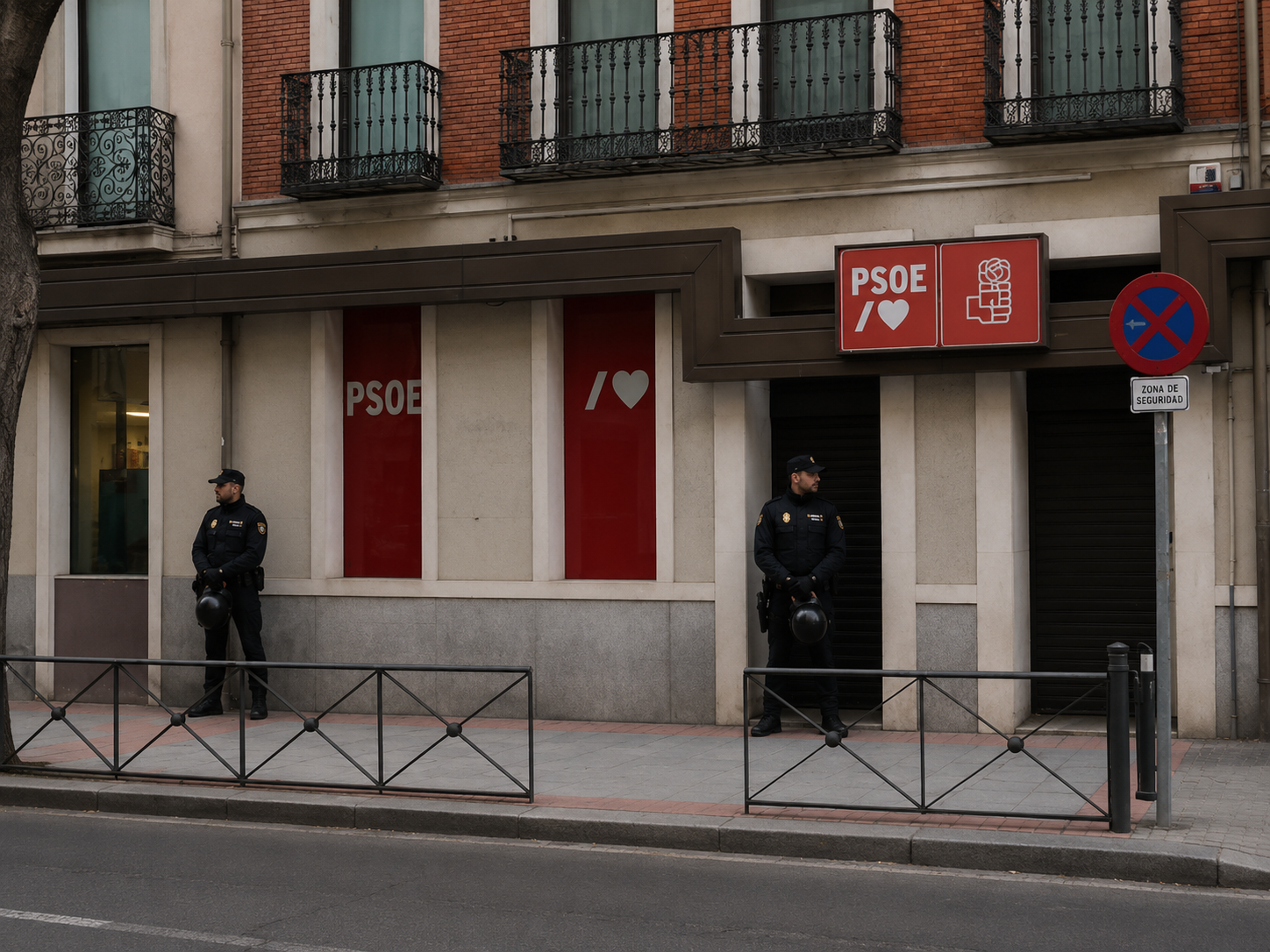
Switch on a Spanish news channel these days and you might find yourself doing a double take. Barely has one scandal been absorbed before the next crashes in. Investigations into the president’s wife, his brother, former ministers, a former prime minister — and now, as what feels like an impossible new low, the Civil Guard walking into the headquarters of the ruling party itself. Spain’s journalists are struggling to keep pace. The public, frankly, even more so.
What Is Happening Inside Spain’s Ruling Party — And Why This Time Feels Different
This is not the first scandal. And anyone who has followed Spanish politics for more than five minutes will not be holding their breath that it will be the last. But what happened yesterday at the Madrid headquarters of the Socialist Party is genuinely without precedent in this country’s recent democratic history. Agents of the Guardia Civil — whose elite investigative unit, the UCO, is roughly equivalent to the FBI or the British National Crime Agency — entered the party’s Calle Ferraz headquarters on the orders of a judge. “Ferraz”, as Spaniards simply call it, is the political nerve centre of the governing party. They left with documents and electronic files.
Sánchez himself was in Rome at the time, fresh from a meeting with Pope Leo XIV. He responded from there with a pledge of “full cooperation with the justice system.” Resignation, he made clear, is categorically off the table. Spain needs stability in an uncertain world — that is the line, and it has not changed once across eleven scandals.
A Corruption Alphabet With No End in Sight
The list of judicial cases touching the president’s immediate circle has grown so long that even seasoned political correspondents sometimes lose track of who is facing what. His wife Begoña Gómez is under investigation for corruption and undue influence over public contracts. His brother David faces trial for influence peddling. José Luis Ábalos — once so close to Sánchez that he was practically his right hand, serving for years as transport minister — now faces up to 24 years in prison. Former party organisation secretary Santos Cerdán is caught up in multiple proceedings. And just last week, as if the list were not already vertiginous, came the charge against José Luis Rodríguez Zapatero: the former Socialist prime minister, once the moral conscience of the Spanish left — or so people believed — allegedly pocketed millions in commissions from a state bailout of Venezuelan airline Plus Ultra.
And now Leire Díez. The former party operative, known to insiders as the PSOE’s “plumber”, is alleged to have collected 700,000 euros in illegal commissions channelled through public companies. But the element that appears to most alarm investigating judge Santiago Pedraz is something of a different order entirely: his suspicion that the party itself pumped money into a network specifically designed to sabotage ongoing judicial proceedings — by gathering compromising material on the judges, prosecutors and investigators who are, somewhat ironically, the very people investigating the PSOE.
The Man Who Promised to Clean Up Spain
This is where the story becomes genuinely hard to stomach. Sánchez came to power in 2018 by engineering the fall of the conservative People’s Party through a vote of no confidence. The charge against them was corruption. His promise was a cleaner Spain — a new way of governing, an end to the cronyism and backroom dealing that had defined the PP years. He said it, and people believed it, or believed it enough.
Eight years on. The judiciary is investigating his wife, his brother, his long-standing political ally, a former Socialist prime minister, and now, potentially, the party’s own funding mechanisms. Sánchez steps in front of the cameras and speaks of cooperation with justice with the serene composure of a man discussing weekend travel plans. That, for a growing number of observers, is the real scandal — not merely what has happened, but the almost performative indifference with which he absorbs it.
Where Do the Coalition Partners Stand?
Sánchez governs with a minority government stitched together from several regional parties, each with their own electoral pressures and each perfectly capable of pulling the plug whenever the calculus shifts against them. They are getting nervous. None of them, so far, has been willing to act on it.
Coalition partner Sumar has drawn what it calls a red line: illegal party financing would end the arrangement. Podemos leader Ione Belarra has called the situation “absolutely untenable” and made clear she sees Sánchez’s political fate as tied to Zapatero’s. The Basque nationalist PNV has said publicly that continuing the legislature through to 2027 would be “irresponsible” — yet it equally refuses to be the party that hands the conservative opposition leader Feijóo the keys to La Moncloa. Junts and ERC have concluded, with characteristic bluntness, that the legislature is simply over.
Everyone is waiting for someone else to go first. It is the oldest move in coalition politics, and it can go on for a surprisingly long time.
Is Sánchez Imploding His Own Party?
That is now the question being discussed in Madrid political circles not as provocation but as sober analysis. This is no longer simply about whether this government limps on to the next budget vote. It is about what will remain of the PSOE — a party with more than a century of history behind it, a party that survived dictatorship, that helped build Spanish democracy, that defined the centre-left for a generation.
The very man who came to power promising to free Spain from corruption now sits at the centre of the most sprawling corruption affair in the country’s recent memory. And he stays. For now.





This seems like an extremely biased article. It is as if you started with a headline and then constructed a narrative around it. I am not a supporter of Sanchez. But as a critical thinker, I recognize propaganda when I see it.
Thank you for your comment. A strong headline does not equal propaganda. The public impact of events as they unfold is part of journalism and the headline refers to what is, factually, another scandal surrounding the current government. You mention also biased. We are interested to know which specific fact in article you believe is inaccurate.